

Thermal Boundary Conditions and Graded Traces
Boundary conditions on the thermal circle record both statistics and insertions in the trace. An ordinary thermal trace gives periodic bosons and antiperiodic fermions. A conserved-charge twist adds the action of its holonomy. Inserting cancels the fermionic thermal minus sign and makes fermions periodic, producing a supertrace or index-like object—not an ordinary thermal partition function, not a positive statistical weight, and not a thermodynamic pressure.
The index interpretation of a graded trace, and its distinction from ordinary thermal weighting, is developed in Witten 1982, § 2, p. 258, Eq. (4) and the following discussion.
Required background. Imaginary Time and Matsubara Frequencies derives thermal periodicities. Continuous Symmetries, Generators, and Charges fixes charge action. Helpful background. The Witten Index, Vacuum Counting, and Its Failure Modes owns the protected-index analysis.
Trace insertions become twists
Section titled “Trace insertions become twists”Consider
If , one may normalize by it, but the resulting twisted functional can be complex or signed and need not define a positive state. For , positivity holds when is trace class and the thermal trace exists; it is not automatic for an arbitrary conserved insertion.
Cutting the trace open at and gluing at yields a boundary condition determined by . If
the twist can be seen directly from cyclicity. With ,
Thus, in a convention where the untwisted bosonic field is periodic,
for a bosonic coherent-state variable. The algebraic trace cyclicity above supplies no statistics sign. In a fermionic coherent-state path integral, the Grassmann variable acquires one additional minus sign when the trace cut is glued:
For , adopt the charged-field convention . Then . The allowed frequencies shift to
for a boson in the displayed transform convention, with a further half-integer shift for an ordinary thermal fermion. Large-gauge identifications and the global form of the symmetry can restrict the periodicity of .
Thermal trace versus supertrace
Section titled “Thermal trace versus supertrace”The thermal partition function is
for a nonzero positive Hilbert space when is trace class. Fermions are antiperiodic around its Euclidean circle. By contrast,
has periodic fermions. Their integer Matsubara lattice can include fermion zero modes, which often require separate treatment. Boson–fermion pairs may cancel, and under suitable supersymmetric spectral and boundary hypotheses can become independent of . These cancellations are the point of an index; they remove the positivity and extensivity assumptions used in ordinary thermodynamics.
For supersymmetric quantum mechanics with paired excited states and unpaired zero-energy states,
while
The two traces answer different questions even when they are computed by similar path integrals.
Chemical potentials and holonomies
Section titled “Chemical potentials and holonomies”A real chemical potential appears in , corresponding formally to a nonunitary twist . An imaginary chemical potential gives the unitary holonomy . Analytically continuing between them requires a domain free of crossed singularities and a declared charge normalization. Conserved Charges and Grand-Canonical States explains the ensemble, stability, and generator choices behind this shorthand.
For gauge charge, Gauss constraints and large gauge transformations can make a would-be chemical potential redundant or identify holonomies. For anomalous charges the trace insertion may not commute with the quantum Hamiltonian, invalidating the simple twisted-equilibrium construction.
Interpretation and failure tests
Section titled “Interpretation and failure tests”| Object | Fermion boundary condition | Positivity | Durable interpretation |
|---|---|---|---|
| antiperiodic | positive when the trace exists | thermal partition function | |
| antiperiodic with charge twist | generally complex | symmetry-twisted thermal trace | |
| periodic | signed | supertrace or index precursor | |
| periodic with charge twist | signed or complex | refined graded trace |
Before interpreting a graded trace, check that the insertion is conserved, the spectrum is discrete or its continuum contribution is controlled, boundary conditions preserve the relevant supercharge, and regulator anomalies do not spoil pairing. Before interpreting any of these as thermal, return to the shared convention and limit table.
The lower panel separates the ordinary, conserved-twist, and sectors. Inspect how the insertion and field parity determine monodromy before the Matsubara lattice is read off.
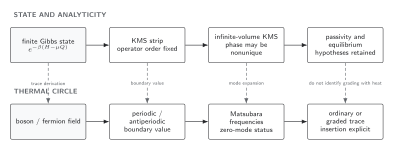
The trace insertion and field parity determine circle monodromy, which then fixes the allowed Matsubara frequencies. When it exists as a trace-class thermal functional, the ordinary heat trace is positive and gives antiperiodic fermions. A conserved twist need not define a positive state, while makes fermions periodic and permits zero modes in a signed supertrace. Calling that supertrace an index requires additional supersymmetric, spectral, boundary, and anomaly hypotheses, and none of these graded objects is thermodynamic heat merely because it is written as a trace. The diagram is schematic and not to scale.
The table together with the preceding monodromy derivation is the local semantic equivalent of the three Euclidean sectors in the figure.
Exercises
Section titled “Exercises”- For one fermionic oscillator , compute and the supertrace.
Solution
The states have energies and . Therefore , whereas . The latter is not temperature independent because this single oscillator is not a complete supersymmetric paired system.
- A supersymmetric spectrum contains bosonic and fermionic zero-energy states. At each it has bosonic states paired with fermionic states. Compute and , and state why the second answer is protected only under additional hypotheses.
Solution
The ordinary trace adds every state with a positive Boltzmann weight,
The supertrace subtracts fermions from bosons. Every positive-energy pair cancels, leaving
This -independence requires exact boson–fermion pairing generated by a conserved supercharge, boundary conditions and a regulator that preserve it, and either a discrete spectrum or controlled continuum and boundary contributions. If any of these conditions fails, the formal cancellation need not define a protected index.
References
Section titled “References”- Witten, Edward. “Constraints on Supersymmetry Breaking.” Nuclear Physics B 202, no. 2 (1982): 253–316. doi:10.1016/0550-3213(82)90071-2.
Further reading
Section titled “Further reading”- Alvarez-Gaumé, Luis. “Supersymmetry and the Atiyah–Singer Index Theorem.” Communications in Mathematical Physics 90 (1983): 161–173. doi:10.1007/BF01205500.
- Kapusta, Joseph I., and Charles Gale. Finite-Temperature Field Theory: Principles and Applications. 2nd ed. Cambridge: Cambridge University Press, 2006. doi:10.1017/CBO9780511535130.
Original QFT.org content:CC BY 4.0, unless an item supplies different terms. Third-party material retains its own terms.