

Magnetohydrodynamics and Higher-Form Symmetries
Relativistic magnetohydrodynamics can be organized either with fluid and electromagnetic fields or with a conserved two-form current whose charge is magnetic flux. The descriptions agree in the regime where magnetic flux is long lived, electric fields relax rapidly, monopoles are absent, and the same electromagnetic stress and constitutive approximations are retained. Full Maxwell theory, resistive MHD, and ideal MHD are distinct truncations.
Required background. Higher-Form Currents, Charges, Backgrounds, and Ward Identities supplies the one-form symmetry. Conservation Laws and Hydrodynamic Fields and Relativistic Dissipative Hydrodynamics supply the stress-current framework.
Helpful background. Strong Hyperbolicity, Stability, and Causal Propagation supplies the constraint and characteristic checks.
Magnetic flux as a conserved charge
Section titled “Magnetic flux as a conserved charge”In four dimensions define the two-form current
The Bianchi identity is
The overall sign is a convention chosen to agree with in the site’s metric. In a local rest frame, . The equation is ; the spatial equations are Faraday induction. A magnetic monopole current would appear on the right-hand side and explicitly break the one-form symmetry.
At ideal order, introduce a unit spacelike direction along the flux, , and a flux density :
The most general anisotropic ideal stress has separate pressures parallel and transverse to . Its thermodynamic conjugate to is a one-form chemical potential. Grozdanov, Hofman, and Iqbal derive this higher-form formulation and its dissipative transport without assuming weak electromagnetic coupling Grozdanov, Hofman, and Iqbal 2017, §§II–IV, Open PDF.
Map to conventional ideal MHD
Section titled “Map to conventional ideal MHD”In Heaviside–Lorentz units and flat spacetime, conventional ideal MHD imposes vanishing electric field in the fluid rest frame,
In three-vector notation this is
Faraday’s law then gives flux freezing:
The higher-form variables map as
The total stress must include the electromagnetic energy and tension. In the simplest isotropic medium this produces transverse magnetic pressure and longitudinal tension . The map fails if one compares a matter-only stress in one description with a matter-plus-field stress in the other.
Finite conductivity replaces the ideal constraint by a constitutive electric field and magnetic diffusion. Keeping displacement current gives full electromagnetic waves and a different high-frequency characteristic system; neglecting it is a low-frequency MHD approximation. Hernandez and Kovtun give a source-covariant relativistic formulation and its thermodynamic regimes Hernandez and Kovtun 2017, §§2–5, Open PDF.
Alfvén waves in both languages
Section titled “Alfvén waves in both languages”Take equilibrium and transverse perturbations depending on . Flux freezing gives
Transverse momentum conservation gives
where is the matter enthalpy and is the electromagnetic inertia in the stated units. Combining them yields
In the two-form language, the same pair comes from transverse fluctuations of and in and . The equality of speeds is the decisive map check. Oblique perturbations also produce fast and slow magnetosonic modes; dissipation broadens all branches and introduces magnetic diffusion.
Constraints and regime boundaries
Section titled “Constraints and regime boundaries”The divergence constraint must propagate numerically. A discretization with adds an unphysical longitudinal force and mode. Boundary conditions must be assigned to incoming characteristic fields, not independently to every primitive variable.
Ideal flux freezing requires conductivity large compared with the frequencies and lengths of interest. It does not hold across reconnection layers, resistive boundaries, finite monopole density, or frequencies where displacement current matters. A background electromagnetic field is not a dynamical hydrodynamic flux; its energy is supplied externally and its Ward identity differs.
The left branch identifies the higher-form extension used here. Inspect how magnetic flux is promoted to a hydrodynamic variable, rather than treated as a fixed external source or folded into the ordinary charge-current branch.
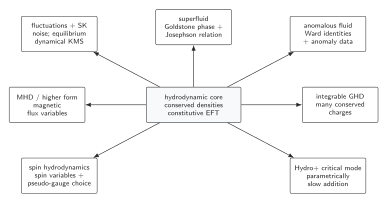
When magnetic flux is conserved on the observation scale, the two-form current supplies an additional hydrodynamic density and ideal MHD supports Alfvén and magnetosonic propagation. This differs from response to a nondynamical background field. The diagram is schematic and does not encode resistivity, reconnection, monopole relaxation, or electromagnetic boundary conditions.
In text: impose , identify in the site convention, include the field energy and tension in , and linearize the coupled flux and momentum equations. Flux relaxation removes this branch from the strict hydrodynamic set.
Exercise
Section titled “Exercise”Derive the Alfvén speed from the two displayed linear equations and give its weak- and strong-field limits.
Solution
Differentiate the induction equation in time and use the momentum equation:
Thus . For , . For , from below. The limiting light speed results only because electromagnetic inertia was included.
Common pitfalls
Section titled “Common pitfalls”Calling a background field MHD. MHD evolves electromagnetic flux and includes field stress.
Dropping . It is a constraint inherited from higher-form conservation.
Using ideal flux freezing at a reconnection scale. Resistivity and microscopic nonideal terms control that region.
Where this leads
Section titled “Where this leads”Charged and Anomalous Hydrodynamics treats parity-odd charge response in prescribed sources. Spectral Functions and Transport Peaks distinguishes Alfvén poles from diffusive and electromagnetic continua.
References
Section titled “References”-
Grozdanov, Sašo, Diego M. Hofman, and Nabil Iqbal. 2017. “Generalized Global Symmetries and Dissipative Magnetohydrodynamics.” Physical Review D 95: 096003. DOI. Open PDF.
-
Hernandez, Juan, and Pavel Kovtun. 2017. “Relativistic Magnetohydrodynamics.” Journal of High Energy Physics 2017 (5): 001. DOI. Open PDF.
Original QFT.org content:CC BY 4.0, unless an item supplies different terms. Third-party material retains its own terms.