

Operator Spreading and Scrambling
Operator spreading asks where a local Heisenberg operator has acquired noncommuting support. Relativistic microcausality fixes an exact outer light cone, while an interacting state can have a slower butterfly front, a broadening law, and a separate saturation scale inside it. “Scrambling” is a useful physical interpretation only after the operator pair, state, regulator, front definition, and information-theoretic handoff are stated.
Required background. OTOCs and contour regularization define the squared commutator used to locate a front. Microcausality fixes the continuum causal boundary. Helpful background. Long-time tails explain why conserved modes can modify late-time relaxation behind the front.
Causal support, butterfly front, and saturation
Section titled “Causal support, butterfly front, and saturation”For local operators and , define
Three boundaries must remain distinct.
- Causal support: in a local relativistic QFT, the commutator vanishes at spacelike separation, , as an operator-valued distribution away from contact subtleties.
- Butterfly front: inside the causal cone, a chosen level set may propagate as .
- Saturation: behind the front, approaches a state- and normalization-dependent value after local operator information has spread over the accessible degrees of freedom.
need not equal the speed of light, a sound speed, an entanglement velocity, or a diffusion constant. It is defined from a particular operator-growth diagnostic.
Regulated lattice bounds and continuum causality
Section titled “Regulated lattice bounds and continuum causality”For a short-range lattice Hamiltonian, a Lieb–Robinson estimate has the schematic form
is a nonunique bound set by the regulator, interaction norm, and proof; it is not a measured butterfly velocity Lieb and Robinson 1972. A lattice discretization of a relativistic theory can therefore have
while the continuum limit must recover the physical causal speed for operator support. Comparing velocities across regulators requires common physical units and a demonstrated scaling limit.
For continuum QFT, smearing or point splitting controls ultraviolet products. A nonzero result outside the light cone can be a discretization, smearing, truncation, or numerical error rather than superluminal physics.
Front scaling and broadening
Section titled “Front scaling and broadening”A sharp-velocity ansatz is often too simple. Write a scaling form
where is the front width. Different dynamics produce different . In one-dimensional Haar-random unitary circuits, operator endpoints execute a biased random walk, giving diffusive broadening and an exactly controlled coarse-grained front Nahum, Vijay, and Haah 2018. This is a solvable universality example, not a theorem that every Hamiltonian front diffuses.
A reproducible extraction uses several thresholds , fits , and checks that the inferred converges while threshold differences grow with the proposed width. A single threshold cannot distinguish drift in amplitude from motion of the front.
Operator-basis growth
Section titled “Operator-basis growth”On a regulated spin or finite local Hilbert space, expand
in orthonormal operator strings . Unitarity preserves the operator norm,
while weight moves from short strings to longer, spatially extended strings. The squared commutator with a local measures the fraction of strings that act nontrivially near , weighted by their local algebra.
This representation clarifies two limitations. First, operator size depends on the chosen local tensor-product regulator. Second, growth of operator support is not literal loss of information: the coefficients evolve unitarily and can in principle be reversed. Recoverability, decoding cost, and channel capacity are developed in Volume XIII.
A front-extraction protocol
Section titled “A front-extraction protocol”Record:
- the state and thermal regularization;
- the local operators and their normalization;
- spatial smearing or lattice spacing;
- ‘s disconnected and saturation values;
- all thresholds or a full-profile likelihood;
- the time interval excluding the microscopic transient and finite-size wraparound;
- covariance across and ; and
- competing sharp, diffusive, KPZ-like, and exponential-tail forms when relevant.
Then vary system size, boundaries, operator pair, smearing, and regulator. A butterfly velocity is licensed only where these choices converge. The thermalization and chaos evidence matrix supplies the common claim ceiling.
Common failure modes
Section titled “Common failure modes”Calling a measured velocity. It is a proof-dependent upper bound.
Using one threshold. Amplitude drift and broadening bias a single level-set velocity.
Treating operator spreading as thermalization. A front can propagate in integrable, localized, or otherwise nonthermal systems.
Ignoring conserved tails. Diffusive or hydrodynamic modes can leave long-lived structure behind an otherwise ballistic front.
The figure locates operator-front measurements beside, but not upstream of, the other diagnostics in the lower row. Inspect how front velocity and broadening answer a different question from an OTOC fit or late spectral statistics.
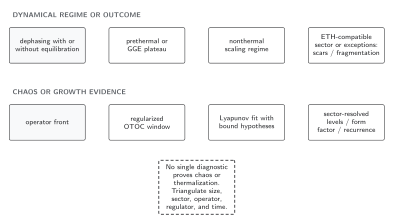
Operator spreading is characterized by support, front velocity, broadening, conserved tails, and regulator dependence. The lower row is deliberately arrow-free: OTOCs can sample commutator growth, but no implication runs from a front to a Lyapunov fit, spectral statistics, or thermalization.
The text equivalent is to reconstruct the operator-weight profile or commutator front, vary the local basis and cutoff, and separate ballistic motion from broadening and hydrodynamic tails. Recoverability and thermal ensemble agreement require additional observables.
Exercises
Section titled “Exercises”Assume . How does the separation between two fixed thresholds scale?
Solution
Solving for a threshold gives . The difference between two thresholds is proportional to , while their common leading slope is .
Why may a lattice measurement yield without approaching a bound-saturating regime?
Solution
is an upper bound assembled from interaction norms and is generally not tight. measures the state- and operator-dependent front. No saturation is expected unless separately demonstrated.
Continue to late-time and information questions
Section titled “Continue to late-time and information questions”Spectral statistics tests late-time energy correlations that a front does not determine. Chaos bounds constrain temporal growth under thermal analyticity hypotheses. Information velocities and recoverability continue in Volume XIII.
References
Section titled “References”- Lieb, Elliott H., and Derek W. Robinson. “The Finite Group Velocity of Quantum Spin Systems.” Communications in Mathematical Physics 28 (1972): 251–257. doi:10.1007/BF01645779.
- Nahum, Adam, Sagar Vijay, and Jeongwan Haah. “Operator Spreading in Random Unitary Circuits.” Physical Review X 8 (2018): 021014. doi:10.1103/PhysRevX.8.021014. Open preprint.
- Roberts, Daniel A., Douglas Stanford, and Leonard Susskind. “Localized Shocks.” Journal of High Energy Physics 2015, no. 3 (2015): 051. doi:10.1007/JHEP03(2015)051. Open preprint.
Original QFT.org content:CC BY 4.0, unless an item supplies different terms. Third-party material retains its own terms.