

Non-Markovian Dynamics and Memory Kernels
Non-Markovian reduced dynamics retains information about earlier system states through a memory kernel, time-dependent generator, or enlarged set of auxiliary modes. Memory is not a single observable: loss of CP divisibility, growth of trace distance, revivals of a correlator, and failure of a local derivative expansion are related but inequivalent diagnostics. A credible claim therefore names the system split, initial preparation, witness, and finite-size controls.
Required background. Influence functionals derive nonlocal kernels from a bath, while quantum master equations identify the extra step that replaces memory by a local generator. Helpful background. Memory kernels in closed evolution treats two-time self-energy memory without tracing an environment.
Memory and time-local representations
Section titled “Memory and time-local representations”For a projection onto selected variables, exact elimination of gives
is an inhomogeneous term determined by ; it vanishes for the compatible factorized preparation associated with the projection. contains propagation in the eliminated subspace and is generally nonlocal. This Nakajima–Zwanzig structure is exact before approximating the kernel Nakajima 1958; Zwanzig 1960.
If the reduced dynamical map is invertible on the relevant operator space, the same trajectory can be written locally in time,
A time-local equation is therefore not synonymous with Markovian dynamics. Its coefficients can encode the entire past, and can become singular when loses invertibility even though remains finite. Conversely, a convolution equation may be embedded in a larger Markovian state space.
The controlled Markov limit requires more than a visibly decaying kernel. Let its correlation time be and a reduced relaxation time be . One expands
inside the integral. The zeroth term is local only when the kernel moments exist and the state changes slowly over their support. Algebraic tails can invalidate the moment expansion; a small long-time tail can dominate late dynamics.
A solvable exponential kernel
Section titled “A solvable exponential kernel”For a field mode amplitude coupled to a Lorentzian reservoir, consider
Introduce an auxiliary amplitude :
Eliminating reproduces the memory equation exactly. The bath memory time is , while the auxiliary mode records the delayed response. In Laplace space,
For , replace the denominator of the self-energy by . This gives a local complex rate
The real part damps and the imaginary part shifts the frequency. A reproducible comparison retains the exact two-pole solution, varies and , and reports the maximum amplitude or state error over a declared time interval. Strong coupling can produce oscillations or revivals, but a finite reservoir discretization can do the same; convergence with bath size is essential.
Sums of exponentials can be represented by several auxiliary modes, giving a controlled pseudomode approximation to structured reservoirs Garraway 1997. The approximation error belongs to the spectral fit and time interval. Adding auxiliaries until one chosen correlator converges does not prove that all multi-time observables have converged.
Divisibility and information-flow witnesses
Section titled “Divisibility and information-flow witnesses”A family of maps is CP-divisible if for every there exists a CPTP propagator with
For an invertible time-local generator in canonical form, CP divisibility corresponds to nonnegative instantaneous decoherence rates. A temporarily negative canonical rate signals loss of CP divisibility; it does not imply that the full map is nonpositive. The map can remain CPTP because it arose from an exact unitary dilation.
The trace distance
cannot increase under a CPTP map. Growth of for some pair is therefore an information-backflow witness Breuer, Laine, and Piilo 2009. It is not equivalent in general to failure of CP divisibility, and a restricted family of initial states can miss the optimal pair. Ancilla-based divisibility tests probe a different property Rivas, Huelga, and Plenio 2010.
Field theories add practical restrictions: trace norms can be regulator-sensitive, Gaussian covariance witnesses see only a subset of states, and local correlator revivals may reflect coherent system modes rather than environmental backflow. State exactly which algebra and cutoff define the map.
Initial correlations and finite environments
Section titled “Initial correlations and finite environments”Pre-existing system–environment correlations produce the inhomogeneous term and restrict the compatibility domain of reduced initial states. Comparing such an evolution with a factorized Markov semigroup attributes preparation memory to bath memory unless the initial conditions are matched.
A finite bath has a discrete spectrum and recurrences. To claim a continuum memory effect, grow the bath volume or mode count while keeping its spectral density fixed, separate the revival time from the fitted kernel time, and show that the signal survives. To claim Markov recovery, demonstrate convergence as the spectral bandwidth grows at fixed physical damping and after the required frequency counterterm is applied.
The open-dynamics consistency and evidence matrix states the evidence ceiling for a chosen memory witness. A reproducible calculation can compare exact kernels, local approximations, and positivity on a bounded model, but it cannot make the witness universal.
Common failure modes
Section titled “Common failure modes”Equating a negative time-local rate with a nonpositive map. The intermediate propagator can fail CP while the map from the initial time remains CPTP.
Calling every revival information backflow. Coherent beating, finite-volume recurrence, and a changing observable basis can generate revivals without the claimed open-system mechanism.
Truncating a tail by eye. Estimate omitted kernel moments and propagate their error to the observable.
Ignoring map singularities. A divergent time-local rate can be a coordinate singularity of rather than a divergence of the physical state.
For non-Markovian dynamics, the central object is the memory-bearing influence functional; the next arrow is an optional approximation whose failure must remain visible.
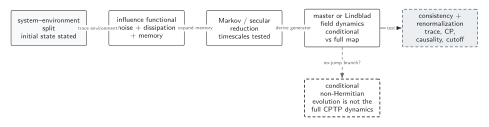
The solid arrow from the influence functional to a Markov or secular reduction is conditional: long tails, initial correlations, or resonant structure can invalidate it. When the memory kernel is retained, one should test the dynamical map itself rather than infer physical failure from a singular time-local parametrization. The dashed no-jump branch remains only a conditional trajectory. The diagram is schematic and not to scale.
Thus the exact reduced equation may remain an integro-differential equation. A negative time-local rate can signal non-divisibility without making the endpoint map nonpositive, and a pole in need not be a singularity of .
Exercises
Section titled “Exercises”Derive the local rate for the exponential kernel through first order in a slow-frequency expansion.
Solution
In Laplace space the self-energy is . Expanding gives . The leading term is the local complex rate. The next term renormalizes the coefficient of and estimates an error of relative order .
Why can trace-distance growth establish non-Markovianity for one definition but not a universal amount of memory?
Solution
Contractivity proves that growth is incompatible with a divisible CPTP propagation for that pair and interval. Its magnitude depends on the chosen state pair, accessible algebra, system–environment split, and optimization. Other definitions test CP divisibility, correlations, or kernel nonlocality and need not assign the same value.
Continue to consistency and steady states
Section titled “Continue to consistency and steady states”Trace, positivity, and causal consistency distinguishes CPTP evolution from CP divisibility and tests approximate maps. Driven steady states studies long-time selection when drive and loss remain active.
References
Section titled “References”- Breuer, Heinz-Peter, Elsi-Mari Laine, and Jyrki Piilo. “Measure for the Degree of Non-Markovian Behavior of Quantum Processes in Open Systems.” Physical Review Letters 103 (2009): 210401. doi:10.1103/PhysRevLett.103.210401. Open preprint.
- Garraway, Barry M. “Nonperturbative Decay of an Atomic System in a Cavity.” Physical Review A 55 (1997): 2290–2303. doi:10.1103/PhysRevA.55.2290.
- Nakajima, Sadao. “On Quantum Theory of Transport Phenomena: Steady Diffusion.” Progress of Theoretical Physics 20 (1958): 948–959. doi:10.1143/PTP.20.948.
- Rivas, Ángel, Susana F. Huelga, and Martin B. Plenio. “Entanglement and Non-Markovianity of Quantum Evolutions.” Physical Review Letters 105 (2010): 050403. doi:10.1103/PhysRevLett.105.050403. Open preprint.
- Rivas, Ángel, Susana F. Huelga, and Martin B. Plenio. “Quantum Non-Markovianity: Characterization, Quantification and Detection.” Reports on Progress in Physics 77 (2014): 094001. doi:10.1088/0034-4885/77/9/094001. Open preprint.
- Zwanzig, Robert. “Ensemble Method in the Theory of Irreversibility.” Journal of Chemical Physics 33 (1960): 1338–1341. doi:10.1063/1.1731409.
Original QFT.org content:CC BY 4.0, unless an item supplies different terms. Third-party material retains its own terms.