

Schwinger–Keldysh Effective Actions for Fluids
A hydrodynamic Schwinger–Keldysh effective action is a doubled low-energy generating functional whose saddle gives constitutive evolution and whose imaginary terms generate fluctuations. Locality and symmetry organize the derivative expansion, while SK normalization, reality, causal response, and positivity constrain every term. Thermal KMS is an additional state-dependent symmetry, not a consequence of doubling alone.
Required background. Hydrodynamic Effective-Theory Architecture supplies the EFT logic. Hydrodynamic Fluctuations and Noise fixes the diffusion kernel to reproduce.
Helpful background. Unitarity, Normalization, and Largest-Time Identities derives the microscopic contour constraints.
The SK constraints in the r/a basis
Section titled “The SK constraints in the r/a basis”For two contour copies, define and . With weight , the effective action must obey
The first is . The second is SK reality. The third makes the noise weight convergent and its quadratic covariance nonnegative. Causal or largest-time identities further forbid a response before the latest source insertion. Crossley, Glorioso, and Liu formulate these constraints for nonlinear dissipative fluids and show how the source gauge symmetries implement conservation Crossley, Glorioso, and Liu 2017, §§2–4, pp. 5–29, Open PDF.
The fundamental fluid construction uses Stueckelberg maps and gauge-invariant combinations on both contour legs. A reduced density action is sufficient to display the mechanism, but it is not a substitute for those symmetries in a full charged fluid.
Quadratic diffusion action
Section titled “Quadratic diffusion action”Let be a conserved density and its response field. The leading classical action is
where . Variation with respect to at the classical saddle gives diffusion. The imaginary term is positive for and vanishes at .
Completing a Gaussian Hubbard–Stratonovich transformation rewrites
as an average over a current noise with covariance . Integrating then imposes
Thus dissipation and noise are two parts of one quadratic kernel.
In Fourier space the retarded inverse operator is
With the site convention and a Hamiltonian source ,
while the symmetric correlator is
Their pole, static limit, and KMS low-frequency relation are independent checks of signs and normalization.
Sources, gauge redundancy, and matching
Section titled “Sources, gauge redundancy, and matching”For a conserved charge, introduce contour phases and sources only through
Independent gauge transformations on the two legs leave invariant and generate the Ward identity. The local chemical potential is built from in the thermal frame; generates current insertions. A full action must match its coefficients to the same equation of state, hydrodynamic frame, and Kubo normalization as the constitutive tensors.
Field redefinitions can move terms between the real response sector and imaginary noise sector. The path-integral Jacobian and any ghost action must move with them. Omitting those induced terms is the stochastic analogue of an incomplete hydrodynamic-frame transformation.
Nonlinear and quantum qualifications
Section titled “Nonlinear and quantum qualifications”Higher powers of encode non-Gaussian noise; nonlinear dependence makes the noise multiplicative. Loops require a cutoff and renormalize thermodynamics and transport. The classical -field power counting assumes ; at quantum frequencies the KMS kernel is nonlocal in time and the simple coefficient is insufficient.
SK consistency alone allows many nonequilibrium actions. Imposing dynamical KMS relates their dissipative and noise vertices and yields nonlinear Onsager-type constraints. Glorioso, Crossley, and Liu derive this classical-limit thermal symmetry and its relation to entropy currents Glorioso, Crossley, and Liu 2017, §§2–5, Open PDF.
The complete checklist is the fluctuating-hydrodynamics and SK consistency reference.
The fluctuation/SK branch is the effective-action completion developed here. Inspect its separation from the superfluid, anomaly, flux, integrable, spin, and critical branches: the doubling organizes response and noise but does not by itself supply those additional slow fields.
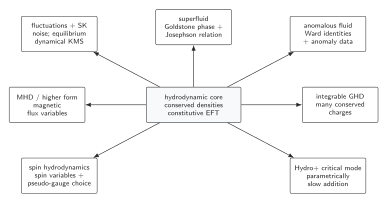
The Schwinger–Keldysh branch packages constitutive response and fluctuations into an action constrained by normalization, reality, and nonnegative noise. Equilibrium dynamical KMS is an additional symmetry, not a consequence of contour doubling alone. The diagram is a qualitative taxonomy and does not imply that its seven extensions can be superposed without rematching fields, symmetries, and regulators.
In text: the field enforces the diffusion equation and generates retarded response, the imaginary term generates noise, and the KMS relation fixes their equilibrium normalization. Goldstone phases, flux currents, rapidity occupations, spin density, and critical modes require separate additions to this action.
Exercise
Section titled “Exercise”Check SK reality and positivity of , and explain why a real term proportional to is forbidden.
Solution
The term linear in is real and changes sign under . The quadratic term is purely imaginary and is unchanged. Hence
Its imaginary part is
A real term would be unchanged by but would have to change sign under the reality relation, forcing its coefficient to vanish. A purely imaginary coefficient is allowed and represents noise.
Common pitfalls
Section titled “Common pitfalls”Equating with KMS. The first follows from contour normalization. KMS requires a thermal state and a thermal transformation.
Writing an action without source gauge invariance. Conservation must follow as a Ward identity, not only after setting sources to zero.
Ignoring the imaginary sector. A dissipative retarded term without its equilibrium noise partner violates fluctuation–dissipation.
Where this leads
Section titled “Where this leads”Dynamical KMS and Topological Symmetries separates the thermal and normalization symmetries. Long-Time Tails and Fluctuation Renormalization uses the nonlinear vertices generated by this EFT.
References
Section titled “References”-
Crossley, Michael, Paolo Glorioso, and Hong Liu. 2017. “Effective Field Theory of Dissipative Fluids.” Journal of High Energy Physics 2017 (9): 095. DOI. Open PDF.
-
Glorioso, Paolo, Michael Crossley, and Hong Liu. 2017. “Effective Field Theory of Dissipative Fluids (II): Classical Limit, Dynamical KMS Symmetry and Entropy Current.” Journal of High Energy Physics 2017 (9): 096. DOI. Open PDF.
Original QFT.org content:CC BY 4.0, unless an item supplies different terms. Third-party material retains its own terms.