

Shear and Bulk Viscosity
Shear viscosity is the zero-frequency dissipative slope of a traceless transverse stress response. Bulk viscosity is the corresponding slope of the scalar stress after projecting out equilibrium pressure changes carried by conserved energy and charge densities. Pressure contacts, sound poles, stress improvements, conformal breaking, critical slow modes, and spectral resolution all belong to the definition and extraction.
Required background. Sources, linear response, and Kubo formulae fixes metric-source response and the retarded sign. Relativistic dissipative hydrodynamics defines the constitutive coefficients. Helpful background. Hydro+ and parametrically slow critical modes explains frequency-dependent bulk response near a critical point.
The shear channel
Section titled “The shear channel”In an isotropic equilibrium state, choose two distinct spatial directions . With the metric source normalized so that it couples to , the shear Kubo formula is
For a rotationally averaged calculation, use the normalized traceless projector
and divide by . This prevents a hidden multiplicity from changing . At nonzero momentum, transverse momentum diffusion gives
providing an independent check against the zero-momentum spectral slope.
The complete metric response includes an equilibrium-pressure contact. It is real and does not change the dissipative slope, but it is required by Ward identities and dispersion relations. Elastic media or phases with additional order can also contain nondissipative zero-frequency weight, which must be separated from fluid viscosity.
The stress-channel normalizations, Euclidean kernels, and practical resolution limitations are reviewed in Meyer 2011, §§2–4, Open PDF.
The thermodynamically projected bulk channel
Section titled “The thermodynamically projected bulk channel”The raw spatial trace mixes with conserved energy and charge fluctuations. Write for the contravariant spatial trace. With one charge, define
At zero charge density this reduces to . The subtraction removes the reversible pressure response associated with conserved densities. The bulk viscosity is
For several charges, project out the full conserved-density susceptibility subspace rather than subtracting each density independently. Different normalizations of the trace operator move factors of between and the Kubo prefactor; the stated pair must be used together.
At nonzero momentum the scalar channel contains sound poles. Setting before the dissipative limit defines homogeneous bulk viscosity; taking a static limit probes compressibility instead. The order cannot be inferred from the symbol .
Conformal symmetry, improvements, and anomalies
Section titled “Conformal symmetry, improvements, and anomalies”In an exactly conformal theory in flat spacetime, an improved stress tensor obeys . Thermodynamics then gives and , so the projected scalar operator vanishes and . Running couplings, masses, chemical scales, curvature anomalies, or explicit symmetry breaking invalidate this conclusion.
Stress-tensor improvement changes local terms and the representative of the trace. A transport comparison must use the same stress definition and include its contacts. The trace anomaly constrains the ultraviolet and integrated spectral weight, but it does not by itself determine the low-frequency slope.
Relaxation scales and critical enhancement
Section titled “Relaxation scales and critical enhancement”In weakly coupled kinetic theory, viscosity can often be interpreted schematically as a stress susceptibility times a relaxation time. This is an approximation tied to a collision operator and a chosen slow subspace, not a universal identity. A broad spectrum or several slow modes need not admit one relaxation time Jeon 1995, §§II–V.
Near a critical point, a parametrically slow scalar mode changes the pressure response between low and high frequency. Ordinary hydrodynamics with a constant bulk viscosity then misses a dispersive contribution. Hydro+ promotes that mode and predicts a frequency-dependent enhancement whose width is its relaxation rate. Extracting a single without resolving or marginalizing over this scale can be strongly model dependent Stephanov and Yin 2018, §§2–4, Open PDF.
The celebrated result holds for a restricted class of large-, strongly coupled theories with two-derivative gravity duals Kovtun, Son, and Starinets 2005, pp. 1–3, Open PDF. Higher-derivative interactions, anisotropy, and other consistent settings alter the ratio. It is therefore not a theorem for all quantum field theories.
The transport-extraction covariance reference records stress normalization, contacts, scalar projection, limit order, sum rules, slow-mode model, covariance, and spectral resolution.
The chain below shows why a stress spectral slope is not yet a viscosity claim. Inspect the source, projector/contact, spectral, and inference boxes together; shear and bulk differ at each of those stages even before their numerical values are estimated.
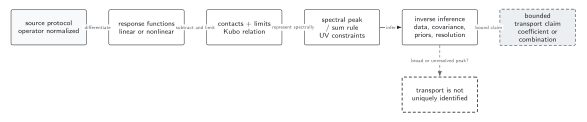
Shear viscosity uses a normalized traceless stress projector; bulk viscosity uses a thermodynamically projected scalar stress with energy, charge, sound, and critical contributions removed or modeled. Pressure contacts, ultraviolet constraints, and low-frequency resolution determine whether the slope is identifiable. The diagram is schematic and does not imply that a good Euclidean fit resolves either dc limit.
In text: differentiate with respect to the metric source, construct the correct tensor projector, include local pressure terms, choose the transport limit, match the infrared spectrum to sum rules and ultraviolet behavior, and propagate continuation uncertainty. In a critical regime, retain the slow mode before interpreting a bulk coefficient.
Exercise: the conformal bulk channel
Section titled “Exercise: the conformal bulk channel”At zero charge density, show that vanishes in a flat-space conformal equilibrium state.
Solution
Tracelessness gives
so . Conformal thermodynamics gives . Therefore
The argument assumes the improved stress tensor and no explicit scale, anomaly contribution relevant to the flat-space channel, or finite-density scale.
References
Section titled “References”- Jeon, Sangyong. 1995. “Hydrodynamic Transport Coefficients in Relativistic Scalar Field Theory.” Physical Review D 52 (6): 3591–3642. DOI. Open PDF.
- Kovtun, Pavel K., Dam T. Son, and Andrei O. Starinets. 2005. “Viscosity in Strongly Interacting Quantum Field Theories from Black Hole Physics.” Physical Review Letters 94 (11): 111601. DOI. Open PDF.
- Meyer, Harvey B. 2011. “Transport Properties of the Quark–Gluon Plasma: A Lattice QCD Perspective.” European Physical Journal A 47: 86. DOI. Open PDF.
- Stephanov, Mikhail, and Yi Yin. 2018. “Hydrodynamics with Parametrically Slow Modes.” Physical Review D 98 (3): 036006. DOI. Open PDF.
Memory Functions and Slow-Mode Projection systematizes transport controlled by selected nearly conserved operators. Transport Extraction, Inverse Problems, and Error Budgets determines whether a stress spectrum resolves a slope, a relaxation scale, or only an integral.
Original QFT.org content:CC BY 4.0, unless an item supplies different terms. Third-party material retains its own terms.