

Matrix-Valued Kinetics and Coherent Transport
A scalar distribution fails when internal states remain coherent on transport timescales. Flavor, spin, chirality, particle–antiparticle, and non-Abelian charge then require a Hermitian matrix whose commutator describes coherent precession and whose collision term damps or transfers both populations and coherences.
Required background. Use Kadanoff–Baym reduction for the Wigner and shell origin of the matrix equation.
Helpful background. Consistent and covariant anomalies and spin, polarization, and pseudogauge supply important specialized constraints.
Covariant matrix equation
Section titled “Covariant matrix equation”On a resolved shell, the density-matrix transport structure used in Sigl and Raffelt 1993, §§ 2–3 has the generic form
contains dispersion splittings and coherent mean fields. Under a local basis change , the connection enters
so the equation transforms covariantly. Diagonalizing and then dropping loses transitions of order , precisely important near degeneracy.
The commutator preserves , , and eigenvalue positivity under unitary evolution. A collision approximation must preserve Hermiticity and the relevant charge traces; positivity is not guaranteed by writing a negative damping rate for off-diagonal entries.
The dashed branch in the hierarchy is the appropriate route when coherent precession competes with damping or gradients. It branches at the shell-reduction stage because discarding off-diagonal components before power counting cannot be repaired by a later scalar collision term.
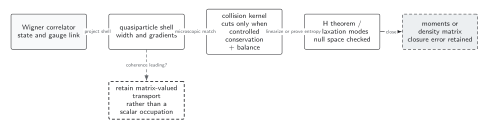
When level splittings, mixing gradients, and damping are comparable, the kinetic variable is a density matrix and its commutator term must be retained at leading order. Gauge or basis covariance then constrains derivatives and collision terms. The microscopic-matching step may use cuts only for an appropriate weak-coupling kernel, and the solid scalar route is recovered only after controlled dephasing or diagonalization, not merely by dropping off-diagonal entries. The diagram is schematic and not to scale.
The sections Covariant matrix equation, Gauge, Berry, and side-jump structure, and Collision closure and double counting give the text and equation equivalent of the coherence branch.
Two-level checked example
Section titled “Two-level checked example”Let
For a simple dephasing model,
With collisions off, precesses and is constant. The eigenvalues remain fixed. A physical fermionic density requires . Arbitrary independent and sources can violate this bound; a microscopic or completely positive closure is needed when positivity is essential.
If , rapid phase averaging can suppress off-diagonal coherence and justify a scalar basis. If the level splitting is comparable to damping or gradients, populations and coherences must evolve together.
Gauge, Berry, and side-jump structure
Section titled “Gauge, Berry, and side-jump structure”Projecting onto momentum-dependent spin or band eigenstates introduces Berry connections. Phase-space measures, velocities, and forces receive curvature corrections; Lorentz covariance can require side jumps under frame changes. In chiral kinetic theory the anomaly emerges only when measure, equations, and boundary terms are treated consistently. Berry-sign and current conventions must be checked against the underlying anomaly normalization.
Spin transport also depends on a spin supplementary condition or pseudogauge choice. Intermediate spin densities can change while total angular momentum observables agree. Comparing results without translating these conventions creates false disagreements.
Collision closure and double counting
Section titled “Collision closure and double counting”Coherent self-energies and collisions originate from the same matrix two-point functions. Adding an oscillation Hamiltonian already resummed into a collision rate can double count level mixing. Secular approximations that discard rapidly oscillating terms require a gap hierarchy; near degeneracy they fail. A diagonal relaxation-time ansatz generally violates non-Abelian covariance unless projected and completed with connection terms.
The coherence column of the validation map is independent of the shell and gradient columns. Resolving a narrow dispersion relation does not justify scalarization when precession, basis rotation, or off-diagonal damping is leading.
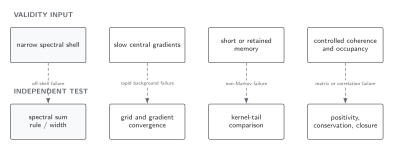
Matrix-valued kinetics requires convergence of coherent precession, covariant gradients, and dissipative terms in a common counting, together with Hermiticity, positivity, and conservation checks. A scalar occupation is allowed only after controlled dephasing or spectral separation. The four columns are independent: passing the shell or gradient tests cannot substitute for the coherence, positivity, conservation, and closure checks in the final column. The diagram is schematic and not to scale.
The sections Covariant matrix equation, Gauge, Berry, and side-jump structure, and Collision closure and double counting give the text and equation equivalent of the coherence and final-validation columns.
Failure tests
Section titled “Failure tests”- Rotate the internal basis locally and verify covariance of every term.
- Monitor Hermiticity, trace charges, and eigenvalue bounds.
- Compare gaps with damping, gradients, and background rotation rates.
- Derive Berry and side-jump conventions with the anomaly/current definition.
- Vary secular and collision closures near degeneracy.
- Compare a scalar reduction with the full matrix solution over the claimed regime.
Exercise
Section titled “Exercise”Show that coherent evolution preserves .
Solution
by cyclicity. Therefore the eigenvalue spectrum, including positivity, is preserved by the commutator alone.
Continue
Section titled “Continue”Use validity and breakdown to test covariance, positivity, collision closure, and the scalar-limit error.
References
Section titled “References”- Sigl, G., and Raffelt, G. (1993). “General Kinetic Description of Relativistic Mixed Neutrinos.” Nuclear Physics B 406, 423–451. DOI.
- Vlasenko, A., Fuller, G. M., and Cirigliano, V. (2014). “Neutrino Quantum Kinetics.” Physical Review D 89, 105004. arXiv:1309.2628; DOI.
Original QFT.org content:CC BY 4.0, unless an item supplies different terms. Third-party material retains its own terms.