

Hydrodynamic Frames and Constitutive Data
A constitutive relation is a map from hydrodynamic fields and sources to the physical tensors and . Away from equilibrium, derivative-order changes in the definitions of , , and move coefficients among components of those tensors. Such a hydrodynamic frame transformation is a field redefinition, not a change of the underlying state or observable.
Required background. Conservation Laws and Hydrodynamic Fields gives the stress-current decomposition. Local Equilibrium and Hydrostatic Constraints identifies the equilibrium equation-of-state surface about which frames are defined.
Helpful background. Frame-Invariant Dissipative Data develops the invariant combinations beyond this first construction.
Constitutive maps at a fixed order
Section titled “Constitutive maps at a fixed order”Write the physical tensors through first derivative order as
Here , , and are zeroth-order functions; every quantity, , , and is . The decomposition is redundant because the same physical tensors can be parametrized by nearby fields.
Let
with all shifts . Keeping and fixed gives
through first order, where and subscripts denote thermodynamic derivatives. Reconstructing the tensors from the primed variables verifies the transformation independently.
Landau and Eckart conventions
Section titled “Landau and Eckart conventions”The Landau convention chooses
Starting from a regular frame, set . The resulting velocity is the timelike energy-flow eigenvector through the retained order. Existence of this perturbative choice requires and a suitable timelike eigenvector; it is not a universal nonperturbative theorem for arbitrary stress tensors.
The Eckart convention chooses
so . It requires a nonzero charge density and becomes singular as . Landau and Eckart conditions can both hold only when the invariant relative diffusion current vanishes:
Indeed,
The complete convention dictionary is the hydrodynamic frame and tensor reference.
Scalar and tensor invariants
Section titled “Scalar and tensor invariants”Use and as independent thermodynamic coordinates locally, so
Then
is invariant under the scalar field redefinitions above. It measures stress perpendicular to the equilibrium equation-of-state surface and becomes the bulk viscous datum once a constitutive basis is chosen. The transverse traceless tensor is also invariant at first order: no scalar or vector redefinition can generate its irreducible tensor representation.
At linear order, the physical poles and residues of correlators of fixed operators and are invariant. Individual entries called “energy correction,” “heat flow,” or “charge diffusion” are generally not.
Hydrostatic constraints on this invariant constitutive data are developed by Bhattacharyya 2014, §§2–4, Open PDF.
Order-by-order equivalence
Section titled “Order-by-order equivalence”A first-order field shift changes second-order terms. For example,
Therefore two first-order constitutive relations related by the displayed map are equivalent only through . To compare them at , one must transform:
- the second-order tensor basis and coefficients;
- source-dependent and curvature terms;
- the equations used to eliminate redundant derivatives;
- initial data and matching conditions;
- any noise variables or transient fields.
Applying a first-order transformation “exactly” inside a truncated PDE implicitly chooses an infinite tower of higher-order terms. Different exact completions can have different high-frequency characteristics even though they share the same hydrodynamic poles. This is why a frame-dependent PDE stability statement is not contradicted by frame invariance of low-energy observables.
Kovtun’s general-frame analysis provides an explicit linear example of stable and unstable exact completions sharing the same retained infrared transport Kovtun 2019, §§2–4, Open PDF.
Translation example
Section titled “Translation example”Suppose a charged fluid is given in a frame with
for one transverse thermodynamic force . Moving to Landau frame uses
The Landau-frame current becomes
The coefficient multiplying has changed, but the relative charge flow with respect to energy flow has not. A comparison that quotes in one frame and in another without this translation compares different component conventions.
Common pitfalls
Section titled “Common pitfalls”Calling the Landau velocity measurable. Detector observables couple to and . A Landau velocity is a useful reconstruction from them within a specified regime.
Comparing truncated equations after an incomplete redefinition. Transforming but not the second-order terms, sources, and initial data breaks the claimed equivalence.
Inferring that every frame is equally well behaved as an exact PDE. Low-energy observables are frame invariant order by order. Exact characteristic structure depends on the chosen higher-order completion; this distinction is central to BDNK theory.
The dashed vertical branch is the point of this page. Inspect how it leaves the constitutive-tensor box: changing frame redefines , , and order by order, while the physical stress tensor, current, and transport observables remain fixed to that order.
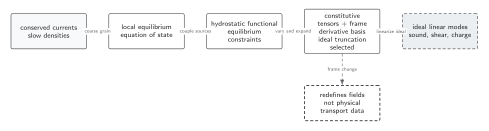
A frame transformation reshuffles scalar corrections and transverse energy and charge fluxes without changing or through the retained derivative order. This equivalence is perturbative: treating two differently truncated formulations as exact PDEs can give different characteristics. The diagram is schematic and makes no claim that Landau, Eckart, and general frames have identical exact high-frequency behavior.
In text: write the same physical tensors in primed and unprimed variables, expand the field redefinition consistently, and compare invariant combinations rather than raw frame coefficients. Landau and Eckart conditions are matching conventions; neither is an observable definition of the fluid velocity.
Exercise
Section titled “Exercise”Show that the Landau-to-Eckart velocity difference is fixed by .
Solution
In Landau frame , so . To reach Eckart frame choose . Hence
Conversely, . Both results reconstruct the same and through first order.
Where this leads
Section titled “Where this leads”Derivative Expansion and Tensor Decomposition removes frame and equation-of-motion redundancies when constructing a basis. Frame-Invariant Dissipative Data carries the translation into pole and transport comparisons.
References
Section titled “References”Original QFT.org content:CC BY 4.0, unless an item supplies different terms. Third-party material retains its own terms.