

EQCD, MQCD, and Dimensional Reduction
Dimensional reduction replaces the long-distance static sector of a hot four-dimensional gauge theory by a sequence of three-dimensional Euclidean effective theories. EQCD retains the spatial gauge field and an adjoint scalar descended from ; MQCD retains only the magnetostatic gauge field. The payoff is a clean factorization of hard, electric, and magnetic physics, including a precise location for nonperturbative input.
Required background. Scale hierarchies identifies , , and . Static dimensional reduction supplies the general matching construction. Helpful background. Continuum extrapolation explains how reduced-theory lattice inputs become continuum statements.
From thermal QCD to EQCD
Section titled “From thermal QCD to EQCD”Bosonic fields have Matsubara frequencies and fermions . At distances , all nonzero modes are heavy. Matching static correlators at external momentum yields
The three-dimensional fields have mass dimension . Consequently
at zero quark chemical potential. The ellipsis contains higher-dimensional gauge-invariant operators suppressed by powers of . Matching, not dimensional guesswork, fixes in a declared renormalization scheme.
One equates infrared-safe static correlators computed in the full and effective theories. Because both sides share the same long-distance singularities, their difference is governed by the hard scale and is perturbative. The matching coefficient is gauge independent when attached to a gauge-invariant operator basis, although individual off-shell Green functions used during the calculation can depend on gauge.
From EQCD to MQCD
Section titled “From EQCD to MQCD”At distances , the adjoint scalar is heavy and can be integrated out. The result is magnetostatic QCD,
Since , this second matching is perturbative when the hierarchy is strong. MQCD is confining at its only intrinsic scale , so dimensionless coefficients of its vacuum energy and screening spectrum require three-dimensional nonperturbative calculation.
The pressure illustrates the factorization:
The separation scales and are arbitrary. Their dependence cancels among adjacent terms to the calculated order. Residual variation estimates missing perturbative orders only if each contribution has been computed consistently. The MQCD vacuum energy scales as , so its four-dimensional contribution is —the first pressure coefficient containing an irreducible nonperturbative constant, as explained on the Linde page.
Screening observables and operator matching
Section titled “Screening observables and operator matching”A screening mass is an inverse spatial correlation length,
The operator must be specified. In EQCD, gauge-invariant composites such as and magnetic operators create different symmetry channels, and the smallest need not equal the leading perturbative parameter . The latter is a matching coefficient, not a universal observable called “the Debye mass.” Gauge-invariant definitions based on discrete Euclidean-time-reflection quantum numbers provide a nonperturbative electric screening mass Arnold and Yaffe 1995, §§ II–III.
Reduced-theory simulations are efficient because the hard scale has already been handled analytically. They still need a line of constant physics, continuum extrapolation, finite-volume control, operator renormalization where required, and matching uncertainty. The common reporting fields are summarized in the hot-gauge plasma validity table.
What dimensional reduction cannot do
Section titled “What dimensional reduction cannot do”The construction matches Euclidean zero-frequency observables. Analytic continuation is not restored merely because EQCD contains fields named and . Damping rates, Landau cuts, viscosities, and formation-time interference require a real-time description. Likewise, chemical potentials or heavy masses modify matching and can add operators; the zero-density formulas above cannot simply be reused.
For dimensional reduction, follow only the static part of the hierarchy: nonzero Matsubara modes are removed before the electric scalar and then the magnetic sector are isolated.
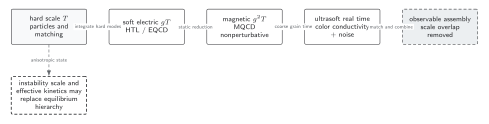
For static equilibrium observables, hard modes at determine EQCD parameters, and integrating out the Debye scale yields MQCD. The magnetic theory is three-dimensional and nonperturbative. The later conductivity-and-noise node belongs to ultrasoft real-time dynamics rather than to analytic continuation of EQCD, while the dashed anisotropic branch lies outside the equilibrium construction. The diagram is schematic and not to scale.
Thus dimensional reduction controls zero-frequency screening and thermodynamics through matched three-dimensional theories. It does not supply Landau cuts, damping rates, viscosities, or formation-time interference, all of which require a real-time description.
The same hard thermal modes also feed several real-time theories, so the common matching origin must not be mistaken for a common observable domain.
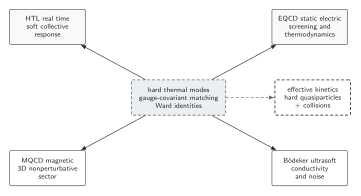
The branches share hard thermal input and gauge constraints but retain different degrees of freedom and questions. EQCD and MQCD describe static Euclidean sectors; HTL describes soft collective response; Bödeker theory adds ultrasoft real-time conductivity and noise; and effective kinetic theory evolves hard quasiparticles with collisions. The dashed kinetic branch emphasizes a distinct quasiparticle construction rather than an analytic continuation of the static theories. The diagram is schematic and not to scale.
In text, a matching coefficient may connect calculations across branches, but it does not identify their correlation functions. Combining contributions requires an explicit factorization prescription and overlap subtraction at the observable level.
Exercises
Section titled “Exercises”1. Power count the magnetic pressure. Show that a three-dimensional vacuum-energy density built only from scales as .
Solution
A three-dimensional energy density has mass dimension three, while has dimension one. With no other scale, dimensional analysis gives . Multiplication by converts it to the four-dimensional pressure contribution at leading matching order.
2. Check factorization-scale cancellation. Suppose and . Differentiate their sum with respect to .
Solution
The derivatives are and , so they cancel. The remaining depends on physical and renormalization scales but not the arbitrary factorization boundary. An uncanceled derivative diagnoses missing or inconsistent matching terms.
Continue to HTL theory for soft real-time response or the magnetostatic sector for the nonperturbative boundary.
References
Section titled “References”- Arnold, Peter, and Laurence G. Yaffe. “The Non-Abelian Debye Screening Length Beyond Leading Order.” Physical Review D 52, no. 12 (1995): 7208–7219. DOI.
- Braaten, Eric, and Agustín Nieto. “Effective Field Theory Approach to High Temperature Thermodynamics.” Physical Review D 51, no. 12 (1995): 6990–7006. DOI.
- Braaten, Eric, and Agustín Nieto. “Free Energy of QCD at High Temperature.” Physical Review D 53, no. 6 (1996): 3421–3437. DOI.
- Kajantie, Keijo, Mikko Laine, Kari Rummukainen, and Mikhail Shaposhnikov. “Generic Rules for High Temperature Dimensional Reduction and Their Application to the Standard Model.” Nuclear Physics B 458, no. 1–2 (1996): 90–136. DOI.
- Laine, Mikko, and Aleksi Vuorinen. Basics of Thermal Field Theory. Lecture Notes in Physics 925. Cham: Springer, 2016; updated notes 2025. DOI.
Original QFT.org content:CC BY 4.0, unless an item supplies different terms. Third-party material retains its own terms.