

Causal and Statistical Propagators
Away from equilibrium, causal response and statistical fluctuations are independent functions. The spectral correlator fixes commutator support and canonical normalization; the statistical correlator fixes occupation, squeezing, and coherence, as developed in Berges 2004, § 3. Only a KMS state relates them by a universal thermal factor.
Required background. Use the retarded/advanced/Keldysh rotation and the canonical field algebra.
Helpful background. Spectral and statistical evolution follows both functions self-consistently in time.
Definitions and support
Section titled “Definitions and support”For a Hermitian bosonic field define
Then and . With the chapter’s convention,
The sign of depends on the source convention, but its retarded support does not. Canonical quantization gives, for spatial Fourier modes,
These conditions are state independent. By contrast, a Gaussian mode requires the complete equal-time covariance data
for a unit-mass canonical oscillator. Here means . Omitting the mixed second derivative loses the momentum variance; higher connected cumulants then supply genuinely non-Gaussian initial data.
Why one occupation number is insufficient
Section titled “Why one occupation number is insufficient”For a free homogeneous Gaussian mode without squeezing,
Here one number suffices because the spectrum is a sharp, known oscillator and anomalous covariances vanish. A squeezed state adds terms depending on ; a broad interacting spectrum distributes weight over frequency; multicomponent fields carry matrix coherence. None can be reconstructed from a scalar alone.
Spectral positivity also needs hypotheses. In an equilibrium Hilbert-space representation, suitable spectral densities for Hermitian operators have definite sign at positive frequency. Wigner transforms of nonstationary correlators, gauge-variant fields, finite-window spectra, and truncated approximations need not share that simple positivity. Canonical normalization remains the safer universal check.
The central boxes in the diagram separate response from fluctuations: and carry causal support, whereas or carries state information. A single occupation ansatz is therefore an additional closure, not a consequence of the contour rotation.
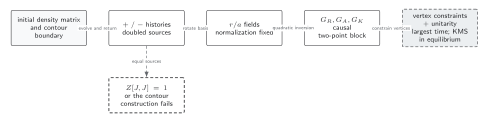
The basis exposes two independent kinds of information: retarded and advanced kernels encode causal response, while the statistical correlator depends on the prepared state. Inverting the two-point kernel determines the propagator block, not the interaction vertices. Unitarity fixes support and normalization identities but does not determine the statistical function. Only a KMS state supplies the equilibrium fluctuation–dissipation relation shown conditionally in the final box. The diagram is schematic and not to scale.
The sections Definitions and support, Why one occupation number is insufficient, and Retarded response from a physical source give the text and equation equivalent of the propagator and response boxes.
Retarded response from a physical source
Section titled “Retarded response from a physical source”Couple . Linear response of is
For , this is under the convention above. Choosing reverses that response sign. The statistical function does not enter the kinematic Kubo identity, though interactions and the state affect the commutator expectation. In equilibrium the KMS condition relates to the dissipative spectral part; outside equilibrium it does not.
Checked normalization and covariance
Section titled “Checked normalization and covariance”For the free mode, differentiate : . The complete Gaussian covariance obeys
For the unsqueezed occupation-number example, and this reduces to . A numerical solution can preserve the commutator while violating covariance positivity, or vice versa; both should be checked where positivity applies.
For fermions, anticommutators and commutators exchange their statistical roles, occupation is bounded, and signs in differ. One must rederive the definitions rather than reuse the bosonic formulas.
Failure tests
Section titled “Failure tests”- Verify symmetry, antisymmetry, and the equal-time derivative separately.
- Change the initial covariance while holding the Hamiltonian fixed; should change immediately, while the free does not.
- Increase the relative-time window before interpreting a fitted width.
- Test any quasiparticle reconstruction against field and momentum variances and, when available, the full Wigner ratio.
- Do not impose fluctuation–dissipation unless the Wightman functions pass the KMS test.
Exercise
Section titled “Exercise”Show that and reconstruct and uniquely.
Solution
Adding and subtracting gives and . Thus response and statistical data together reconstruct both Wightman functions; neither piece alone suffices.
Continue
Section titled “Continue”At equilibrium, derive the relation between these functions on KMS and fluctuation–dissipation. For general evolution, continue to two-time Green functions.
References
Section titled “References”- Berges, J. (2004). “Introduction to Nonequilibrium Quantum Field Theory.” AIP Conference Proceedings 739, 3–62. arXiv:hep-ph/0409233; DOI.
- Kubo, R. (1957). “Statistical-Mechanical Theory of Irreversible Processes. I.” Journal of the Physical Society of Japan 12, 570–586. DOI.
Original QFT.org content:CC BY 4.0, unless an item supplies different terms. Third-party material retains its own terms.