

Spectral Statistics, Form Factors, and Late-Time Evidence
Quantum-chaotic spectra exhibit correlations only after exact symmetries, degeneracies, smooth density variation, and finite-size structure have been handled. Nearest-neighbor ratios test local energy correlations; the connected spectral form factor tests correlations across time-dependent spectral scales; the late plateau records discreteness and recurrences. Agreement with a random-matrix class is strong spectral evidence in the tested window, not a proof of ETH, operator growth, or universal continuum dynamics.
Required background. ETH supplies the matrix-element diagnostic that spectral evidence does not replace. OTOCs supply an independent dynamical diagnostic. Helpful background. ETH exceptions explains how unresolved sectors and fragmentation create false spectral conclusions.
Resolve the spectrum before measuring chaos
Section titled “Resolve the spectrum before measuring chaos”Let be ordered eigenvalues in one irreducible sector. Remove exact degeneracies that follow from known multiplets only by treating the correct irreducible representation; never perturb them away merely to improve a statistic. Restrict to an energy-density window with approximately stationary spectral properties.
The adjacent-gap ratio
is insensitive to a slowly varying local density and avoids explicit unfolding. Typical ensemble means are approximately for Poisson and for the Gaussian orthogonal ensemble, but comparison must use the class implied by antiunitary and other symmetries Atas et al. 2013.
A mean ratio alone hides mixtures. Report the distribution , sector, energy window, sample count, disorder or parameter averaging, degeneracies, and size drift. Superposing two independent Wigner–Dyson spectra weakens level repulsion and can resemble Poisson statistics.
Spectral form factor and connected subtraction
Section titled “Spectral form factor and connected subtraction”Define the analytically continued partition sum
The spectral form factor is
The brackets denote a declared ensemble, disorder, parameter, time, or spectral-window average. The disconnected contribution from the smooth density is
and the connected form factor is . Without this subtraction, Fourier structure of the mean density can imitate or obscure the dip and ramp.
Random-matrix terminology describes three regimes:
- the dip, where the disconnected piece decays and connected correlations emerge;
- the ramp, where level repulsion produces increasing connected correlation; and
- the plateau, set by spectral discreteness near the Heisenberg time.
The shapes and normalizations depend on ensemble, filter, temperature, and unfolding. A “ramp” judged by visual linearity without a connected subtraction is not reproducible evidence.
The plateau is an exact discreteness check
Section titled “The plateau is an exact discreteness check”For a nondegenerate finite spectrum, the infinite-time mean is
If levels have degeneracies at energy , it becomes
This is a valuable normalization check and a warning: an unexpectedly high plateau can signal unresolved degeneracy rather than enhanced chaos. Exact evolution also produces fluctuations and Poincaré recurrences around the plateau. Smoothing that erases them may clarify a universal window but must not be reported as the exact late-time function.
A minimal two-level counterexample
Section titled “A minimal two-level counterexample”For , at ,
Its long-time mean is , equal to the number of levels, but the system has neither a random-matrix ramp nor irreversible late-time behavior. A coarse time average over part of one oscillation can manufacture an apparently smooth rise. This fixture tests normalization, sampling cadence, windowing, and the distinction between recurrence and plateau.
A defensible late-time workflow
Section titled “A defensible late-time workflow”- Resolve all exact symmetries and choose the appropriate random-matrix class.
- Predeclare the energy window or smooth filter.
- Report gap-ratio distributions before global time transforms.
- Compute , the disconnected density contribution, and with identical normalization.
- Compare the plateau with the exact degeneracy formula.
- Vary unfolding/filtering, averaging procedure, time binning, and window.
- Scale system size and seek an expanding interval matching the predicted form factor.
- Compare with ETH matrix elements, OTOCs, and operator fronts without requiring them to agree point by point.
The exactly solvable self-dual kicked Ising chain provides a controlled many-body example in which random-matrix form-factor behavior can be derived in a thermodynamic limit Bertini, Kos, and Prosen 2018. It demonstrates possibility under special structure, not a theorem for generic local Hamiltonians.
Evidence boundaries
Section titled “Evidence boundaries”Random-matrix agreement is a universality statement about spectral correlations after coarse information has been removed. It does not identify a microscopic mechanism. Poisson statistics can arise from integrability, localization, unresolved symmetries, fragmentation, or insufficient levels. Wigner–Dyson statistics can coexist with atypical states relevant to special preparations.
The thermalization and chaos evidence matrix states the common ceiling. Finite- gravitational spectra and their interpretation continue in Volume XV.
Common failure modes
Section titled “Common failure modes”Mixing sectors. Independent spectral sequences erase level repulsion.
Using one unfolding. Vary local polynomial, filter, and ratio-based checks; quote the induced systematic error.
Calling the disconnected slope a ramp. Compute explicitly.
Ignoring the plateau normalization. Compare with and degeneracy factors before interpreting late time.
The lower-right part of the figure collects late spectral diagnostics. Inspect it only after resolving symmetries and unfolding the spectrum, and keep its evidence distinct from operator growth or equilibration of a chosen state.
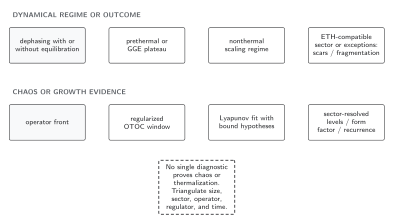
Spectral statistics and form factors provide late-time evidence for correlations associated with quantum chaos, but they do not determine a local relaxation mechanism or prove ETH for every observable. The diagram is schematic and arrow-free; sector, size, regulator, unfolding, and recurrence windows remain part of the claim.
The text equivalent is to analyze each irreducible sector separately, validate unfolding, normalize the form factor against the sector dimension and degeneracies, and scale the dip, ramp, plateau, and recurrence times with size. Operator and state-dependent thermalization require additional tests.
Exercises
Section titled “Exercises”Derive the nondegenerate plateau formula.
Solution
In the double sum for , the infinite-time average of vanishes unless . For a nondegenerate spectrum only remains, giving .
Two parity sectors each show GOE statistics, but their combined spectrum has weak repulsion. Which conclusion is correct?
Solution
The Hamiltonian has GOE-like correlations within each irreducible parity sector. The combined statistic is invalid because levels from different sectors cross freely. Report the sector-resolved result and never use the mixture to infer integrability.
Continue across diagnostics
Section titled “Continue across diagnostics”OTOCs test real-time operator order, operator spreading tests spatial growth, and ETH tests matrix elements. A reproducible late-time calculation should include window and false-positive tests.
References
Section titled “References”- Atas, Y. Y., E. Bogomolny, O. Giraud, and G. Roux. “Distribution of the Ratio of Consecutive Level Spacings in Random Matrix Ensembles.” Physical Review Letters 110 (2013): 084101. doi:10.1103/PhysRevLett.110.084101. Open preprint.
- Bertini, Bruno, Pavel Kos, and Tomaž Prosen. “Exact Spectral Form Factor in a Minimal Model of Many-Body Quantum Chaos.” Physical Review Letters 121 (2018): 264101. doi:10.1103/PhysRevLett.121.264101. Open preprint.
- Bohigas, Oriol, Marie-Joya Giannoni, and Charles Schmit. “Characterization of Chaotic Quantum Spectra and Universality of Level Fluctuation Laws.” Physical Review Letters 52 (1984): 1–4. doi:10.1103/PhysRevLett.52.1.
- Cotler, Jordan S., Guy Gur-Ari, Masanori Hanada, Joseph Polchinski, Phil Saad, Stephen H. Shenker, Douglas Stanford, Alexandre Streicher, and Masaki Tezuka. “Black Holes and Random Matrices.” Journal of High Energy Physics 2017, no. 5 (2017): 118. doi:10.1007/JHEP05(2017)118. Open preprint.
Original QFT.org content:CC BY 4.0, unless an item supplies different terms. Third-party material retains its own terms.