

Collision Kernels, Conservation, and Detailed Balance
A collision kernel is correct only as a complete reaction set: invariant measures, matrix-element normalization, identical-particle factors, quantum statistics, inverse reactions, medium-modified kinematics, and soft resummations must be mutually consistent. Conservation follows from reaction-level invariants, not from the appearance of an energy delta function in one species equation.
Required background. Use distribution functions, Lorentz-invariant phase space, and cross sections and decay rates.
Helpful background. The kinetic H-theorem uses microreversibility and positivity of these kernels.
Relativistic 2↔2 kernel
Section titled “Relativistic 2↔2 kernel”Let and for bosons, for fermions. For ,
divides identical initial or final configurations according to the matrix-element convention. Degeneracy averages must likewise match the definition of . A kernel imported from a cross section with initial-state averages cannot be multiplied by the same degeneracies again.
For , the collision term contains
with the appropriate measures and symmetry factor. Medium dispersion can open or close this channel; unstable species and finite widths may require an off-shell treatment to avoid double counting a resonant contribution.
Conservation by reaction invariants
Section titled “Conservation by reaction invariants”For charges satisfying , sum the charge moment over every species and relabel integration variables between gain and loss. The common integrand is multiplied by
The energy–momentum moment vanishes by the same argument with and the four-momentum delta function. A reaction conserves only charge combinations with ; individual particle numbers need not survive.
Numerically, conservation requires the discrete gain and loss terms to share quadrature nodes and weights or to be projected onto the exact invariant subspace. Post-step “correction” can hide a kernel inconsistency and may violate positivity.
Detailed balance
Section titled “Detailed balance”Equilibrium distributions are
Energy–momentum and charge conservation make the exponential factors equal across each reaction, so gain equals loss pointwise. This proof also shows that chemical potentials are allowed only for charges conserved by the full reaction network. Stationarity of one incomplete subset does not establish equilibrium.
Microreversibility relates forward and inverse matrix elements after reversing momenta, spins, and external fields correctly. In a magnetic field or CP-violating background, the reversed process may belong to the time-reversed system rather than the same fixed external parameters.
The collision box in the hierarchy carries three obligations, not one label: derive or specify the kernel, prove its reaction invariants, and establish detailed balance in the equilibrium family. Only then can the next box support an H theorem or a trustworthy relaxation spectrum.
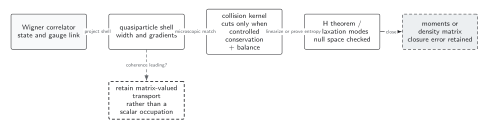
In a weakly coupled quasiparticle regime, appropriately resummed cuts can generate a collision kernel. Conservation follows only if every channel, measure, symmetry factor, and mean-field exchange is treated consistently; detailed balance additionally uses the equilibrium weights and microreversibility. Soft, collinear, or resonant physics may require a different effective kernel rather than the displayed truncation. The diagram is schematic and not to scale.
The sections Relativistic 2↔2 kernel, Conservation by reaction invariants, and Detailed balance give the text and equation equivalent of the collision box.
Soft, collinear, and resonant boundaries
Section titled “Soft, collinear, and resonant boundaries”Massless exchange produces soft divergences that require screening and matching. Nearly collinear splitting can overlap with repeated soft scattering, requiring the LPM integral equations in Arnold, Moore, and Yaffe 2003, §§ 2–3. Real intermediate states can be counted both as sequential decays and as resonant scattering unless a subtraction scheme is specified. These are leading-order consistency issues in many gauge plasmas.
The shared stochastic and kinetic closure table records collision invariants, regulator, closure order, positivity, and convergence obligations.
Failure tests
Section titled “Failure tests”- Verify dimensions and recover a known vacuum decay rate or cross section in the dilute limit.
- Enumerate identical-particle factors and internal-state averages.
- Include every inverse reaction and the correct Bose/Pauli factors.
- Prove conserved moments analytically, then demand discrete conservation.
- Test equilibrium pointwise, not only after integration.
- Vary screening, resonant subtraction, and soft/collinear matching scales.
Exercise
Section titled “Exercise”Use to show that the bracket vanishes in equilibrium.
Solution
The gain term equals , while the loss term has the exponential with and . Reaction-level conservation makes the exponents identical.
Continue
Section titled “Continue”Use this kernel to prove the H-theorem, derive moment closures, and analyze its linearized spectrum.
References
Section titled “References”- Arnold, P., Moore, G. D., and Yaffe, L. G. (2003). “Effective Kinetic Theory for High Temperature Gauge Theories.” Journal of High Energy Physics 2003(01), 030. arXiv:hep-ph/0209353; DOI.
- de Groot, S. R., van Leeuwen, W. A., and van Weert, C. G. (1980). Relativistic Kinetic Theory: Principles and Applications. Amsterdam: North-Holland. WorldCat record.
Original QFT.org content:CC BY 4.0, unless an item supplies different terms. Third-party material retains its own terms.