

Screening and Infrared Scale Separation
Screening is the suppression of a long-range response by medium polarization. Its definition must name the channel and limit: a static scalar correlation length, an electric Debye pole, a magnetic response, and real-time Landau damping are different objects. Scale separation determines whether a screened propagator is a controlled reorganization, a matched EFT result, or merely a model ansatz.
Static and dynamical screening, including their gauge and momentum-limit qualifications, are reviewed by Kraemmer and Rebhan 2004, §§ 3–5, pp. 368–404.
Required background. Thermal Self-Energies and Mass Definitions distinguishes screening from pole and asymptotic masses. Bosonic Zero Modes and Infrared Breakdown explains why the static sector must be reorganized. Thermal Modes, Matching, and EFT Power Counting supplies the matching logic.
Static screening from a spatial pole
Section titled “Static screening from a spatial pole”For a scalar operator whose zero-frequency propagator is analytic near small spatial momentum,
the nearest pole at controls the large-distance correlator. In three spatial dimensions,
Thus is a correlation length. Replacing the full denominator by is justified only for momenta well below the next scale and away from branch points or competing poles. A curvature mass obtained from an effective potential need not equal this spatial pole beyond the approximation in which wave-function and momentum-dependent terms are neglected.
Electric screening and its qualifications
Section titled “Electric screening and its qualifications”In an Abelian plasma, a conventional weak-coupling definition is the static longitudinal pole determined by the temporal polarization tensor. With signs chosen so that the screened denominator is ,
For one massless Dirac fermion of unit charge in QED,
at leading order. The corresponding static potential is Yukawa-like only within the momentum window where the pole approximation dominates. Non-Abelian Debye screening can be organized perturbatively at the electric scale, but a propagator pole defined in a fixed gauge and a manifestly gauge-invariant screening observable are not interchangeable. Beyond leading order, one should specify the operator, matching prescription, and definition used.
Dynamical screening is not a static mass
Section titled “Dynamical screening is not a static mass”Real-time polarization depends separately on frequency and momentum. The limits
need not agree. For spacelike kinematics, scattering from thermal excitations produces an imaginary part—Landau damping—and therefore a cut rather than a simple local mass term. A static Euclidean screening mass does not determine this dissipative kernel.
The same distinction prevents a universal “thermal mass” from being inserted in every line. Static scalar zero modes, electric gauge fields, hard quasiparticles, and nearly lightlike excitations require different self-energies and often different resummations.
The magnetic boundary
Section titled “The magnetic boundary”At asymptotically high temperature, a weakly coupled non-Abelian plasma has the hierarchy
The electric sector is screened at . Static transverse magnetic fields do not acquire a perturbative mass of that order. At , the dimensionful three-dimensional coupling is as large as the momentum, so magnetostatic Yang–Mills dynamics is nonperturbative. Inserting a guessed magnetic mass may regulate an integral, but it does not constitute matching or a controlled error estimate.
A screening decision table
Section titled “A screening decision table”| Question | Appropriate object | Controlled check | Common category error |
|---|---|---|---|
| large-distance static scalar correlation | nearest spatial Euclidean pole | fit several distances and include derivative corrections | identify a potential curvature with the pole automatically |
| static electric response | longitudinal static pole or gauge-invariant matched observable | Ward identities and matching-scale cancellation | call every self-energy value a Debye mass |
| spacelike real-time response | retarded kernel and its cut | spectral relation and causal support | replace Landau damping by a real local mass |
| non-Abelian magnetostatic response | three-dimensional nonperturbative theory | regulator and continuum control | invent a perturbative magnetic screening mass |
The matching and double-counting table records which degrees of freedom and subtractions belong to each description.
The schematic below organizes the relationships used on this page. Inspect it with this question in mind: How do ring, daisy, screened, variational, and EFT reorganizations differ?
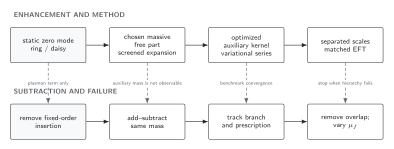
Each reorganization targets a named enhanced sector and must include its compensating subtraction; optimization, factorization-scale, gauge, and strong-soft-sector tests decide whether apparent convergence is meaningful. The method columns are alternatives or partially overlapping reorganizations, not a mandatory sequence: horizontal arrows organize increasing structural scope, while vertical dashed arrows pair each method with its subtraction or failure check. The diagram is schematic and not to scale.
The surrounding discussion supplies the relevant equations and checks in text form; the figure is a navigational summary.
Exercise
Section titled “Exercise”Starting from , derive the three-dimensional Yukawa form and explain why the result alone does not establish that an interacting correlator has a single screening length.
Solution
Angular integration followed by the standard contour integral gives
An interacting correlator can contain several poles, cuts, operator-dependent residues, and finite-volume effects. Only the singularity nearest the origin dominates asymptotically, and a single-exponential window must be demonstrated rather than assumed.
References
Section titled “References”- Arnold, Peter, and Laurence G. Yaffe. “The Non-Abelian Debye Screening Length Beyond Leading Order.” Physical Review D 52, no. 12 (1995): 7208–7219. doi:10.1103/PhysRevD.52.7208.
- Kraemmer, Ulrike, and Anton Rebhan. “Advances in Perturbative Thermal Field Theory.” Reports on Progress in Physics 67, no. 3 (2004): 351–431. doi:10.1088/0034-4885/67/3/R05.
- Le Bellac, Michel. Thermal Field Theory. Cambridge: Cambridge University Press, 1996. doi:10.1017/CBO9780511721700.
- Linde, A. D. “Infrared Problem in Thermodynamics of the Yang–Mills Gas.” Physics Letters B 96, nos. 3–4 (1980): 289–292. doi:10.1016/0370-2693(80)90769-8.
Original QFT.org content:CC BY 4.0, unless an item supplies different terms. Third-party material retains its own terms.