

The Magnetostatic Sector and Linde Problem
The Linde problem is a precise limit on thermal perturbation theory: static non-Abelian magnetic fields at momentum form a strongly coupled three-dimensional Yang–Mills theory, so an infinite set of diagrams contributes to the pressure at order . Perturbation theory still determines the hard and electric matching pieces, but not the magnetostatic constant.
Required background. EQCD and MQCD supplies the reduced theories, while thermal zero modes and infrared breakdown supplies the general infrared counting. Helpful background. Bödeker theory uses the same magnetic scale in real time but adds dissipative matching.
Why magnetostatic perturbation theory fails
Section titled “Why magnetostatic perturbation theory fails”The bosonic zero modes reduce the infrared problem to three Euclidean dimensions. For static transverse fields, perturbation theory supplies no magnetic mass of order . Introduce an infrared regulator only to expose the counting. An -loop vacuum graph built from magnetostatic propagators and Yang–Mills vertices contributes parametrically
At , every loop order gives
Thus adding more four-dimensional diagrams cannot determine the full coefficient. The obstruction is physical three-dimensional confinement, not merely a poorly chosen resummation. Giving transverse gluons an ad hoc mass can make individual integrals finite, but it changes the theory and cannot fix the QCD coefficient.
Factorized pressure at the first magnetic order
Section titled “Factorized pressure at the first magnetic order”Dimensional reduction turns the obstruction into a calculational program. One writes
The schematic notation suppresses renormalization-scale logarithms and flavor dependence. Hard four-dimensional and soft EQCD calculations determine the perturbative pieces, including the logarithmic coefficient. The dimensionless constant is obtained by matching the MQCD vacuum energy to a regulated three-dimensional lattice calculation. Both the lattice definition and the perturbative subtraction scheme are required; the bare lattice vacuum energy alone is not the continuum coefficient.
Kajantie and collaborators completed the factorized form through the last perturbatively accessible logarithm Kajantie et al. 2003, §§ 2–5. The resulting statement is not “the pressure is unknowable at .” It is that the coefficient contains one or more nonperturbative MQCD matrix elements that can be calculated outside ordinary perturbation theory.
What else is magnetically sensitive?
Section titled “What else is magnetically sensitive?”Any observable whose long-distance support reaches can inherit nonperturbative information. Examples include the asymptotic spatial string tension, the lightest magnetostatic screening states, and contributions to some soft collision kernels. The perturbative order at which sensitivity first appears depends on the observable; is specific to the pressure.
Conversely, not every infrared-sensitive quantity is controlled entirely by MQCD. A transport coefficient may receive leading contributions from a range of momentum transfers and require real-time kinetic matching. A topological diffusion rate needs the magnetic equilibrium measure and a color conductivity, giving Bödeker theory. Static MQCD alone supplies no clock.
Evidence and checks
Section titled “Evidence and checks”A nonperturbative magnetic contribution is credible only when:
- the hard-to-EQCD and EQCD-to-MQCD matching conventions are stated;
- ultraviolet divergences of the three-dimensional vacuum energy are subtracted in the same scheme;
- lattice spacing and volume are extrapolated or their residual effects bounded;
- the arbitrary factorization scale cancels to the claimed order;
- the result is not presented as a real-time rate.
The corresponding pressure and screening rows are in the hot-gauge plasma validity table.
The Linde problem sits at the magnetic node of the thermal hierarchy, where perturbative loop counting loses its suppressing parameter.
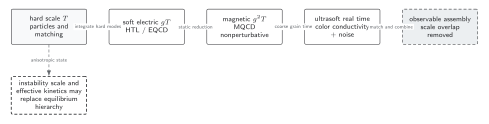
After hard and Debye-scale matching, the magnetic node contains MQCD with coupling . Its vacuum energy scales as , producing the nonperturbative order- pressure coefficient. The ultrasoft real-time node is a further dynamical construction, not the origin of the equilibrium Linde obstruction. The diagram is schematic and assumes a weak-coupling scale hierarchy.
Equivalently, no finite resummation of four-dimensional perturbative diagrams determines the pure magnetostatic coefficient. It must be supplied by a nonperturbative three-dimensional calculation and combined with hard and electric pieces so that factorization-scale dependence cancels.
Exercises
Section titled “Exercises”1. Identify the first uncontrolled order. Use and the three-dimensional vacuum-energy dimension to recover the four-dimensional order of the magnetostatic contribution.
Solution
The only MQCD scale is , so its vacuum energy is proportional to . The thermal pressure includes a factor of from the Euclidean time circle. Hence .
2. Explain the Abelian contrast. Why does hot QED not have the same Linde obstruction?
Solution
After dimensional reduction, the Abelian magnetostatic zero mode has no photon self-interaction. There is therefore no dimensionful three-dimensional coupling that becomes strong at in the same manner. Nonperturbative magnetic confinement, which drives the Yang–Mills obstruction, is absent.
Continue to ultrasoft color dynamics to add the real-time matching needed for magnetic diffusion.
References
Section titled “References”- Kajantie, Keijo, Mikko Laine, Kari Rummukainen, and York Schröder. “The Pressure of Hot QCD up to .” Physical Review D 67, no. 10 (2003): 105008. DOI.
- Linde, Andrei D. “Infrared Problem in Thermodynamics of the Yang–Mills Gas.” Physics Letters B 96, no. 3–4 (1980): 289–292. DOI.
- Schröder, York. “The Pressure of Hot QCD.” Nuclear Physics B Proceedings Supplements 129–130 (2004): 572–574. DOI.
Original QFT.org content:CC BY 4.0, unless an item supplies different terms. Third-party material retains its own terms.