

Prethermalization, Floquet Dynamics, and Generalized Ensembles
A prethermal state is controlled by an approximately conserved generator and a separation between rapid local relaxation and slow violation of that conservation law. Weak integrability breaking, high-frequency periodic driving, and hierarchically separated interaction scales realize this structure in different ways. The plateau is meaningful only together with the small parameter, the observables it constrains, and an estimate of the time at which resonances or collisions destroy it.
Required background. Equilibration and dephasing separates a stationary plateau from thermal ensemble identification. Generalized Gibbs ensembles define the charge constraints used during an integrable plateau. Helpful background. Generalized hydrodynamics evolves locally varying integrable charges, while noncommuting-charge ensembles explain why the ordinary commuting GGE formula is not universal.
Approximate conservation creates two clocks
Section titled “Approximate conservation creates two clocks”Write
where has conserved charges and . The exact Heisenberg equation gives
Rapid dynamics under can dephase local observables toward a generalized ensemble
while the change slowly. At first order the derivative can oscillate to zero; irreversible drift typically appears at order after a kinetic or golden-rule reduction, so is common but not universal. Selection rules, resonances, dimensionality, and nearly conserved modes can change the power or generate exponential times.
A controlled claim therefore has three parts:
- an effective generator or charge set whose commutator with the exact evolution is bounded;
- fast equilibration conditional on those approximate charges; and
- a quantitative drift or remainder that limits the plateau.
Floquet evolution and the effective Hamiltonian
Section titled “Floquet evolution and the effective Hamiltonian”For , the one-period evolution is
The logarithm is branch-dependent because quasienergies are defined modulo . A high-frequency expansion constructs a local approximate Floquet Hamiltonian without claiming that one exact extensive logarithm is globally local. The Magnus terms begin
For a local lattice Hamiltonian with local scale and , truncating near the smallest term yields a quasi-conserved and a heating time that can be exponentially large in . Precise constants and hypotheses depend on bounded local terms, locality, and drive regularity Abanin et al. 2017, Theorems 2.1–2.3. Unbounded bosonic fields, continuum limits, long-range interactions, and dense resonances require separate control.
A two-step drive exposes the first correction
Section titled “A two-step drive exposes the first correction”Let
Then
The Baker–Campbell–Hausdorff formula gives
The commutator is the first drive-ordering correction. A plateau governed only by the time average fails first in an observable for which is large. This supplies an adversarial diagnostic: compare exact stroboscopic evolution with both and while varying .
The approximation is controlled for local observables at times before the accumulated remainder becomes order one. It does not license replacing the full micromotion within a period, ignoring quasienergy resonances, or extrapolating an exponentially long lattice bound through an unregulated continuum limit.
Which generalized ensemble belongs on the plateau?
Section titled “Which generalized ensemble belongs on the plateau?”An integrable plateau is not specified by energy alone. The charge set must distinguish the stationary macrostates relevant to the observables. Omitting quasilocal charges can produce an apparently converged but incorrect GGE. Conversely, fitting many Lagrange multipliers to finite data can hide nonstationarity.
| Regime | Slowly changing data | Plateau description | Breakdown signal |
|---|---|---|---|
| weak integrability breaking | local and quasilocal of | time-dependent GGE or kinetic equation for charges | collision-induced drift among rapidities |
| high-frequency Floquet | quasi-local and exact symmetries | Gibbs/GGE of for stroboscopic local observables | absorption and resonance proliferation |
| large energy hierarchy | occupation or band charges | constrained ensemble after fast intraband relaxation | interband transitions |
| near a nonthermal fixed point | conserved cascade fluxes | self-similar distribution, not generally a GGE | loss of collapse or flux plateau |
The charge-to-macrostate map and model tests remain with the integrable-matter treatment; the present claim is the timescale role of the constrained ensemble.
Controlled evidence and failure cases
Section titled “Controlled evidence and failure cases”The minimal record reports , or , system size, local Hilbert-space cutoff, drive protocol, effective-generator order, observable, micromotion convention, fit window, and the norm or correlation error. Vary the truncation order and the small parameter independently.
A long plateau without a generator. Metastability can have many causes. Demonstrate approximate conservation and its drift rather than identifying prethermalization from flat data alone.
An asymptotic series treated as convergent. The high-frequency series is generally truncated optimally. Adding terms beyond the minimum can worsen the approximation.
A complete GGE assumed. The ensemble is only as complete as its charge set and macrostate map.
Finite-size absence of resonances. A small spectrum can miss the resonant network that controls heating at larger volume. Scale both size and drive frequency.
The upper row places a prethermal or generalized-ensemble plateau among other possible dynamical regimes. On this page, inspect the finite interval in which an effective Hamiltonian or approximately conserved charges suppress heating.
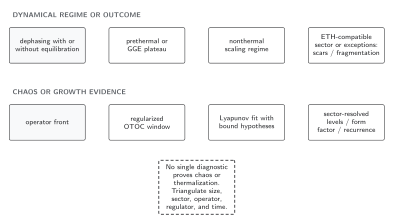
Prethermal and GGE descriptions are controlled only over their stated frequency, coupling, size, and time ranges. The figure is schematic and its upper row has no evolution arrows: a plateau need not pass through a nonthermal fixed point, and finite-size suppression of resonances does not establish an infinite-volume lifetime.
The text equivalent is to identify the approximate conserved generator or charges, bound their violation, and demonstrate a plateau whose lifetime and observables scale as predicted. Heating, ETH behavior, and chaos diagnostics require separate late-time tests.
Exercises
Section titled “Exercises”Derive the first correction for the two-step drive and show when it vanishes.
Solution
With and , . Dividing by gives . The correction vanishes when ; then the time average generates the exact stroboscopic evolution.
An observable plateau lasts as over one decade in . What additional checks are needed before calling it kinetic prethermalization?
Solution
Identify the approximate charges, show fast conditional relaxation, verify their drift is order , vary volume and initial state, exclude a recurrence or finite-resolution floor, and compare with the collision operator that predicts both the coefficient and the observable that first leaves the plateau.
Continue beyond the plateau
Section titled “Continue beyond the plateau”Nonthermal fixed points treat self-similar rather than generalized-ensemble plateaus. ETH addresses eventual thermal values in generic sectors. Concrete Floquet platforms and integrable model tests continue in Volume XII.
References
Section titled “References”- Abanin, Dmitry A., Wojciech De Roeck, Wen Wei Ho, and François Huveneers. “Effective Hamiltonians, Prethermalization, and Slow Energy Absorption in Periodically Driven Many-Body Systems.” Physical Review B 95 (2017): 014112. doi:10.1103/PhysRevB.95.014112. Open preprint.
- Abanin, Dmitry A., Wojciech De Roeck, and François Huveneers. “Exponentially Slow Heating in Periodically Driven Many-Body Systems.” Communications in Mathematical Physics 354 (2017): 809–827. doi:10.1007/s00220-016-2751-y. Open preprint.
- Mori, Takashi, Tatsuhiko N. Ikeda, Eriko Kaminishi, and Masahito Ueda. “Thermalization and Prethermalization in Isolated Quantum Systems: A Theoretical Overview.” Journal of Physics B 51 (2018): 112001. doi:10.1088/1361-6455/aabcdf. Open preprint.
Original QFT.org content:CC BY 4.0, unless an item supplies different terms. Third-party material retains its own terms.