

Quarkonium In-Medium Dynamics and Regeneration
Quarkonium in a medium is governed by competing hierarchies: heavy-quark mass, inverse radius, binding energy, temperature, Debye scale, and dynamical relaxation rates. Screening and inelastic scattering modify the bound state, while uncorrelated heavy quarks can regenerate quarkonia during evolution and hadronization. Suppression is therefore not a thermometer by itself.
Required background. Quarkonium and NRQCD, thermal damping and cuts, and open heavy flavor supply the hierarchy and heavy-quark population. Helpful background. Influence functionals, bulk evolution, spectral reconstruction, and inverse-problem error budgets supply the dynamical and evidential boundaries.
Evidence status on this page was checked through 10 August 2026.
Scale hierarchies
Section titled “Scale hierarchies”For a nonrelativistic heavy pair,
Finite temperature adds , the Debye scale , and collision rates. Different orderings lead to different EFTs. If , thermal effects enter below the soft matching. If competes with , screening affects the potential matching itself. A single complex potential cannot be applied across all orderings without qualification.
In real time, an in-medium singlet potential can acquire an imaginary part from Landau damping and singlet–octet transitions. A schematic Schrödinger equation,
captures loss from the singlet amplitude but not, by itself, the probability flowing into octet states and back. Treating this non-Hermitian equation as the complete open-system dynamics can violate trace preservation.
Spectra, potentials, and open systems
Section titled “Spectra, potentials, and open systems”Euclidean lattice correlators constrain a smeared integral of the spectral function. Reconstructing peak position and width is ill posed; prior or basis dependence must be reported. A lattice free energy or internal energy is not automatically the real-time potential.
In an open-system description, tracing out medium degrees of freedom gives a reduced density matrix for singlet/octet sectors. Under a justified hierarchy and Markov/coarse-graining limit, its evolution may take Lindblad form,
which preserves trace and complete positivity. The Lindblad operators and coefficients must be matched to microscopic chromoelectric correlators. Outside the Markov/secular domain, a time-nonlocal equation may be required; forcing Lindblad form is not a derivation. Akamatsu reviews the controlled relations among potentials, stochastic evolution, and open-system limits Akamatsu 2022.
Rate equation and regeneration
Section titled “Rate equation and regeneration”When coherence has decayed and states can be represented by populations, a rate equation is a further reduction:
Its solution is
The first term is surviving primordial production; the second is regeneration. When an equilibrium reduction is justified, detailed balance fixes the gain term from the same microscopic transitions that determine loss. Tuning dissociation and regeneration independently forfeits that equilibrium limit. For charmonium at LHC energies, abundant charm makes regeneration important in many models. For bottomonium it is generally smaller but not identically zero. The equilibrium target also needs heavy-quark number conservation, spatial correlations, canonical effects, and incomplete kinetic equilibration.
Production, feed-down, and baselines
Section titled “Production, feed-down, and baselines”The initial production cross section, nuclear PDFs, initial-state energy loss, and nuclear absorption where relevant form the cold-nuclear baseline. Formation time matters: a compact pre-resonant pair may traverse early matter before a vacuum eigenstate forms. Excited states have different binding and feed-down:
Sequential suppression can therefore reflect both direct survival and lost feed-down. Regeneration couples the quarkonium calculation to the same open-heavy-flavor production and transport used on the previous page.
Evidence boundary
Section titled “Evidence boundary”Collision data establish state-dependent quarkonium modification and substantial hot-medium effects when compared with controlled and baselines. Transport and statistical-hadronization models support regeneration as an important charmonium component at high energy Andronic et al. 2016. But data do not uniquely determine a real-time potential, a spectral width, or one dissociation mechanism.
The typed quarkonium record in the global-inference provenance table requires the EFT hierarchy, baseline, state/feed-down network, rate or open-system kernel, bulk history, regeneration and formation prescription, covariance, validity domain, and evidence cutoff.
The corrected six-branch map separates quarkonium dynamics from both open-heavy-flavor transport and conserved-charge fluctuations.
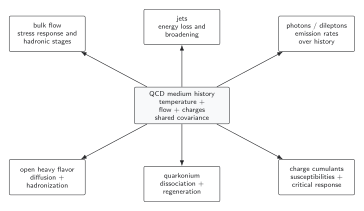
Quarkonium yields require a state and feed-down network, a matched potential, rate, transport, or open-system kernel, formation and dissociation, and regeneration from heavy-quark pairs. Open heavy flavor instead follows single-heavy-quark diffusion and hadronization, while charge cumulants probe conserved susceptibilities and critical response. All branches share medium-history and covariance uncertainties but not one generic likelihood. The diagram is schematic and not to scale.
In text, select an EFT hierarchy and evolution kernel whose Markov, secular, and scale assumptions are explicit; preserve trace and complete positivity when a Lindblad limit is claimed; then propagate formation, feed-down, cold-nuclear baselines, and regeneration through the same bulk history.
Exercises
Section titled “Exercises”1. Constant-rate solution. For constant and , solve the rate equation.
Solution
. At short time it retains the primordial value; at long time it approaches the equilibrium target. This limit assumes the target and medium remain constant.
2. Non-Hermitian loss. Show that alone does not preserve .
Solution
gives . The missing jump terms represent probability transferred to other states. A consistent reduced theory must include them or explicitly interpret the norm as a survival probability rather than a normalized density matrix.
Continue to multistage global inference.
References
Section titled “References”- Akamatsu, Yukinao. “Quarkonium in Quark–Gluon Plasma: Open Quantum System Approaches Re-Examined.” Progress in Particle and Nuclear Physics 123 (2022): 103932. DOI.
- Andronic, Anton, et al. “Heavy-Flavour and Quarkonium Production in the LHC Era: From Proton–Proton to Heavy-Ion Collisions.” European Physical Journal C 76 (2016): 107. DOI.
- Brambilla, Nora, et al. “Heavy Quarkonium in a Weakly-Coupled Quark–Gluon Plasma below the Melting Temperature.” Journal of High Energy Physics 2010, no. 9 (2010): 038. DOI.
- Rothkopf, Alexander. “Heavy Quarkonium in Extreme Conditions.” Physics Reports 858 (2020): 1–117. DOI.
Original QFT.org content:CC BY 4.0, unless an item supplies different terms. Third-party material retains its own terms.