

Bubble Growth and Wall Friction
Nucleation prepares a critical bubble; it does not determine its later speed. Bubble growth is a real-time wall–plasma problem in which the pressure difference drives the interface, nonequilibrium distributions provide friction, and energy–momentum conservation selects possible deflagration, detonation, hybrid, or runaway branches.
Required background. Use the complete nucleation rate for the initial bubble population and hydrodynamic effective-theory architecture for constitutive assumptions.
Helpful background. Conservation laws and hydrodynamic fields fix matching, while matrix-valued coherent transport is needed when flavor coherence affects friction or CP-violating sources.
Wall equation and microscopic friction
Section titled “Wall equation and microscopic friction”For an approximately planar wall moving steadily in the direction, a scalar background obeys a coarse-grained equation of the form
up to the declared metric and wall-coordinate convention. The equilibrium part of each distribution belongs in ; only the nonequilibrium deviation belongs in the friction term. Including the full in both places double counts thermal forces.
follows from kinetic, Kadanoff–Baym, Langevin, or lattice dynamics appropriate to the hierarchy of wall thickness , mean free path , and coherence lengths. A fluid moment expansion requires collisions fast enough to control higher moments. A ballistic treatment applies in a different limit. Interpolating between them with one fitted coefficient is a model whose calibration range must be stated.
Multiplying the wall equation by and integrating across a stationary wall gives a force-balance relation,
provided gradient and boundary terms are consistently included. A solution is a candidate terminal velocity, not a proof of stability or uniqueness.
Hydrodynamic matching
Section titled “Hydrodynamic matching”In the wall rest frame, ideal-fluid energy–momentum conservation requires continuity of and :
and label the fluid immediately ahead of and behind the wall, not contour branches. Eliminating the enthalpies gives the standard relations
They must be solved with an equation of state and entropy/shock conditions. A deflagration has a subsonic wall relative to the fluid ahead and generally a shock in front; a detonation is supersonic ahead and leaves the upstream fluid unperturbed; hybrid solutions contain both structures. “Subsonic” without specifying the frame and local sound speed is ambiguous.
The matching equations can admit multiple mathematical branches. Microscopic friction selects among them only after causal boundary conditions, shock matching, and stability are imposed. Jouguet constructions are special sonic endpoints, not universal predictions.
The wall is deliberately downstream of the rate in the diagram. A bounce calculation supplies neither a terminal velocity nor a hydrodynamic branch; those follow only after microscopic friction and plasma matching are solved consistently.
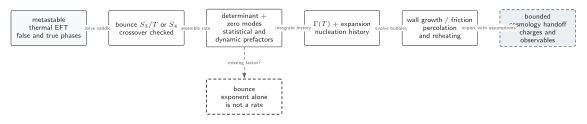
Wall growth starts from a licensed nucleation history but requires additional real-time input: microscopic friction, hydrodynamic matching, and a check for stationary or runaway behavior. Percolation and reheating then depend on the resulting radius history. The arrow therefore denotes a handoff of inputs, not a claim that the bounce fixes the wall speed. The diagram is schematic and not to scale.
The sections Wall equation and microscopic friction, Hydrodynamic matching, and Runaway and transition-radiation boundaries give the text and equation equivalent of the corresponding dynamical assumptions and failure tests.
Checked force-balance model
Section titled “Checked force-balance model”Suppose a phenomenological friction law is with constant and ignore hydrodynamic reheating. Force balance gives
The solution is subluminal and tends to one as . It is only an algebraic check: realistic depends on velocity, wall profile, temperature, and species, while hydrodynamic backreaction changes across the wall. Using this formula outside its calibration does not establish a runaway.
Runaway and transition-radiation boundaries
Section titled “Runaway and transition-radiation boundaries”A wall runs away only if the net force remains positive as grows. The leading ultra-relativistic plasma friction can saturate in some approximations, motivating a mean-field pressure criterion Bödeker and Moore 2009. At higher , transition radiation and gauge-boson splitting can produce friction growing with and prevent or delay runaway. The appropriate criterion depends on the theory and hierarchy; a large vacuum energy or a missing terminal solution in a low-velocity ansatz is not proof of indefinite acceleration.
Hydrodynamic and corrugation instabilities can also invalidate a steady planar solution. The wall thickness and profile may change with velocity, feeding back into friction. A complete claim therefore includes branch stability and, when needed, multidimensional evolution.
Gauge, frame, and closure checks
Section titled “Gauge, frame, and closure checks”The wall profile in a gauge-fixed field coordinate is not observable. Friction and driving pressure must be computed in a consistent EFT or shown to satisfy gauge cancellations at the claimed order. Collision operators must conserve the charges and energy used in hydrodynamic matching; relaxation-time ansätze require projected zero modes or matching conditions.
Use the thermal transition validity table to record the equation of state, frame, friction closure, gauge/EFT order, branch, shock, and stability evidence.
Failure tests
Section titled “Failure tests”- Solve all admissible hydrodynamic branches rather than seeding only the desired one.
- Vary the distribution ansatz or moment order and test collision-operator conservation.
- Compare with mean free paths and coherence lengths.
- Propagate gauge and scale changes through pressure, profile, and friction together.
- Perturb the steady solution to test branch stability.
- Check ultra-relativistic friction before claiming runaway.
Exercise
Section titled “Exercise”Derive the two velocity relations from the flux equations by eliminating .
Solution
Divide appropriate linear combinations of the energy and momentum flux equations and use . Straight algebra yields and . Their signs require a consistent orientation of both velocities in the wall frame.
Continue
Section titled “Continue”Pass the validated, possibly time-dependent growth law to percolation, reheating, and completion. Do not replace it by a constant without a sensitivity test.
References
Section titled “References”- Bödeker, D., and Moore, G. D. (2009). “Can Electroweak Bubble Walls Run Away?” Journal of Cosmology and Astroparticle Physics 2009(05), 009. arXiv:0903.4099; DOI.
- Espinosa, J. R., Konstandin, T., No, J. M., and Servant, G. (2010). “Energy Budget of Cosmological First-Order Phase Transitions.” Journal of Cosmology and Astroparticle Physics 2010(06), 028. arXiv:1004.4187; DOI.
- Moore, G. D., and Prokopec, T. (1995). “How Fast Can the Wall Move? A Study of the Electroweak Phase Transition Dynamics.” Physical Review D 52, 7182–7204. arXiv:hep-ph/9506475; DOI.
Original QFT.org content:CC BY 4.0, unless an item supplies different terms. Third-party material retains its own terms.