

Retarded, Advanced, and Keldysh Bases
The Keldysh rotation converts four contour components into response, advanced propagation, and state-dependent fluctuations. Causality then appears as a structural zero rather than a cancellation among branches. The rotation is exact, but its factors and the fermionic barred-field convention must be declared locally.
Required background. Use the closed-time-path generating functional for branch signs and thermal propagators and spectral representations for Wightman functions.
Helpful background. Causal and statistical propagators interpret the independent rotated components.
Bosonic branch matrix
Section titled “Bosonic branch matrix”Define and
In terms of Wightman functions,
, and . Therefore has future support, for a Hermitian scalar, and carries the anticommutator.
With and ,
The lower-right zero follows from . The common alternative rotation is displayed in Kamenev and Levchenko 2009, § 2. If one uses it, the factor moves; a copied matrix with unmatched field and source rotations gives incorrect vertices even if its causal support looks plausible.
The inverse kernel has the complementary structure
where fixes statistical data or noise. Inverting a block matrix without respecting operator order is unsafe when kernels do not commute.
Complete rotation check
Section titled “Complete rotation check”Let
Because the return branch enters source differentiation with a sign metric , the correlator transformation is not a naive unless that metric has already been included in the definition. Expanding each correlator into the four branch correlators is the safest derivation. It reproduces the matrix above and provides an effective convention consistency check.
The diagram shows where the basis rotation sits: it follows the doubled contour and precedes any identification of retarded, advanced, or statistical components. The labels , , and are therefore meaningful only after the local normalization has been fixed and checked.
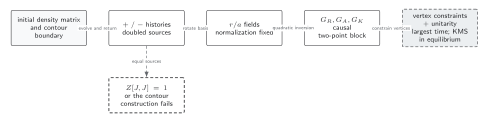
The transformation is a linear change of contour variables, but factors of two and the placement of , , and depend on the declared field, source, and Green-function conventions. Equal-source normalization and the full branch-to- rotation test those factors. Kernel inversion produces the two-point propagator block; interaction vertices must be rotated separately. Fermions require their own barred-field rotation; the bosonic box does not silently fix it. The diagram is schematic and not to scale.
The sections Bosonic branch matrix, Complete rotation check, and Fermionic rotation provide the text and equation equivalent of the matrices and normalization checks in the central boxes.
Fermionic rotation
Section titled “Fermionic rotation”For Grassmann fields it is convenient to rotate barred and unbarred variables differently. One common Larkin–Ovchinnikov choice is
Then the fermion propagator can be arranged as
The reversed sign pattern for barred fields incorporates the contour metric and Grassmann ordering. Fermionic Wightman and KMS relations carry the antiperiodic sign, so a bosonic rotation formula cannot be imported by changing only to . State the ordering of and , the definition of , and the equal-time prescription before comparing formulas.
Checked causal example
Section titled “Checked causal example”For a free oscillator,
with the present convention. is independent of while is not. The overall sign of tracks the source and Green-function definitions; its support and the branch identities are invariant checks.
Failure tests
Section titled “Failure tests”- Reconstruct all four branch components from , , and and recover the original matrix.
- Check before the source time and the component exactly zero.
- Verify the inverse matrix by both left and right multiplication for nonlocal kernels.
- For fermions, test the equal-time anticommutator and antiperiodic KMS sign.
- Keep contact terms when derivatives act on step functions.
Exercise
Section titled “Exercise”Use the branch identity to derive .
Solution
Expanding gives one half of . Substitute ; the result is .
Continue
Section titled “Continue”Interpret the matrix through causal and statistical propagators and apply the rotation to interaction vertices on Keldysh diagrammatics.
References
Section titled “References”- Kamenev, A., and Levchenko, A. (2009). “Keldysh Technique and Non-Linear Sigma-Model: Basic Principles and Applications.” Advances in Physics 58, 197–319. arXiv:0901.3586; DOI.
- Keldysh, L. V. (1965). “Diagram Technique for Nonequilibrium Processes.” Soviet Physics JETP 20, 1018–1026. JETP PDF.
Original QFT.org content:CC BY 4.0, unless an item supplies different terms. Third-party material retains its own terms.