

Hydro+ and Parametrically Slow Critical Modes
Hydro+ extends hydrodynamics when a nonconserved critical fluctuation relaxes as slowly as sound and diffusion. Retaining that mode restores a local enlarged theory and turns the ordinary bulk viscosity into a frequency-dependent response that interpolates between equilibrated and frozen equations of state. The construction is controlled only when the slow rate is separated from all other omitted microscopic rates.
Required background. Dynamic Scaling and Critical Slowing Down and Dynamic Universality Classes supply the critical rate and mode coupling. The Hydrodynamic Limit and Slow Variables supplies the promotion criterion.
Helpful background. Conserved-Charge Fluctuations and Criticality supplies the QCD-facing observable boundary.
One slow mode and partial equilibrium
Section titled “One slow mode and partial equilibrium”Let denote a coarse-grained fluctuation variable, such as a long-wavelength two-point amplitude, with partial-equilibrium entropy . Its conjugate restoring force vanishes at
A minimal comoving equation is
with KMS-matched noise . Ordinary hydrodynamics assumes and replaces algebraically by . Near a critical point, for the critical wave-number band, so that elimination becomes singular.
Stephanov and Yin formulate Hydro+ with a continuum of fluctuation modes, a generalized entropy, and a relaxation kernel while preserving the conservation laws Stephanov and Yin 2018, §§II–IV, Open PDF. The single scalar here isolates the response mechanism; a quantitative critical calculation must restore the wave-number-dependent spectrum and dynamic universality class.
Frequency-dependent pressure
Section titled “Frequency-dependent pressure”Linearize at fixed charge for clarity. Let
The relaxation equation gives
Therefore
with
and
For , the mode equilibrates and sound sees . For , it is frozen and sound sees . In the common softening case , rewrite
The second term is a frequency-dependent bulk response,
Its static limit grows as , explaining critical bulk enhancement. At fixed nonzero , however, the response remains frequency resolved; replacing it by an arbitrarily large constant viscosity loses the slow pole.
Modified sound modes
Section titled “Modified sound modes”Including ordinary sound attenuation , the longitudinal determinant is schematically
Together with the relaxation pole near , it contains avoided crossings and frequency-dependent attenuation. A complete calculation evolves energy, charge, momentum, and the critical spectrum together and checks susceptibilities for positivity.
Hydro+ is not merely “hydrodynamics with a large bulk viscosity.” It preserves the transient mode whose elimination generated that viscosity and can therefore remain predictive when . Rajagopal et al. demonstrate the resulting evolution and fluctuation backreaction in expanding backgrounds Rajagopal et al. 2020, §§2–5, Open PDF.
Matching and validity
Section titled “Matching and validity”A controlled implementation must state:
- which critical eigenmode or correlator represents;
- its equilibrium susceptibility and -dependent relaxation rate;
- the dynamic universality class and conserved-mode coupling;
- how fluctuations already present in stochastic hydrodynamics are excluded from to avoid double counting;
- the nonlinear closure and regulator;
- the causal completion of the enlarged dissipative equations;
- the range in which is slow but all omitted rates remain fast.
Outside the critical region the mode becomes fast and should match back to ordinary hydrodynamics. At the critical point, nonlinear fluctuation interactions can invalidate a Gaussian single-mode truncation. Converting Hydro+ fluctuations into particle cumulants additionally requires a freeze-out map; it is not fixed by the fluid equations.
The methodological evidence cutoff is 10 August 2026. This page does not assert that a QCD critical point exists at a particular location, that a single-mode closure is quantitatively adequate for a collision, or that a fluid fluctuation transfers unchanged to an observed particle cumulant.
The lower-right Hydro+ branch is drawn as a parametrically slow addition to the ordinary core. Inspect that wording: the extra critical variable is retained because its relaxation rate enters the hydrodynamic window, not because every nonconserved fluctuation deserves a new equation.
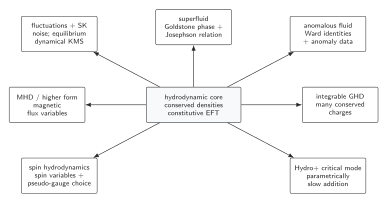
Hydro+ retains a nonconserved critical mode when critical slowing makes its rate comparable to hydrodynamic frequencies. Its relaxation changes the frequency-dependent stiffness and bulk response, while the ordinary theory is recovered when the mode equilibrates rapidly. The diagram is schematic and does not establish a critical point, select a single-mode closure, or map fluid fluctuations to measured cumulants.
In text: specify the slow correlator or order parameter, its partial-equilibrium entropy, coupling to pressure, and relaxation rate; evolve it alongside the conserved fields; and match back to ordinary hydrodynamics for . Outside the critical scaling window this additional branch should be removed.
Exercise
Section titled “Exercise”Expand for and identify the static bulk-viscosity enhancement.
Solution
Using
gives
Since a bulk pressure is and linear energy conservation gives , the coefficient is
It is positive in the softening case.
Common pitfalls
Section titled “Common pitfalls”Integrating out the mode at . That is precisely where the local bulk-viscosity approximation fails.
Double counting critical fluctuations. The Hydro+ variable and stochastic hydrodynamic loops require a shared mode split and regulator.
Equating a fluid fluctuation with a measured particle cumulant. Freeze-out, conservation, acceptance, and decays intervene.
Chapter synthesis
Section titled “Chapter synthesis”The chapter’s extensions all obey one rule: promote a variable only when symmetry or a parametric hierarchy makes it slow, then match its constitutive response, fluctuations, sources, and regulator in the same formulation. The next chapter turns those controlled response functions into transport coefficients and evidence-bounded inference.
References
Section titled “References”-
Rajagopal, Krishna, Gregory Ridgway, Ryan Weller, and Yi Yin. 2020. “Hydro+ in Action: Understanding the Out-of-Equilibrium Dynamics Near a Critical Point in the QCD Phase Diagram.” Physical Review D 102: 094025. DOI. Open PDF.
-
Stephanov, Mikhail, and Yi Yin. 2018. “Hydrodynamics with Parametrically Slow Modes.” Physical Review D 98: 036006. DOI. Open PDF.
Original QFT.org content:CC BY 4.0, unless an item supplies different terms. Third-party material retains its own terms.