

Screened and Variational Thermal Expansions
Screened and variational expansions reorganize perturbation theory around a solvable action containing selected medium effects, then add a compensating interaction so the exact theory is unchanged. They can improve finite-order behavior, but the introduced mass or kernel is auxiliary until a physical pole or matched observable establishes otherwise. Optimization dependence is therefore part of the truncation error, not new thermodynamic data.
The screened scalar expansion and its compensating mass insertion were introduced by Karsch, Patkós, and Petreczky 1997, pp. 69–73.
Required background. Ring and Daisy Resummation supplies the simplest infrared reorganization. Helpful background. Thermal Counterterms and Renormalization-Group Invariance supplies the ultraviolet consistency test.
Add and subtract the same physics
Section titled “Add and subtract the same physics”For scalar theory, introduce an arbitrary positive mass and a bookkeeping parameter :
At this is the original massless theory. At finite order in , propagators contain while the compensating mass insertion is treated as an interaction. Keeping one without the other changes the theory and double counts the screened contribution.
The same architecture underlies screened perturbation theory, optimized perturbation theory, and more elaborate gauge-covariant reorganizations. In hard-thermal-loop perturbation theory the added solvable structure is a gauge-invariant HTL effective action rather than a local scalar mass. The hot-gauge construction and its scale hierarchy are developed in Hot Gauge Theory and Plasma EFTs.
Optimization is a prescription
Section titled “Optimization is a prescription”The exact result is independent of , but a truncated approximation is not. Common prescriptions include
and choosing so a specified higher-order correction vanishes (fastest apparent convergence). One may instead use a perturbatively matched screening mass. These choices answer different finite-order questions.
A stationarity equation can have several branches, complex solutions, or no solution. Selecting a branch by continuity, free-energy comparison, or asymptotic matching is additional information and must be reported. Discarding an inconvenient branch without a criterion understates the method dependence.
Renormalization and gauge consistency
Section titled “Renormalization and gauge consistency”Reorganization changes propagators and vertices but not the ultraviolet theory at . At each truncation one must include the counterterms required by the reorganized expansion and verify that residual renormalization-scale dependence begins beyond the claimed order. An optimized result that is numerically smooth but ultraviolet inconsistent has not improved the theory.
In a gauge theory, inserting a local mass into selected gauge propagators generally violates Ward identities. A gauge-covariant HTL reorganization avoids that elementary error, but finite-order thermodynamic potentials and optimization prescriptions still carry truncation, scale, and sometimes gauge or scheme sensitivity. No auxiliary parameter becomes an observable merely because its optimized value is stable.
Evidence for improvement
Section titled “Evidence for improvement”A convincing convergence claim compares more than two successive central values. Record
- the strict and reorganized expansions through matched orders;
- renormalization- and factorization-scale variation;
- auxiliary-parameter prescription and every admissible branch;
- sensitivity to the operator or kernel included in the solvable action;
- agreement with a controlled weak-coupling limit or independent benchmark; and
- the region where successive differences cease to decrease.
For a quantity , a useful diagnostic is
where spans the declared scale and optimization choices. A small over a narrow prescription family does not bound missing operators or nonperturbative sectors.
The shared matching and subtraction table records the auxiliary structure and compensating term.
Common pitfalls
Section titled “Common pitfalls”Calling the thermal mass. It is a variational coordinate unless a separately defined pole, screening length, or matching condition identifies it with a physical mass definition.
Reading apparent convergence as proof. Several nearby truncations can share the same omitted sector. Scale variation, prescription variation, and an independent benchmark test different failure modes.
The schematic below organizes the relationships used on this page. Inspect it with this question in mind: How do ring, daisy, screened, variational, and EFT reorganizations differ?
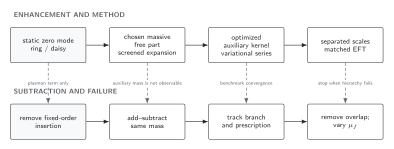
Each reorganization targets a named enhanced sector and must include its compensating subtraction; optimization, factorization-scale, gauge, and strong-soft-sector tests decide whether apparent convergence is meaningful. The method columns are alternatives or partially overlapping reorganizations, not a mandatory sequence: horizontal arrows organize increasing structural scope, while vertical dashed arrows pair each method with its subtraction or failure check. The diagram is schematic and not to scale.
The surrounding discussion supplies the relevant equations and checks in text form; the figure is a navigational summary.
Exercise
Section titled “Exercise”Show that the exact generating functional at is independent of , and explain why a finite-order truncation is not.
Solution
At , the added term and the compensating interaction cancel algebraically before any expansion, so the exact action contains no . Truncating the series retains only part of the compensating insertions; the cancellation is incomplete and residual dependence measures one component of the truncation ambiguity.
References
Section titled “References”- Andersen, Jens O., Eric Braaten, and Michael Strickland. “Hard-Thermal-Loop Resummation of the Free Energy of a Hot Gluon Plasma.” Physical Review Letters 83, no. 11 (1999): 2139–2142. doi:10.1103/PhysRevLett.83.2139.
- Karsch, F., A. Patkós, and P. Petreczky. “Screened Perturbation Theory.” Physics Letters B 401, nos. 1–2 (1997): 69–73. doi:10.1016/S0370-2693(97)00392-4.
- Stevenson, Paul M. “Optimized Perturbation Theory.” Physical Review D 23, no. 12 (1981): 2916–2944. doi:10.1103/PhysRevD.23.2916.
Original QFT.org content:CC BY 4.0, unless an item supplies different terms. Third-party material retains its own terms.