

Silver Blaze Behavior, Thresholds, and Density Instabilities
At zero temperature, observables remain independent of chemical potential while the vacuum continues to minimize . The endpoint of this Silver Blaze regime is the smallest energy per unit charge available to the system, with the charge sign and competing sectors specified. At threshold the ground state changes: bosons may condense, fermions form a Fermi surface, paired or inhomogeneous phases may intervene, and susceptibilities reveal the loss of stability of the continued low-density branch.
The cancellation mechanism behind zero density below threshold is analyzed by Cohen 2003, entire Letter.
Required background. Finite-Density Correlators and Charge Susceptibilities supplies response diagnostics. Chemical Potentials and Finite-Density Ensembles supplies grand energies. Helpful background. Thermodynamic Limits, Phases, and Ensemble Equivalence fixes limit order and phase selection.
Ground-state threshold
Section titled “Ground-state threshold”Let have and energy . At , the grand-canonical ground state minimizes
For positive-charge onset, define
If , every charged state has , so the ground state and all neutral ground-state observables are unchanged. This is Silver Blaze behavior: the action or propagators can depend explicitly on while physical zero-temperature observables do not.
The threshold is not always the lightest one-particle mass divided by charge. A bound state, pair, soliton, nuclear droplet, or spatially modulated phase can minimize . The finite-volume gap approaches the thermodynamic threshold only after its volume and boundary corrections are controlled.
Contour-shift explanation
Section titled “Contour-shift explanation”In the displayed and convention, a chemical potential shifts
At , the continuous contour can be translated back if the integrand is analytic in the intervening strip and decays at infinity. The observable is then independent. Reversing the Euclidean Fourier or charge convention reverses the displayed shift and the contour displacement together. Once a pole or cut crosses the contour, the deformation acquires a residue or discontinuity and density turns on.
This argument makes the failure test explicit: locate the nearest charged singularity in the correct interacting channel. A regulator that obstructs the contour shift or a truncation that moves singularities can produce spurious early onset.
Onset mechanisms
Section titled “Onset mechanisms”Bosonic condensation. For a stable charged boson the normal occupation diverges as reaches the lowest excitation energy. Interactions determine the condensate and new collective modes.
Fermi surface. For fermions, modes satisfying fill at . The onset density grows from the newly formed Fermi surface rather than a divergent single mode.
Pairing. An attractive channel can become unstable to a condensate of charge or another composite before a naive one-particle continuation remains valid. The relevant susceptibility is the pair channel.
Inhomogeneous order. A response eigenvalue may soften first at . Checking only the homogeneous Hessian misses density waves or modulated condensates.
First-order onset. The global minimum can jump before the analytically continued low-density branch loses local stability. Metastability and spinodals are not the equilibrium transition point.
The schematic below organizes the relationships used on this page. Inspect it with this question in mind: Which charge structures license chemical potentials or generalized equilibrium states?
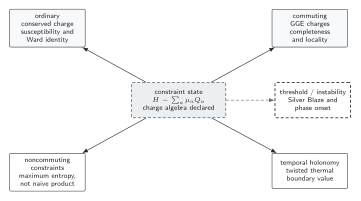
A grand-canonical state requires conserved charges and a declared algebra; commuting integrable charges, noncommuting constraints, temporal holonomies, and density thresholds demand distinct constructions and checks. Connections classify the charge structure and required construction; their direction is organizational, not a causal-time ordering. Dashed marks show qualifications and failure boundaries. The diagram is schematic and not to scale.
The surrounding discussion supplies the relevant equations and checks in text form; the figure is a navigational summary.
Limit and regulator tests
Section titled “Limit and regulator tests”Silver Blaze is a statement. At any nonzero , charged excitations contribute exponentially small factors . A careful calculation declares the order among , , continuum removal, and source removal.
To validate onset:
- compute or bound the lowest in all relevant sectors;
- verify the contour shift until the first physical singularity;
- compare canonical-sector energies with grand-canonical density;
- scan susceptibility eigenvalues over momentum and pairing channels;
- distinguish global phase crossing from local spinodal loss;
- repeat across volume and regulator; and
- test a solvable benchmark before extrapolating a method into an inaccessible regime.
The schematic below organizes the relationships used on this page. Inspect it with this question in mind: What can different finite-density access methods establish?
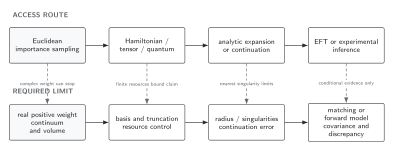
Euclidean, Hamiltonian, analytic, EFT, and experimental routes have different sign, overlap, continuation, volume, and model assumptions, so each supports a different ceiling on finite-density claims. The method columns are alternatives rather than stages of a universal pipeline; horizontal arrows organize cross-method comparison. Dashed marks show qualifications and failure boundaries. The diagram is schematic and not to scale.
The surrounding discussion supplies the relevant equations and checks in text form; the figure is a navigational summary.
Exercise
Section titled “Exercise”For a free complex scalar of mass and charge , identify and explain why using the normal-phase Bose distribution for is invalid.
Solution
The lowest charged excitation has and charge , so . At threshold the zero-momentum grand energy vanishes and its occupation diverges in the thermodynamic limit. Beyond it, is not bounded in the assumed free normal phase; a condensate and interactions must be included.
References
Section titled “References”- Cohen, Thomas D. “Functional Integrals for QCD at Nonzero Chemical Potential and Zero Density.” Physical Review Letters 91 (2003): 222001. doi:10.1103/PhysRevLett.91.222001; Open PDF.
- Son, D. T., and M. A. Stephanov. “QCD at Finite Isospin Density.” Physical Review Letters 86, no. 4 (2001): 592–595. doi:10.1103/PhysRevLett.86.592.
Original QFT.org content:CC BY 4.0, unless an item supplies different terms. Third-party material retains its own terms.