

Trace, Positivity, and Causal Consistency
An effective open-field evolution is physically interpretable only on a declared operator domain and only after trace, Hermiticity, positivity, causality, constraints, and approximation error have been checked independently. These conditions are not interchangeable. Stable retarded poles do not prove complete positivity; trace preservation does not prove positivity; and agreement on Gaussian states does not certify a map on the full field algebra.
Required background. Lindblad field dynamics gives the manifest CPTP semigroup form at a regulator, and open Schwinger–Keldysh actions give the action identities for response and noise. Helpful background. Renormalization of open dynamics asks whether the same conditions survive cutoff changes.
Specify the object before testing it
Section titled “Specify the object before testing it”First state whether the proposal is
- a map from a fixed initial time;
- a time-local generator ;
- a memory equation with kernel ;
- a Schwinger–Keldysh action at a stated truncation; or
- a non-Hermitian amplitude or conditional trajectory.
Also state the regulator, Hilbert or operator space, allowed initial states, gauge or charge sector, and time interval. Complete positivity is a property of a linear map on an operator algebra; it is not defined by the behavior of one solution curve alone. For initially correlated system and environment states, the reduced map may exist only on a compatibility domain, so extending it to arbitrary density matrices is an additional choice.
Algebraic checks
Section titled “Algebraic checks”For a generator, trace preservation is
and Hermiticity preservation is
Test these as operator identities with the regulator in place. A numerical observation that remains close to one for a selected state can miss a state-dependent defect or a cancellation broken by cutoff removal.
For a finite-dimensional map, positivity means for every . Complete positivity requires to remain positive for every ancillary dimension ; it is enough to take equal to the system dimension. With , the Choi criterion is
This gives a decisive finite-cutoff test Choi 1975. In large field Hilbert spaces, use symmetry blocks and converged occupation cutoffs, and report the smallest Choi eigenvalue with numerical error. Sampling random states is only a lower-power test.
For a time-homogeneous generator, finding a positive Kossakowski matrix in a well-defined GKSL representation proves the finite-dimensional semigroup is CPTP. A Redfield generator without that representation can still approximate some observables, but it must not be advertised as a completely positive theory.
The non-Hermitian adversarial test
Section titled “The non-Hermitian adversarial test”Suppose a proposed unconditional equation is
with and . Then
Unless the last expression vanishes for every allowed state, this is not trace-preserving reduced dynamics. If , choose jump operators satisfying
and add the recycling term . The result is trace preserving and has GKSL form. The factorization is not unique, so the anti-Hermitian Hamiltonian does not determine which environmental records or final states receive the lost probability. If has a negative eigenvalue, no Lindblad jump factorization with that exists.
For , the jump turns exponential no-click norm loss into amplitude damping. This exposes the missing physical content: the no-jump equation is a valid conditional branch, while the recycling term and its associated fluctuations complete the unconditional dynamics.
Causality, locality, and constraints
Section titled “Causality, locality, and constraints”For a relativistic response channel, check the support of
Retarded time ordering requires for ; microcausality further requires the commutator to vanish at spacelike separation for local observables. Poles in the lower half-plane establish temporal stability and retarded analyticity under suitable falloff, but a spatially nonlocal kernel can still violate the desired causal cone. Inspect real-space support or derive a regulator-uniform propagation bound.
In an action, verify , contour reality, latest-time zeros, and noise-kernel positivity. A regulator that violates these identities and restores them only by an untested extrapolation does not provide a finite-cutoff consistency certificate.
For a conserved observable , require
For gauge systems, the evolution must preserve the physical state space or map the gauge-invariant algebra into itself. Checking only gauge-fixed propagator transversality can miss a jump that violates Gauss’s law. Boundary and edge degrees of freedom must be included when they are part of the chosen algebraic split.
A reproducible consistency certificate
Section titled “A reproducible consistency certificate”For any proposed generator or action, record the following results.
- Domain: cutoff, volume, local occupation, operator smearing, and allowed state set.
- Normalization: or as an exact regulated identity.
- Hermiticity: operator or contour-reality identity.
- Complete positivity: positive Kossakowski factorization, Choi test, or an explicit statement that only restricted positivity was tested.
- Causality and locality: support test for response plus the assumptions behind any propagation bound.
- Constraints: charge, gauge, and symmetry identities under the adjoint evolution.
- Dynamics: trace, minimum eigenvalue, conserved quantities, and response for adversarial initial states.
- Stability: convergence under cutoff, volume, timestep, operator-basis, and parameter variations.
- Approximation error: comparison with a microscopic, exactly solvable, or higher-order result in the claimed regime.
The canonical open-dynamics consistency and evidence matrix classifies what conclusion these tests support. A reproducible calculation can execute finite-dimensional Choi, memory, and running-coupling checks; its scan does not prove properties outside the declared cutoff and state domain.
Restricted agreement is not map agreement
Section titled “Restricted agreement is not map agreement”Two generators may agree on one-point functions, on all diagonal density matrices, or on Gaussian covariance matrices while differing on coherences, ancilla correlations, or higher moments. A map reconstructed from a restricted state family should be labeled accordingly. To upgrade the claim, enlarge the preparation and observable set or prove an operator identity.
This distinction is especially important for field truncations. A covariance matrix satisfying the uncertainty relation proves positivity of a Gaussian state, not positivity of a nonlinear evolution on non-Gaussian states. Likewise, a low-energy scattering or response match constrains selected correlators, not the entire reduced channel.
Common failure modes
Section titled “Common failure modes”Testing stability instead of causality. Decay in time does not prohibit instantaneous or acausal spatial response.
Testing positivity without an ancilla. The transposition map is positive but not completely positive; spectator entanglement exposes the failure.
Completing loss with an arbitrary scalar noise. The recycling operators determine which states receive probability and must respect symmetries and domains.
Reporting a cutoff Choi test as a continuum theorem. Repeat it as the field and occupation cutoffs change and combine it with renormalized operator control.
The last node of the reduction map is deliberately plural: trace, Hermiticity, complete positivity, causality, and cutoff control are logically distinct tests.
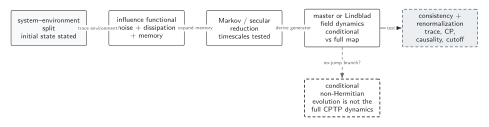
No single algebraic check certifies an open-QFT generator. Trace preservation follows from the balance of loss and recycling, complete positivity concerns extensions by arbitrary ancillas, causal response concerns commutator support, and renormalization controls the cutoff limit. The dashed no-jump branch omits recycling and is not the full CPTP map. The diagram is schematic and not to scale.
The corresponding procedure is to verify each condition on the regulated physical algebra, repeat the tests as field and occupation cutoffs change, and distinguish a failure of a chosen time-local representation from a failure of the dynamical map itself.
Exercises
Section titled “Exercises”Show that matrix transposition is positive but not completely positive on a qubit.
Solution
Transposition preserves the eigenvalues of a single positive matrix, so it is positive. Apply transposition to one half of the Bell state . The partial transpose has eigenvalues , so the extended map is not positive. Hence transposition is not completely positive.
Why is necessary for the no-jump Hamiltonian of a Lindblad completion?
Solution
Any Lindblad completion has . For every , . A negative eigenvalue therefore cannot arise from jump loss.
Continue to renormalization
Section titled “Continue to renormalization”Renormalization of open effective dynamics applies these checks to the counterterm basis and RG flow. Driven criticality shows why Liouvillian-gap and finite-size evidence must be added before interpreting a consistent generator as a phase transition.
References
Section titled “References”- Breuer, Heinz-Peter, and Francesco Petruccione. The Theory of Open Quantum Systems. Oxford: Oxford University Press, 2002. doi:10.1093/acprof:oso/9780199213900.001.0001.
- Choi, Man-Duen. “Completely Positive Linear Maps on Complex Matrices.” Linear Algebra and Its Applications 10 (1975): 285–290. doi:10.1016/0024-3795(75)90075-0.
- Gorini, Vittorio, Andrzej Kossakowski, and E. C. George Sudarshan. “Completely Positive Dynamical Semigroups of N-Level Systems.” Journal of Mathematical Physics 17 (1976): 821–825. doi:10.1063/1.522979.
- Lindblad, Göran. “On the Generators of Quantum Dynamical Semigroups.” Communications in Mathematical Physics 48 (1976): 119–130. doi:10.1007/BF01608499.
Original QFT.org content:CC BY 4.0, unless an item supplies different terms. Third-party material retains its own terms.