

Perturbative QFT and Scattering
Perturbative scattering is a chain of claims, not a synonym for drawing diagrams. One begins with a declared action, state prescription, gauge choice, and normalization; constructs amplitudes either from perturbative rules or on-shell data; checks their unitarity and analytic structure; controls ultraviolet and infrared singular regions; and finally specifies a measurement for which cancellation, factorization, integration, and uncertainty can be defended. A failure at any link can invalidate the prediction even when the algebraic amplitude is finite.
This volume develops that chain in flat-spacetime perturbative QFT. It covers conventional and on-shell tree construction, loop-integral methods, analytic S-matrix constraints, soft and collinear structure, and precision observables. It does not assume that every QFT has stable in/out particles, and it does not turn model-specific collider phenomenology, renormalization theory, rigorous scattering existence, or active amplitude programs into consequences of notation.
Helpful background. Wick’s theorem supplies the free-field contraction identity used inside the Dyson expansion. The pole-to-particle scattering handoff identifies the spectral assumptions behind stable external states. Hilbert-space positivity and unitary evolution separates physical unitarity from gauge-fixed bookkeeping, and branches, sheets, and monodromy prepares the analytic continuation used for thresholds, cuts, and resonances. None is a prerequisite for using this page as a route map.
From interacting data to a physical prediction
Section titled “From interacting data to a physical prediction”The shortest conventional route is
For two incoming particles, the final state sum has the convention-explicit form
where is the invariant flux, removes identical-state overcounting, the bar denotes the declared discrete-state sums and initial averages, and is the measurement function. A decay rate replaces by for a parent of mass . Thus is a convention-dependent stripped amplitude, not yet an observable. The S-matrix and LSZ portion of this chain is developed pedagogically in Schwartz 2014, chs. 5–7, pp. 56–103; the same text’s unitarity, infrared, on-shell, and factorization chapters make clear why later links cannot be inferred from the first three alone Schwartz 2014, chs. 20, 24, 27, and 36, pp. 355–380, 452–477, 534–559, and 776–810.
The route map below separates four useful trunks. Its vertical layout is for legibility: the infrared-observability and structural-frontier routes branch from stable analytic inputs, and a reader need not pass through every chapter.
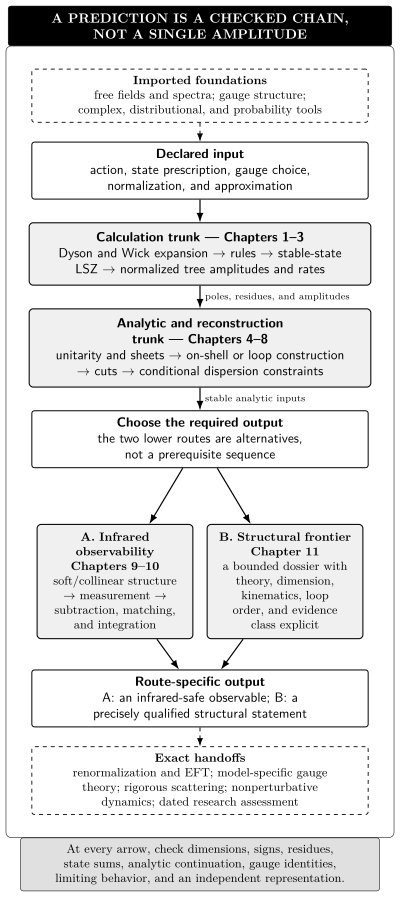
Architecture of the volume. Chapters 1–3 construct normalized amplitudes and rates; Chapters 4–8 test and reconstruct analytic data; Chapters 9–10 define infrared-safe observables; and Chapter 11 records bounded structural claims. The two lower routes are alternatives, not a mandatory sequence. Every transition requires convention, state, analytic, gauge, limiting-case, and independent-representation checks. Schematic, not to scale.
| Route trunk | Input | Output | Stop condition |
|---|---|---|---|
| Calculation, Chapters 1–3 | Action, free-field preparation, stable-particle assumptions | Normalized tree amplitude, form factor, cross section, or decay rate | Stop before loop, infrared, or model-specific claims that the chosen route has not checked |
| Analytic and reconstruction, Chapters 4–8 | Amplitudes plus state, sheet, growth, and regulator data | Unitarity relation, on-shell construction, reduced loop family, cut reconstruction, or conditional dispersive constraint | Stop when a theorem hypothesis, boundary term, branch choice, rational term, or subtraction remains uncontrolled |
| Infrared observability, Chapters 9–10 | Singular amplitudes plus a declared measurement | IRC-safe perturbative observable with cancellation, factorization, integration, matching, and uncertainty evidence | Stop if inclusivity, Glauber exchange, power corrections, or numerical validation is missing |
| Structural frontier, Chapter 11 | Stable amplitude objects and a declared theory/kinematic domain | A proved, constructed, observed, conjectured, limited, or open statement | Stop before generalizing beyond the verified theory, dimension, multiplicity, kinematics, or loop order |
What belongs here—and what does not
Section titled “What belongs here—and what does not”The volume’s canonical objects are perturbative scattering amplitudes, their stable-state reduction, their singular and analytic structure, and the observables built from them. It treats:
- Dyson and Wick expansion, graph combinatorics, momentum-space rules, fermion signs, derivative/contact terms, and gauge-fixed amplitude checks;
- in/out states, S- and T-matrix conventions, LSZ for stable isolated poles, invariant kinematics and phase space, rates, and local-operator form factors;
- diagrammatic and on-shell tree construction, physical poles, factorization, crossing, polarization, color, and constructibility tests;
- loop-integral representations and reduction, with the regulator, branch, ultraviolet/infrared origin, and numerical error exposed;
- S-matrix and partial-wave unitarity, thresholds, sheets, resonances, Landau candidates, physical cuts, generalized cuts, and dispersion relations; and
- soft/collinear limits, inclusive cancellation, factorization and resummation interfaces, measurement functions, subtraction, Monte Carlo integration, matching, and theory-uncertainty validation.
The boundary is equally important. Renormalization and Effective Field Theory develops counterterm construction, subtraction schemes, beta functions, EFT matching, operator mixing, and the renormalization-group machinery used by factorization. Symmetry and Gauge Structure develops gauge orbits, Faddeev–Popov and BRST/BV structure, generalized Wilson operators, and anomalies; this volume imports those structures to construct and test amplitudes. Gauge Theories and the Standard Model supplies model-specific rule catalogs, parton distributions, collider processes, confinement, and phenomenology. Mathematical QFT treats scattering existence, Haag–Ruelle construction, asymptotic completeness, and theorem-level analyticity bounds.
An ordinary external line therefore represents a stable asymptotic particle supported by the needed pole and wave-operator assumptions. A resonance pole, infraparticle, confined colored excitation, or state in a spacetime without suitable asymptotic regions is not repaired by attaching an LSZ factor. Resonance observables, dressed states, nonperturbative scattering, finite-volume extraction, and curved-spacetime in-in observables each receive their own qualified handoff.
Choose a route by the question you need to answer
Section titled “Choose a route by the question you need to answer”| Reader’s task | Shortest useful route | Capability at the exit |
|---|---|---|
| Derive rules and a first rate from an action | Chapters 1, 2, and 3, then the optical theorem in Chapter 4 | Produce a normalized scalar, fermion, or vector tree rate and check a physical forward-unitarity identity |
| Construct a tree amplitude on shell | Stable-state and factorization preparation in Chapters 2–4, then Chapter 5 | Fix little-group weights and residues, run a recursion, and identify missing contact or boundary data |
| Evaluate and continue a loop family | Chapter 6 followed by Chapter 7 | Reduce a family, impose boundary data, continue it across a cut, and compare an independent numerical representation |
| Derive a dispersive or positivity statement | Analytic domains in Chapter 4, then Chapters 7 and 8 | State the contour, sheets, subtractions, positivity input, infrared treatment, and exact conclusion |
| Turn a divergent amplitude into a prediction | Rates and optical unitarity in Chapters 2 and 4, then Chapters 9 and 10 | Define an IRC-safe measurement and show cancellation, factorization, integration, matching, and classified uncertainty |
| Test a resonance claim | LSZ limits in Chapter 2, sheets and poles in Chapter 4, and resonance-aware observables in Chapter 10 | Distinguish pole position and residue from a process-dependent line shape and a controlled narrow-width approximation |
| Enter a modern amplitude program | Stable on-shell, loop, cut, and dispersion inputs in Chapters 5–8, then one dossier in Chapter 11 | Classify the claim by domain and evidence without promoting a pattern to a universal theorem |
The Scattering calculations for phenomenology pathway provides curriculum ordering and remediation. The volume itself remains a reference map: chapter order records a coherent dependency spine, not a requirement that every reader traverse all 84 topics.
Check your preparation
Section titled “Check your preparation”Use each row independently to identify the background most relevant to your chosen path and follow only the suggested review route when needed.
| Try this without looking up a formula | A satisfactory check | Routes unlocked | Repair |
|---|---|---|---|
| Normalize a one-particle state and write its Lorentz-invariant completeness measure | Keeps the and factors consistent with the delta function | LSZ, phase space, rates | Fock space, vacuum, and particle number |
| Expand a four-field Gaussian correlator and explain the fermion exchange sign | Lists every scalar pairing and derives graded signs from field permutation, not diagram appearance | Dyson/Wick rules and diagrammatics | Wick’s theorem and free Gaussian factorization |
| Explain why a propagator pole can represent a stable particle and why a resonance peak need not | Names an isolated real mass-shell pole, positive residue, stability, and asymptotic-state assumptions | LSZ and resonance routes | From one-particle poles to the scattering handoff |
| Continue a logarithm around its branch point and identify the changed boundary value | Declares the branch, cut, starting sheet, path, and resulting discontinuity | Loops, cuts, resonances, dispersion | Branches, sheets, analytic continuation, and monodromy |
| Replace a massless-vector polarization by its momentum in a complete tree amplitude | Predicts zero for a physical Ward check while recognizing that individual gauge-fixed graphs need not vanish | Gauge and on-shell routes | Massive and massless spin-one polarizations and the Faddeev–Popov construction |
| State what a Monte Carlo standard error does and does not establish | Separates estimator variance from bias, truncation, model, and perturbative uncertainty | Precision integration and validation | Probabilistic convergence and limit theorems |
Exact chapter map
Section titled “Exact chapter map”- Perturbative Expansion and Feynman Rules. Converts a declared action and state prescription into Dyson/Wick expansions, graph weights, momentum rules, signs, contact terms, and gauge-fixed checks. Enter with free fields and Wick factorization; leave able to reproduce the complete rule set rather than guess vertices from memory.
- Asymptotic States, LSZ, and Scattering Observables. Makes state normalization, isolated poles, residues, wave packets, external spin/polarization data, invariant phase space, and rates explicit. Its stopping boundary is ordinary stable-particle scattering: resonances, infraparticles, confinement, and unsuitable asymptotics remain failures, not special external-line conventions.
- Tree Amplitudes and Gauge Consistency. Builds scalar, Yukawa, and vector amplitudes from connected amputated graphs and checks their channels, poles, residues, crossing, and Ward identities. The useful exit is a complete tree amplitude with independently verified normalization and factorization.
- S-Matrix Unitarity, Analyticity, and Resonances. Derives , the optical theorem, and partial-wave constraints before introducing sheets, resonance poles, growth assumptions, and Regge regimes. It states physical assumptions and hands theorem-level existence and analytic domains to rigorous treatments. A modern physics-first development of these connections appears in Mizera 2024, §§ 1–6.
- On-Shell Construction. Uses little-group covariance, spinor-helicity variables, complex factorization, three-point seeds, recursion, color decomposition, and soft limits to construct amplitudes. Every result carries the selected shift, large-complex-momentum behavior, dimension, mass, and boundary terms; Elvang and Huang 2015, chs. 2–5 and 8, open prepublication version supplies a broad bridge from standard QFT to these tools.
- Loop Integrals and Reduction. Defines measures, routings, numerators, prescriptions, regulators, singular regions, and branches before parameterization, tensor/IBP reduction, master differential equations, or numerical evaluation. Regularization is not renormalization, and agreement between two representations requires stated precision and branch checks. Weinzierl 2022, chs. 2–7 develops the integral representations and reduction methods used here.
- Singularities, Cuts, and Integrand Reconstruction. Separates Landau pinch candidates, physical Cutkosky discontinuities, generalized on-shell cuts, integrand reduction, and leading singularities. The chapter’s central diagnostic is to state exactly which object and which information a cut constrains—and which rational, dimension-dependent, contour, or integrand ambiguity remains.
- Dispersion, Positivity, and UV Constraints. Derives subtracted dispersion relations and conditional positivity statements from explicit analytic, growth, crossing, unitarity, gap, pole-subtraction, and infrared hypotheses. A positivity violation can reject that complete assumption set; it does not by itself identify which hypothesis or construct a UV completion.
- Infrared Structure and Factorization. Locates soft and collinear regions, derives universal limits, and distinguishes inclusive cancellation, eikonalization, factorization, resummation, rapidity/Glauber obstructions, and dressed-state organizations. Finding regions is not a proof of factorization, and no cancellation theorem makes an arbitrary exclusive quantity finite.
- Infrared-Safe and Precision Observables. Begins with a measurement function, tests soft/collinear limits, and then treats subtraction, phase-space integration, perturbative organization, matching, jets, resonance approximations, and uncertainty. Its end product is a reproducible prediction record, not a central value with scale variation relabeled as a confidence interval.
- Structures and Frontiers in Amplitudes. Gives bounded entries to color–kinematics duality, double copy, positive geometry, celestial transforms, amplitude bootstrap, and function-space patterns. Each dossier distinguishes theorem, construction, verified example, observed pattern, conjecture, obstruction, and open extension; a broad review of the first two subjects is Bern et al. 2024, §§ 2–7.
Six calculations to carry through the volume
Section titled “Six calculations to carry through the volume”The most efficient way to preserve conventions is to keep one physical object fixed while adding new layers. Each thread below ends when its scientific job is complete rather than forcing the example through unrelated chapters.
| Thread | Ordered layers | Invariant checks that must survive |
|---|---|---|
| Scalar interaction to a rate | Dyson/Wick expansion → symmetry factor → momentum rule → scalar LSZ → two-body phase space → contact/exchange tree → cross section → optical theorem | Dimensions, factors, pole residue, identical-particle factor, threshold, forward discontinuity |
| Gauge amplitude to an IRC-safe measurement | Gauge fixing and ghosts → external polarizations → complete Ward check → color decomposition → soft/collinear limits → KLN sum → measurement → subtraction and uncertainty | Reference-vector independence, physical-state sum, color normalization, unresolved-emission limit, regulator cancellation |
| One loop family across representations | Loop definition → parameters and → scalar family → reduction → differential equation → branch continuation → Landau/cut analysis → numerical benchmark | Mass dimension, UV/IR label, boundary value, discontinuity sign, precision and residual |
| Resonance without an external-particle fiction | Partial wave → threshold sheets → pole and residue → line shape → narrow-width check → process handoff | Sheet connectivity, pole stability under parametrization, threshold behavior, gauge consistency, approximation error |
| Conditional positivity statement | Analytic domain and growth → subtractions → optical discontinuity → forward moment → positivity → massless/loop caveats → EFT interpretation | Contour orientation, pole subtraction, convergence, sign of the physical state sum, infrared regulator dependence |
| On-shell construction to a structural dossier | Little-group weights → three-point seeds → complex factorization → recursion → generalized cuts → selected frontier structure | Helicity weight, physical residues, large-shift boundary, cut completeness, exact theory/kinematic/evidence domain |
Conventions that must remain visible
Section titled “Conventions that must remain visible”The site-wide baseline is the mostly-minus metric, , and Fourier transform . Scattering pages add local information only when it affects a result. In particular:
- all external momenta are stated as physically incoming/outgoing or algebraically all-incoming before Mandelstam variables or crossing are used;
- one-particle normalization and completeness, , the momentum-conserving delta function, and the definition of the stripped appear before rates or unitarity sums;
- the spinor-product, little-group, polarization-reference, generator-trace, and color-ordering conventions appear before an on-shell or gauge amplitude;
- every loop states its integration measure, insertion, convention, , master basis, and whether an pole is ultraviolet or infrared;
- every analytic continuation names the initial boundary value, sheet, branch cut, contour orientation, and discontinuity convention; and
- every factorized or numerical prediction names its momentum scaling, regulator, overlap subtraction, factorization scale, convolution, seed policy, precision, stopping rule, and benchmark.
Invariant tests carry formulas between sources: a physical pole and residue, a Ward identity, an optical discontinuity, a threshold limit, a positive state sum, or an infrared-safe measured rate must agree after translation. Matching symbols without one of these checks is not a convention conversion.
Interfaces to the rest of QFT.org
Section titled “Interfaces to the rest of QFT.org”| Interface | What arrives here | What leaves this volume |
|---|---|---|
| Mathematical Methods | Distributions, residues, analytic continuation, spinor algebra, asymptotics, probability, and numerical error | Their first substantial amplitude, cut, phase-space, or estimator applications |
| Foundations | Free fields, propagators, Fock states, one-particle poles, Wick’s theorem, local operators, and physical unitarity | Complete interacting expansion, stable-particle LSZ, amplitudes, and rates |
| Symmetry and Gauge Structure | Gauge fixing, ghosts, BRST/Slavnov structure, Wilson operators, and asymptotic-symmetry grammar | Gauge-amplitude rules, Ward checks, eikonal factors, and soft limits |
| Renormalization and Effective Field Theory | Counterterms, schemes, running, matching, operator mixing, EFT power counting, and factorization RG | Regulated amplitudes, UV/IR classification, regions, and measured factorized observables |
| Gauge Theories and the Standard Model | Model field content and phenomenological questions | Generic amplitude, infrared, and precision tools with declared conventions |
| Nonperturbative Dynamics and Lattice and Hamiltonian QFT | Nonperturbative states, finite-volume spectra, and strong-coupling methods | Infinite-volume amplitude and analytic conventions, with no claim of nonperturbative completeness |
| Conformal Field Theory and Bootstrap | Correlator crossing and OPE data as distinct objects | S-matrix crossing and amplitude bootstrap; the two meanings of “crossing” are not synonyms |
| Supersymmetry and Duality | On-shell supermultiplets, Ward constraints, shortening, and protected data | Amplitude construction and dynamics using those representation inputs |
| Thermal and Nonequilibrium QFT and QFT in Curved Spacetime | Medium, contour, and background-dependent state questions | Vacuum scattering conventions plus an explicit diagnosis of when in/out assumptions fail |
| Mathematical QFT | Exact hypotheses and rigorous constructions | Physical perturbative statements and clearly named theorem obligations |
What you can do after a chosen route
Section titled “What you can do after a chosen route”After the conventional core, you should be able to derive rule factors and signs from an action, reduce stable-state correlators to amplitudes, normalize phase space and rates, and check a scalar, fermion, or vector tree calculation by poles, crossing, and a physical Ward or unitarity identity. After the loop and analytic routes, you should be able to distinguish singularity candidates from physical discontinuities, reduce a representative loop family, maintain sheet information, and derive a dispersive statement whose hypotheses are inspectable. After the infrared and precision routes, you should be able to specify the measurement first, demonstrate unresolved-limit safety and real–virtual cancellation, validate numerical integration and matching, and separate perturbative, parametric, numerical, and model uncertainties.
The most consequential warning is simple: a finite, gauge-checked amplitude is still not necessarily an observable. Stable asymptotic states, a physical state sum, an inclusive or infrared-safe measurement, and a validated numerical or analytic evaluation remain independent obligations.
Where to continue
Section titled “Where to continue”- Build the first rules: Perturbative Expansion and Feynman Rules starts from a declared action.
- Normalize a physical process: Asymptotic States, LSZ, and Scattering Observables connects correlators to stable-particle rates.
- Check analytic consistency: S-Matrix Unitarity, Analyticity, and Resonances separates physical unitarity, sheets, and pole data.
- Produce an infrared-safe quantity: Infrared Structure and Factorization and Infrared-Safe and Precision Observables supply the singular-region and measurement sides of the problem.
- Use a structured curriculum: Scattering calculations for phenomenology provides learning order and remediation without changing the scientific scope of these pages.
- Cross the theory boundary: Renormalization and Effective Field Theory, Gauge Theories and the Standard Model, and Mathematical QFT develop the main downstream constructions.
References
Section titled “References”- Bern, Zvi, John Joseph Carrasco, Marco Chiodaroli, Henrik Johansson, and Radu Roiban. “The Duality Between Color and Kinematics and Its Applications.” Journal of Physics A: Mathematical and Theoretical 57, no. 33 (2024): 333002. DOI. Open preprint.
- Elvang, Henriette, and Yu-tin Huang. Scattering Amplitudes in Gauge Theory and Gravity. Cambridge: Cambridge University Press, 2015. DOI. Open prepublication version.
- Mizera, Sebastian. “Physics of the Analytic S-Matrix.” Physics Reports 1047 (2024): 1–92. DOI. Open PDF.
- Schwartz, Matthew D. Quantum Field Theory and the Standard Model. Cambridge: Cambridge University Press, 2014. DOI.
- Weinzierl, Stefan. Feynman Integrals: A Comprehensive Treatment for Students and Researchers. Cham: Springer, 2022. DOI. Open prepublication version.
Original QFT.org content:CC BY 4.0, unless an item supplies different terms. Third-party material retains its own terms.