

Color–Kinematics Duality
Color–kinematics duality is the statement that a gauge-theory amplitude can, in suitable representations, be written with kinematic numerators obeying the same antisymmetry and Jacobi relations as cubic color factors. The amplitude itself does not force a unique numerator choice; generalized gauge freedom is central. General constructions and formal proofs are available for tree amplitudes in specified theory classes, whereas loop-level claims comprise explicit integrands, cut checks, and action-level constructions with counterterm qualifications—not a local, counterterm-free representation theorem for every gauge theory Bern et al. 2024, §§ 2.2–2.4, pp. 14–32; § 6, pp. 98–118.
Required background. Color Decomposition and Partial Amplitudes supplies trace and color-factor conventions. Generalized Unitarity and Integrand Reduction supplies the cut tests used for loop integrands.
Cubic graphs and Jacobi triplets
Section titled “Cubic graphs and Jacobi triplets”Quartic gauge vertices can be distributed among cubic graphs by multiplying and dividing by inverse propagators. A tree amplitude may then be represented as
where is the product of scalar propagator denominators of graph , is built from structure constants, and contains polarization and momentum dependence. For any three graphs differing only by one internal edge, choose orientations so that
A color-dual representation obeys
for the same triplet, together with matching sign reversal when a cubic vertex orientation is flipped.
The duality is a property of a representation, not a new algebraic identity of arbitrary raw Feynman numerators. Bern, Carrasco, and Johansson exhibited the tree-level relations and their consequences for color-ordered amplitudes in Bern, Carrasco, and Johansson 2008, §§ II–IV, pp. 085011-2–085011-8.
The figure below follows one Jacobi triplet from color factors to kinematic numerators and then shows the bounded replacement that produces a double-copy representation. Inspect the two separate requirements: the gauge-theory representation is unchanged under allowed numerator shifts, and at least one numerator set used in the replacement must satisfy the dual relations.
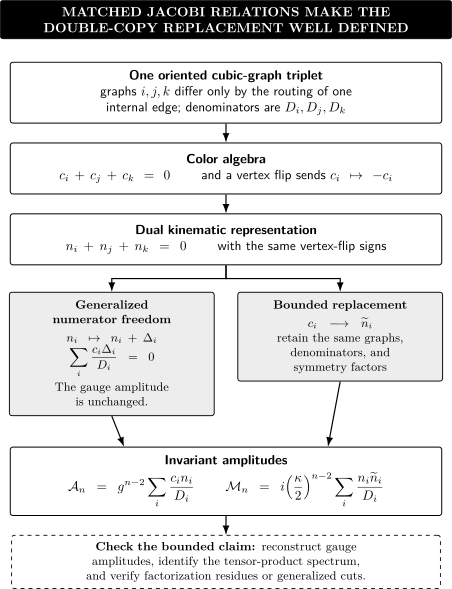
Color–kinematics duality and the double-copy replacement. Matched Jacobi triplets obey and ; generalized gauge shifts leave the color-dressed amplitude fixed, while yields a gravity-like representation when the required duality conditions hold. The diagram is schematic.
Generalized gauge freedom
Section titled “Generalized gauge freedom”Shift the numerators by
The color-dressed amplitude is unchanged whenever
This freedom includes redistributing contact terms among graphs. Consequently, two numerator sets can look very different and still encode the same amplitude. Jacobi-satisfying numerators may be nonlocal or obscure some graph symmetries; locality, power counting, manifest crossing, and duality are simultaneous constraints rather than automatic properties.
For four massless external states, with and all momenta outgoing,
with and after orientations are fixed. A dual representation has . Eliminating one numerator yields the four-point BCJ relation among partial amplitudes,
in the all-outgoing convention. This is an invariant consequence that can be checked without assigning physical meaning to an individual numerator.
Tree and loop status
Section titled “Tree and loop status”At tree level, pure Yang–Mills amplitudes and specified adjoint-only extensions admit general dual constructions and proofs. Fundamental matter, massive states, and effective interactions require their own color identities and state-dependent numerator relations; a result for one such class is not automatically a theorem for the others.
At loop level one seeks
Candidate dual numerators are tested on generalized cuts, graph automorphisms, power counting, and integrated results. The original loop-level proposal was tested on the three-loop four-point amplitude of four-dimensional super-Yang–Mills theory Bern, Carrasco, and Johansson 2010, pp. 061602-1–061602-4. A later action-level construction gives CK-dual loop integrands for theories with CK-dual trees up to possible Jacobian counterterms; those counterterms are precisely why it is not a theorem that every renormalized integrand has a local, manifestly dual form Borsten et al. 2023, §§ 3.8–3.9, pp. 20–23; §§ 5.4–5.5, pp. 39–44. Terms that integrate to zero or vanish on a chosen set of cuts further complicate uniqueness.
The evidence cutoff for this status statement is 9 August 2026. Mutable questions about the obtainable theories, counterterms, loop orders, and representations continue in the dated Research dossier on color–kinematics and double copy.
Evidence status across the frontier
Section titled “Evidence status across the frontier”The following table states a bounded literature snapshot with an evidence cutoff of 9 August 2026. “Established” applies only in the domain named in its cell; the last column prevents a successful special construction from being read as a universal theorem.
| Structure | Established result in a stated domain | Broader evidence or use | Limitation or open question |
|---|---|---|---|
| Color–kinematics duality | Pure Yang–Mills trees and specified adjoint-only extensions admit general dual constructions and proofs Bern et al. 2024, §§ 2.2–2.4, pp. 14–32. | The three-loop four-point integrand of four-dimensional N=4 super-Yang–Mills theory supplied the original loop test Bern, Carrasco, and Johansson 2010, pp. 061602-1–061602-4; an action-level construction is qualified by possible Jacobian counterterms Borsten et al. 2023, §§ 5.4–5.5, pp. 39–44. | Those constructions do not furnish a local, counterterm-free representation theorem for every gauge theory, loop order, and multiplicity. |
| Double copy | At tree level, replacing color factors by a second numerator set gives gravity-side amplitudes when at least one set obeys the dual Jacobi relations Bern, Carrasco, and Johansson 2010, pp. 061602-1–061602-3. | The same primary construction proposes the loop replacement and tests it for the three-loop four-point N=4 super-Yang–Mills/N=8 supergravity pair Bern, Carrasco, and Johansson 2010, pp. 061602-2–061602-4. | The gauge-factor state tensor product fixes the generic gravity-side spectrum; obtaining pure Einstein gravity or other selected field content requires extra projections or matter prescriptions. |
| Leading singularities and geometry | Maximal residues determine local integrand data when the chosen poles fully and nondegenerately localize the contour Abreu, Britto, and Duhr 2022, § 3.3.2, p. 34. | Geometric and logarithmic-form organizations expose locality and unitarity in special theories. | Residues need not fix terms invisible to the chosen cuts or global integration data. |
| Positive geometry | Under the recursive positive-geometry definition, the canonical rational form has only logarithmic boundary singularities and its residues are the boundary canonical forms Arkani-Hamed, Bai, and Lam 2017, §§ 2–4, pp. 5–11. | For positive external data in planar four-dimensional N=4 super-Yang–Mills theory, the original amplituhedron paper conjectures that its canonical form gives the n-particle, k-sector, L-loop integrand and verifies nontrivial examples Arkani-Hamed and Trnka 2014, § 1, pp. 2–4; §§ 9–11, pp. 17–22. | The cited construction supplies neither a universal geometry for general QFTs nor a proof of its amplitude identification in all n, k, and L sectors. |
| Celestial amplitudes | Massless scalar, spin-one, and spin-two conformal-primary wavefunctions in four-dimensional Minkowski space form delta-function-normalizable bases on the principal continuous series Pasterski and Shao 2017, §§ 3–6, pp. 065022-11–065022-33. | For tree-level massless four-dimensional nonabelian gauge theory, the positive-helicity soft-gluon limit gives a holomorphic current insertion; mixed-helicity consecutive double-soft limits require an order prescription He, Mitra, and Strominger 2016, §§ 2–4, pp. 3–9. | Conformal covariance and soft-current identities alone do not supply a complete Hilbert space, operator algebra, positivity structure, or gravitational dual. |
| S-matrix bootstrap | For gapped 1+1-dimensional Lorentz-invariant QFT with identical neutral external particles and a fixed stable spectrum, analyticity, crossing, and unitarity give analytic and numerical coupling bounds Paulos et al. 2017, § 2, pp. 4–17. | A separate crossing-symmetric analytic ansatz gives numerical elastic bounds for the lightest identical real scalar in 3+1 dimensions Paulos et al. 2019, §§ 3–4, pp. 8–22. | Neither result implies uniqueness outside its dimension, spectrum, analyticity class, asymptotics, or converged ansatz. |
| Function spaces and coaction patterns | For multiple polylogarithms, the symbol records ordered logarithmic differentials modulo multiplicative constants and leaves lower-weight terms times transcendental constants undetermined Goncharov et al. 2010, pp. 151605-2–151605-3. | A pinches-and-cuts coaction for dimensionally regulated one-loop scalar integrals is a conjecture checked on nontrivial examples, not an all-loop theorem Abreu et al. 2017, § 4.3, pp. 20–21; § 6, pp. 25–34. | Constants, branches, boundary values, and the explicit elliptic sunrise periods are outside an ordinary multiple-polylogarithm symbol. |
The table is reused by the linked pages as a guardrail. It is not a ranking of methods and does not claim an exhaustive list of results published by the evidence cutoff.
Validation workflow
Section titled “Validation workflow”For a proposed numerator representation:
- fix graph orientations and verify every color Jacobi relation;
- test the matched kinematic antisymmetries and Jacobi sums algebraically;
- reconstruct the color-dressed amplitude and compare partial amplitudes or known factorization residues;
- at loop level, test a spanning set of generalized cuts in the intended dimension and regulator;
- apply allowed generalized gauge shifts and confirm invariant amplitude data are unchanged;
- state which desired properties—locality, crossing, graph symmetry, power counting—are manifest and which are not.
Passing a finite collection of cuts establishes only what that collection spans. Rational terms, evanescent contributions, or contact terms may require additional information.
Common pitfalls
Section titled “Common pitfalls”Calling arbitrary Feynman numerators dual. Duality generally appears after contact terms and generalized gauge freedom are reorganized. Check the Jacobi sums explicitly.
Comparing numerator values without matching gauges. Numerators are representation dependent. Compare amplitude residues, cuts, and declared algebraic identities.
Promoting loop evidence to an all-loop theorem. State the theory, loop order, multiplicity, dimension, and cut coverage of each construction.
Ignoring orientation signs. A flipped cubic vertex changes both color and kinematic signs. Fix an orientation convention before evaluating Jacobi triplets.
Check your understanding
Section titled “Check your understanding”Starting from the four-point cubic representation, impose and . Eliminate the channel and derive the single relation among the two independent color-ordered amplitudes, keeping the all-outgoing Mandelstam signs explicit.
Where to continue
Section titled “Where to continue”- The Double Copy performs the color-to-kinematics replacement and tracks field content.
- Leading Singularities and Integrand Geometry explains what generalized cuts determine and what they can miss.
- Function Spaces, Symbols, and Coaction Patterns gives a different representation-level organization with analogous boundary-data caveats.
References
Section titled “References”- Abreu, Samuel, Ruth Britto, Claude Duhr, and Einan Gardi. “Diagrammatic Hopf Algebra of Cut Feynman Integrals: The One-Loop Case.” Journal of High Energy Physics 12 (2017): 090. DOI. Open preprint.
- Abreu, Samuel, Ruth Britto, and Claude Duhr. “The SAGEX Review on Scattering Amplitudes, Chapter 3: Mathematical Structures in Feynman Integrals.” Journal of Physics A: Mathematical and Theoretical 55 (2022): 443004. DOI. Open PDF.
- Arkani-Hamed, Nima, Yuntao Bai, and Thomas Lam. “Positive Geometries and Canonical Forms.” Journal of High Energy Physics 11 (2017): 039. DOI. Open preprint.
- Arkani-Hamed, Nima, and Jaroslav Trnka. “The Amplituhedron.” Journal of High Energy Physics 10 (2014): 030. DOI. Open preprint.
- Bern, Zvi, John Joseph Carrasco, and Henrik Johansson. “New Relations for Gauge-Theory Amplitudes.” Physical Review D 78 (2008): 085011. DOI. Open preprint.
- Bern, Zvi, John Joseph Carrasco, and Henrik Johansson. “Perturbative Quantum Gravity as a Double Copy of Gauge Theory.” Physical Review Letters 105 (2010): 061602. DOI. Open preprint.
- Bern, Zvi, John Joseph Carrasco, Marco Chiodaroli, Henrik Johansson, and Radu Roiban. “The Duality between Color and Kinematics and Its Applications.” Journal of Physics A: Mathematical and Theoretical 57 (2024): 333002. DOI. Open PDF.
- Borsten, Leron, Branislav Jurčo, Hyungrok Kim, Tommaso Macrelli, Christian Sämann, and Martin Wolf. “Tree-Level Color–Kinematics Duality Implies Loop-Level Color–Kinematics Duality up to Counterterms.” Nuclear Physics B 989 (2023): 116144. DOI. Open preprint.
- Goncharov, Alexander B., Marcus Spradlin, Cristian Vergu, and Anastasia Volovich. “Classical Polylogarithms for Amplitudes and Wilson Loops.” Physical Review Letters 105 (2010): 151605. DOI. Open preprint.
- He, Temple, Prahar Mitra, and Andrew Strominger. “2D Kac–Moody Symmetry of 4D Yang–Mills Theory.” Journal of High Energy Physics 10 (2016): 137. DOI. Open preprint.
- Pasterski, Sabrina, and Shu-Heng Shao. “Conformal Basis for Flat Space Amplitudes.” Physical Review D 96 (2017): 065022. DOI. Open preprint.
- Paulos, Miguel F., Joao Penedones, Jonathan Toledo, Balt C. van Rees, and Pedro Vieira. “The S-Matrix Bootstrap II: Two Dimensional Amplitudes.” Journal of High Energy Physics 11 (2017): 143. DOI. Open preprint.
- Paulos, Miguel F., Joao Penedones, Jonathan Toledo, Balt C. van Rees, and Pedro Vieira. “The S-Matrix Bootstrap. Part III: Higher Dimensional Amplitudes.” Journal of High Energy Physics 12 (2019): 040. DOI. Open preprint.
Original QFT.org content:CC BY 4.0, unless an item supplies different terms. Third-party material retains its own terms.