

Mandelstam Channels and Tree-Level Crossing
Production, annihilation, and exchange amplitudes are related at tree level by one all-incoming analytic expression evaluated with different external particle assignments and in different real kinematic regions. Crossing an external leg reverses its momentum and replaces the state by its antiparticle; fermionic reorderings may add a sign. This diagrammatic rule anticipates, but does not prove, a general analytic crossing theorem.
Required background. Scalar Contact and Exchange Amplitudes supplies a common rational four-point function. Relativistic Scattering Kinematics supplies thresholds and physical regions.
Helpful background. Antiparticles and Charge-Conjugate Excitations supplies the state interpretation of crossed charged legs.
One all-incoming momentum convention
Section titled “One all-incoming momentum convention”Assign four momenta into the amplitude,
and define
For the physical process , take . Thus the ordinary expressions , , and are recovered. Crossing particle 3 to the initial state means using an incoming antiparticle with momentum , which is the same analytic leg previously carrying . The state-level all-incoming convention and its symmetry constraints are illustrated by the fermion–antifermion crossing discussion in Weinberg 1995, § 6.1, printed p. 269, which also emphasizes that crossing entails analytic continuation rather than an ordinary symmetry operation.
For equal masses in the physical -channel,
The -channel physical region instead has . These are different real slices, not simultaneous inequalities on one event.
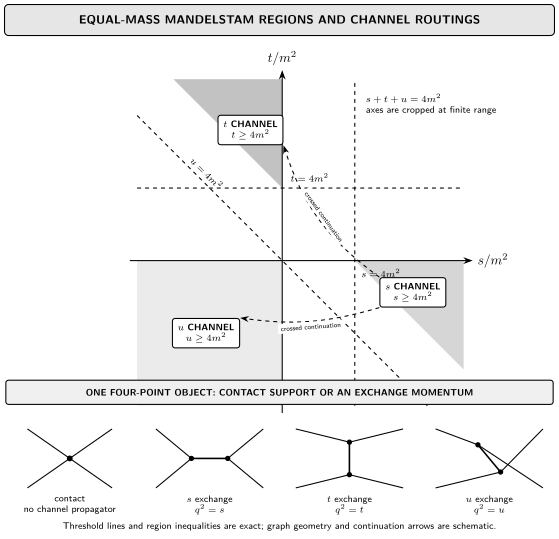
Distinct channel experiments evaluate boundary values in distinct physical regions of the same Mandelstam-variable description. The schematic does not turn a forbidden real interpolation into a proof of analytic continuation.
The following text table gives the nonvisual equivalent of the figure’s equal-mass channel map. The exchanged momentum is the partition momentum that would appear in a propagator; it does not imply that its pole lies inside the listed two-body physical region.
| Physical channel | Center-of-mass invariant | Other real invariants | Exchange momentum in the all-incoming convention |
|---|---|---|---|
| s-channel | s ≥ 4m² | t ≤ 0 and u ≤ 0 | P = k₁ + k₂, so P² = s |
| t-channel | t ≥ 4m² | s ≤ 0 and u ≤ 0 | P = k₁ + k₃, so P² = t |
| u-channel | u ≥ 4m² | s ≤ 0 and t ≤ 0 | P = k₁ + k₄, so P² = u |
Crossing a scalar exchange expression
Section titled “Crossing a scalar exchange expression”For identical real scalars,
is symmetric under permutations of . The same algebraic function therefore describes the crossed assignments. What changes is which invariant is the center-of-mass energy and which boundary value and physical interval are approached. A pole that is inaccessible in one channel can acquire the interpretation of a stable one-particle intermediate state in a crossed channel, although its pole position can still lie below that channel’s two-particle scattering threshold. The tree-level scalar realization is worked out in Schwartz 2014, § 7.4.1, printed pp. 97–99.
For distinct or charged fields, crossing also changes species. A scalar outgoing particle becomes its charge-conjugate incoming particle. For spinors, and wave functions and their order change. The sign is determined by returning the external fermionic operators to the declared canonical order; there is no universal “one minus sign per crossed fermion” rule independent of that order.
| Original external leg | Crossed state | Analytic momentum replacement | External wave function |
|---|---|---|---|
| outgoing charged scalar | incoming | becomes the incoming analytic leg | replace the field/state by its conjugate |
| outgoing fermion | incoming antifermion | row endpoint | |
| outgoing antifermion | incoming fermion | column endpoint | |
| outgoing self-conjugate boson | incoming same species | continue its polarization or scalar wave function |
The table records state changes, not an algorithm for fermion phases. A direct calculation of one crossed process in the same external-operator convention is the decisive sign check.
What tree-level crossing does and does not establish
Section titled “What tree-level crossing does and does not establish”At tree level the stripped diagram expression is meromorphic in complexified external momenta and invariants. The notation specifies a boundary value in a chosen physical region; it is not a sign that can simply be carried unchanged through every crossed real assignment. One relates two physical regions by continuing momenta along a nonsingular complex path and then taking the target boundary value. This is transparent when the only obstructions are the displayed tree poles. Beyond tree level, thresholds generate cuts, so the continuation also requires a named sheet and path. Mizera 2024, § 5.2, arXiv v2 manuscript PDF, pp. 131–140 explains why crossed processes are boundary values of a common analytic object only within qualified domains and why continuing energy signs is more subtle than a casual substitution.
Accordingly, this page establishes the perturbative external-leg rule and physical-region distinction. Analyticity and Crossing of Amplitudes develops sheets, cuts, real analyticity, and the limitations of rigorous crossing statements. Dispersion relations and crossing kernels require still more growth and subtraction input.
Check your understanding
Section titled “Check your understanding”Starting from , cross legs 2 and 3 and write the new physical process, the new all-incoming assignments, and which of is now the center-of-mass energy squared. The check is successful only if momentum conservation, antiparticle identity, and the physical region are all updated. With distinct charged species the answer is , and the original becomes the new center-of-mass invariant; for self-conjugate particles the bars are omitted. Any fermionic sign must still be derived by restoring the declared external operator order.
Momentum assignment
Keep the analytic all-incoming vectors fixed as labels while continuing their energy components. On the target real slice, and are the future-directed incoming physical momenta, while and are the future-directed outgoing momenta. Momentum conservation remains , and the target center-of-mass invariant is . The target value of is reached by analytic continuation from the vector that equaled in the original physical region; it is not the same real four-vector with its sign changed by notation alone.
References
Section titled “References”- Mizera, Sebastian. “Physics of the Analytic S-Matrix.” Physics Reports 1047 (2024): 1–92. § 5.2 appears in the cited arXiv v2 manuscript on pp. 131–140. arXiv:2306.05395v2 PDF.
- Schwartz, Matthew D. Quantum Field Theory and the Standard Model. Cambridge University Press, 2014, § 7.4.1, printed pp. 97–99. doi:10.1017/9781139540940.
- Weinberg, Steven. The Quantum Theory of Fields, Volume I: Foundations. Cambridge University Press, 1995, § 6.1, printed p. 269. doi:10.1017/CBO9781139644167.
Original QFT.org content:CC BY 4.0, unless an item supplies different terms. Third-party material retains its own terms.