

Scalar Contact and Exchange Amplitudes
A local quartic interaction contributes a polynomial contact term, while two cubic vertices joined by a propagator contribute exchange denominators. For identical real scalars all allowed -, -, and -channel attachments must be summed. Their pole residues reveal the exchanged one-particle coupling; threshold, permutation, and high-energy limits then provide independent checks.
Required background. Connected Tree Diagrams and Amputated Amplitudes supplies the enumeration and normalization algorithm.
Helpful background. What an Interacting Lagrangian Does and Does Not Specify explains why a written interaction is not by itself a complete nonperturbative theory.
Contact and exchange in one model
Section titled “Contact and exchange in one model”Take one canonically normalized real scalar in four dimensions,
Take and expand perturbatively about the local vacuum at . If this polynomial is intended as more than a local perturbative benchmark, its other stationary points and large-field stability must also be checked—for example, is required for boundedness at large . None of the tree algebra below establishes the existence of a nonperturbative continuum theory.
The vertex factors are and . For , define
The complete tree result is
The first term is local: it contains no propagator and hence no exchange pole. Each remaining term records propagation in one partition of the four external legs. Schwartz obtains this same contact-versus-exchange structure in Schwartz 2014, § 7.4, printed pp. 97–99. The factorial and identical-field combinatorics used here are also developed in Srednicki 2007, §§ 10–12, printed pp. 87–105.
For the physical equal-mass -channel, and , so the pole at is below the two-particle physical region; the - and -channel poles are likewise not reached there. They remain genuine poles of the analytically continued tree amplitude. The physical regions and their crossed relation are summarized by the Mandelstam-region figure; the exact continuation is developed on the next channel page.
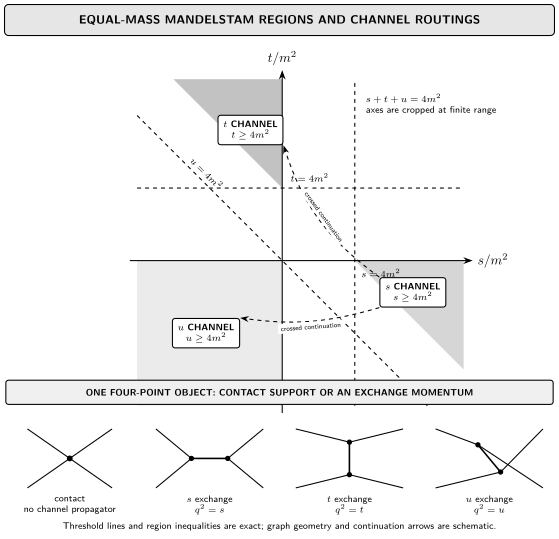
Physical two-body regions occupy different real slices of the common Mandelstam surface. The diagram is schematic; it does not assert that every tree pole lies in the physical region of the process being drawn.
Residues and identical-particle symmetry
Section titled “Residues and identical-particle symmetry”Near the -channel pole,
Equivalently, the diagram factor is the product of two on-shell three-point factors and the internal propagator,
This form is safer than memorizing a sign for the residue of , because it preserves the declared convention. The full result is invariant under any permutation of identical external scalars: such a permutation merely permutes . Omitting one allowed exchange channel therefore fails an immediate Bose-symmetry check.
Threshold and high-energy checks
Section titled “Threshold and high-energy checks”At center-of-mass threshold, and , giving
This finite value is a useful arithmetic check for ; it is not a statement about a bound state or a resummed scattering length. At fixed angle away from the forward and backward limits, and with , all exchange terms scale as , while the quartic contact approaches the constant . The angular qualification matters: in a forward limit, need not scale with . The dimensions agree: , , and the four-point amplitude is dimensionless.
The order of limits matters. At fixed negative with , the -channel term approaches rather than falling as ; only fixed-angle kinematics makes and grow with . This simple distinction is the seed of the fixed-angle versus Regge-limit separation used later in the volume.
The result does not include loop self-energies, running or renormalized couplings, or bound-state resummation. In particular, inserting a width by hand into a tree propagator mixes perturbative orders and can spoil identities; unstable-particle poles are treated in Resonance Poles, Riemann Sheets, and Unstable States. A cross section additionally requires flux, phase space, and the factor for identical final scalars; those enter in Cross Sections and Decay Rates, not in the amplitude above.
Check your understanding
Section titled “Check your understanding”Set , then , and identify which analytic features remain in each limit. Next exchange and verify that the full expression is invariant while the - and -terms interchange.
Solution
For , is a polynomial contact amplitude with no tree pole. For , only the three simple exchange poles remain. The exchange leaves fixed and interchanges with , so the sum is invariant. A denominator on the term or omission of either crossed exchange would violate these checks.
References
Section titled “References”- Schwartz, Matthew D. Quantum Field Theory and the Standard Model. Cambridge University Press, 2014, § 7.4, printed pp. 97–99. doi:10.1017/9781139540940.
- Srednicki, Mark. Quantum Field Theory. Cambridge University Press, 2007, §§ 10–12, printed pp. 87–105. doi:10.1017/CBO9780511813917.
Original QFT.org content:CC BY 4.0, unless an item supplies different terms. Third-party material retains its own terms.