

Relativistic Scattering Kinematics
For a two-body reaction, on-shell masses and four-momentum conservation leave two independent Lorentz invariants. The Mandelstam variables package the center-of-mass energy, momentum transfer, and crossed channels; the Källén function determines thresholds and momentum magnitudes; and a bounded interval of is exactly the physical scattering-angle range.
Required background. S-Matrix and T-Matrix Normalization fixes which overall delta function has been removed from the invariant amplitude.
Helpful background. Lorentz Field Representations and Poincaré Particle Representations supplies the orbit and invariant-product language used here.
Two-to-two invariants
Section titled “Two-to-two invariants”Consider
with every displayed future-directed and on shell, . Define
Expanding and using momentum conservation gives
Only two of the three variables are independent. In the physical -channel, is the total center-of-mass energy; is the squared transfer from particle 1 to particle 3. These definitions and the sum rule agree with the convention-explicit treatment in Schwartz 2014, § 7.4.1, pp. 98–99.
The Källén function and thresholds
Section titled “The Källén function and thresholds”Define
In the center-of-mass frame, . Solving yields
Similarly,
A physical reaction therefore requires
The other zero, , is a pseudothreshold of the algebraic square root; it is not the production threshold for two future-directed particles of masses . At the final-state threshold, .
These center-of-momentum energies, square roots, and physical threshold branches are worked through with the same covariant normalization in Srednicki 2007, § 11, pp. 93–101.
The scattering angle is an invariant interval
Section titled “The scattering angle is an invariant interval”Choose the center-of-mass axis along and let be the angle between and . Then
Substituting the invariant energies gives
Thus the physical interval is , where is obtained at and at . The Jacobian is
Equivalently, proposed invariants describe a real two-body collision only if both Källén functions are nonnegative and
The quantity inside the absolute value is . This invariant inequality is often a cleaner physical-region check than constructing explicit four-vectors.
For equal masses , elastic scattering has
so the physical -channel obeys and .
An independent invariant treatment of two-body collision and decay kinematics appears in Weinberg 1995, § 3.4, pp. 134–141.
The figure locates this region and its two crossed counterparts. Inspect the threshold lines and note that the small exchange graphs label which invariant can flow through a propagator; they do not by themselves prove analytic crossing.
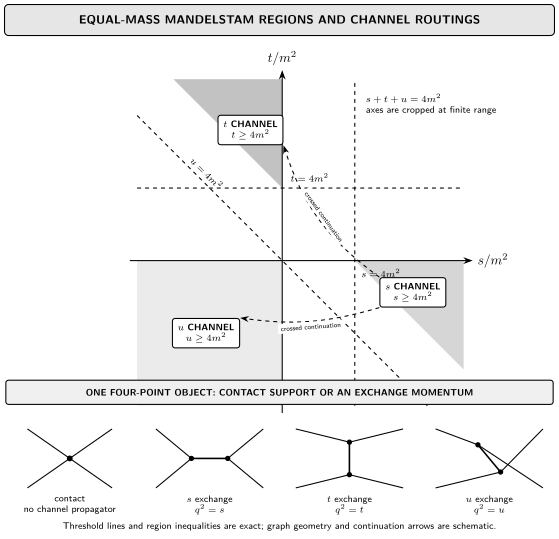
Equal-mass kinematics with . The -channel has and ; the - and -channel regions follow by permutation. Threshold locations are exact, the displayed wedges are cropped, and the contact and exchange sketches are schematic and not to scale. Dashed arrows denote crossed continuation as a kinematic relation, not a proof of an analytic crossing theorem.
The same information has a nonvisual form:
| Physical interpretation for equal masses | Timelike channel invariant | Other two invariants |
|---|---|---|
| , | ||
| , | ||
| , |
Beyond two-to-two scattering
Section titled “Beyond two-to-two scattering”For , useful invariants include subsystem masses
They are constrained by on-shell conditions, total momentum conservation, and Gram determinants. For any selected vectors , define
In four spacetime dimensions, any five four-vectors are linearly dependent, so for their Gram matrix. The condition is necessary, not sufficient: the on-shell equations, energy signs, and physical-region inequalities must also hold. A list of pairwise invariants that violates any of these constraints describes no real momentum configuration.
For a three-body decay , two pair masses such as and provide coordinates on a Dalitz plot. Its boundary occurs when the remaining decay angle reaches , equivalently when the relevant Gram determinant vanishes. Phase space, rather than kinematics alone, supplies the integration measure on that domain.
Common pitfalls
Section titled “Common pitfalls”“ are always independent.” On-shell four-point kinematics imposes one linear relation. Special masses and dimensions can impose further constraints.
“A zero of is always a physical production threshold.” The factorization has both threshold and pseudothreshold zeros. Future-directed positive-energy kinematics selects the physical branch.
“Crossing is just renaming .” Permuting external momenta maps kinematic formulas, but relating physical amplitudes in separated regions requires analytic continuation, statistics phases, and state conventions.
“Any chosen and define a real collision.” The Källén functions must be nonnegative and must lie in its angular interval. Multi-particle configurations obey additional Gram constraints.
Check your understanding
Section titled “Check your understanding”-
Derive by expanding the definitions.
Answer
Expand , , and . Momentum conservation gives , so the dot-product combination equals . The remaining masses give the stated sum.
-
For massless scattering, show that .
Answer
With every mass zero, and . Substitution in the angle formula gives .
-
At fixed above both thresholds, show that the endpoints coalesce when either the incoming or outgoing pair reaches threshold.
Answer
Their separation is
If either Källén function vanishes, the corresponding center-of-mass momentum is zero and no scattering angle remains to vary, so the allowed interval collapses to one point.
Continue
Section titled “Continue”Lorentz-Invariant Phase Space turns the allowed momentum domain into an integration measure. Mandelstam Channels and Tree-Level Crossing develops channel permutations and analytic continuation. High-Energy and Regge Limits treats the special large- limits.
References
Section titled “References”- Schwartz, Matthew D. Quantum Field Theory and the Standard Model. Cambridge: Cambridge University Press, 2014. DOI.
- Srednicki, Mark. Quantum Field Theory. Cambridge: Cambridge University Press, 2007. DOI.
- Weinberg, Steven. The Quantum Theory of Fields. Volume I: Foundations. Cambridge: Cambridge University Press, 1995. DOI.
Original QFT.org content:CC BY 4.0, unless an item supplies different terms. Third-party material retains its own terms.