

The Interaction Picture and Dyson Series
Splitting the Hamiltonian as moves the exactly solvable evolution into the operators and leaves the state evolution generated by the interaction-picture Hamiltonian. Iterating that evolution equation gives integrals over ordered time simplices; equivalently, a factor and the time-ordering operator extend each simplex to the full -dimensional time domain. This is the Dyson series. It is a perturbative construction with a declared time interval, state prescription, regulator, and switching procedure—not a globally exact unitary equivalence between free and interacting relativistic fields.
Required background. Fock Space, Vacuum, and Particle Number supplies the free representation and the action of creation and annihilation operators used below.
Helpful background. Haag’s Theorem: Physical Meaning and Scope explains why the interaction picture requires a cutoff, finite-time use, or asymptotic interpretation; Interacting Fields, Asymptotic Observables, and Effective Descriptions separates that controlled use from a nonperturbative existence claim.
Interaction-picture evolution
Section titled “Interaction-picture evolution”Let be the Schrödinger-picture evolution. For time-independent , define the two-endpoint interaction-picture evolution consistently with the interaction-picture operators by
Then
with . Integrating once gives the Volterra equation
The interaction-picture construction and this integral equation are derived in Weinberg 1995, § 3.5, pp. 142–143. Iteration, rather than an ordinary exponential, is necessary because and generally do not commute.
Ordered simplices and the Dyson series
Section titled “Ordered simplices and the Dyson series”Substituting the integral equation into itself produces
At order , the domain is the simplex
With a regulator that makes the operator products well defined and assigns no separate contact contribution to their coincidence sets, the open simplices partition the hypercube up to their common boundaries. Time ordering places the latest operator to the left, so all regions become copies of the same ordered integrand. If distributional contact terms occur, their prescription is part of the definition of the time-ordered product and cannot be discarded merely because it is supported at equal times. Under the regulated assumption just stated,
The notation means precisely this series; it is not an instruction to ignore noncommutativity. Dyson’s original construction organizes the scattering operator by these ordered products Dyson 1949, pp. 1736–1743, while the simplex-to-hypercube step and its factorial are displayed explicitly in Weinberg 1995, § 3.5, pp. 143–144.
There is a useful sharp distinction between the finite-time operator theorem and its QFT use. If is bounded and strongly measurable on , with
then the norm of the th ordered term is at most , so the series converges absolutely in operator norm. Unbounded Hamiltonians require a common invariant domain or a stronger evolution theorem. Local continuum interaction densities do not meet the bounded hypothesis without regulation, so their Dyson expansion is ordinarily interpreted coefficient by coefficient.
For a first field-theory application, take , with no time derivatives. Only under that qualification may one use , giving
and, writing ,
The next page turns the labeled free fields in these ordered products into contractions; no graph or symmetry factor has yet been assumed here.
The figure encodes the same identity geometrically. Inspect the diagonal separating the two second-order orderings and the qualification attached to the infinite-time limit.
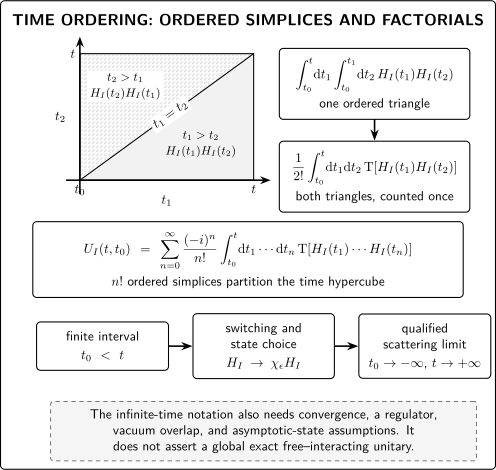
On a narrow screen, swipe the diagram or focus it and use the left/right arrow keys; Home and End move to its edges. Open the full-size diagram.
At second order, the regions and fill the time square and are mapped into one another by relabeling. Time ordering makes their operator products agree, producing the factor . Extending the endpoints to infinity is a separate, qualified scattering limit. Schematic, not to scale.
| Representation | Domain | Operator order | Multiplicity |
|---|---|---|---|
| Iterated integral | one ordered simplex | ||
| Complementary simplex | obtained by exchanging labels | ||
| Time-ordered form | later time always left | divide by | |
| Scattering notation | endpoints formally sent to | same ordering | also requires asymptotic-state and convergence prescriptions |
Checks and limiting cases
Section titled “Checks and limiting cases”Commuting interaction. If for all times, time ordering is inert and the series sums to the ordinary exponential
Composition. Uniqueness of the evolution equation gives
Expanding both sides through second order partitions the ordered simplex according to whether both insertions lie before , both after it, or one on each side.
Unitarity. For Hermitian , the adjoint equation implies . At second order, the two time orderings in cancel the product . A truncation is unitary only up to terms beyond the retained order.
Noncommuting pulses. Let for and for , with . Composition gives
The mixed product is , because the later pulse stands to the left. The ordinary exponential instead averages and ; their difference starts at . This checks both the operator order and the need for .
Switching, vacuum selection, and Haag’s theorem
Section titled “Switching, vacuum selection, and Haag’s theorem”For scattering one often makes the replacement , with tending to zero at large , and only afterward studies a limit such as . A convergence factor also fixes the boundary value that becomes the Feynman prescription and may project onto the desired vacuum when overlap and spectral assumptions hold. Weinberg makes the convergence factor explicit in the passage from energy denominators to time integrals Weinberg 1995, § 3.5, p. 143.
These devices do not prove that the interacting Hilbert-space representation is unitarily equivalent to the free Fock representation. In infinite-volume relativistic QFT, Haag’s theorem obstructs that literal global reading under its hypotheses. Perturbation theory remains meaningful with regulators, finite-time evolution, finite volume, renormalized asymptotic constructions, or formal power-series interpretation, but the chosen meaning must be stated. Nor is convergence in the coupling guaranteed: the Dyson series is normally used order by order, with its truncation and regulator dependence kept visible.
Common pitfalls
Section titled “Common pitfalls”Dropping time ordering inside an exponential. The compact exponential is notation for the ordered series. It becomes an ordinary exponential only under a commutativity condition.
Treating adiabatic switching as a theorem about physical preparation. Switching is a calculational prescription whose removal can fail, especially in theories with massless long-range interactions or without suitable asymptotic states.
Claiming exact free–interacting equivalence. Interaction-picture fields are the free fields used inside a regulated or asymptotic perturbative construction. Their usefulness does not supply a global intertwining unitary for the exact theory.
Check your understanding
Section titled “Check your understanding”Expand to second order and divide its ordered domain at an intermediate time . Show explicitly that the result equals through the same order.
Solution
Split the ordered region into three disjoint pieces: both times above , both below it, and . The first two pieces are the second-order terms of and . The mixed piece factorizes as
which is the product of their first-order terms, with the later operator already on the left. Together with the zeroth- and first-order pieces this is precisely the expansion of .
Where to continue
Section titled “Where to continue”- Turn ordered products into contractions: Wick Expansion for Interacting Fields applies the free-field theorem inside the Dyson numerator and denominator.
- Check the representation-theoretic limitation: Haag’s Theorem: Physical Meaning and Scope states the hypotheses behind the obstruction.
- Proceed toward observables after the rule set is complete: Asymptotic States, LSZ, and Scattering Observables explains what additional pole and asymptotic-state assumptions convert correlators into scattering amplitudes.
References
Section titled “References”Original QFT.org content:CC BY 4.0, unless an item supplies different terms. Third-party material retains its own terms.