

Vector External States and Ward Checks
An external massless vector is represented by a transverse polarization modulo . A physical amplitude must therefore be unchanged by that shift, equivalently it must vanish when any external polarization is replaced by its momentum. This Ward check generally succeeds only after every gauge-related tree graph—including contact terms—has been summed.
Required background. Connected Tree Diagrams and Amputated Amplitudes supplies the complete-graph rule. Massive and Massless Spin-One Polarizations supplies the two-helicity quotient and reference-vector freedom.
Helpful background. Covariant Free-Photon Quantization and Propagator explains the indefinite covariant state space. Gauge-Fixed Perturbation Rules, Ghost Diagrams, and Identity Checks and Slavnov–Taylor and Zinn-Justin Identities develop the general gauge-fixed and non-Abelian identities.
Polarization representatives and the Ward test
Section titled “Polarization representatives and the Ward test”For a null external momentum , choose
where is any non-collinear null or timelike reference vector used to select a representative. For a fixed helicity and phase convention, changing shifts the representative by a multiple of . A general change of linear-polarization basis may also rotate the two physical states; that basis rotation is distinct from gauge-reference dependence. If
then reference independence follows from
For several external vectors the same replacement is tested one leg at a time. This is stronger than checking : transversality defines the chosen external state, whereas the Ward replacement tests the dynamics and graph completeness. Schwartz derives the physical-state condition and amplitude identity in Schwartz 2014, §§ 8.4 and 9.4, printed pp. 123–127 and 147–149. The corresponding general statement that longitudinal external-photon replacements decouple from physical amplitudes is treated in Weinberg 1995, §§ 8.6–8.7, printed pp. 355–368.
Scalar-QED Compton cancellation
Section titled “Scalar-QED Compton cancellation”Consider
with all external legs on shell. Scalar QED supplies two ordered scalar exchange graphs and an contact graph. Take the scalar with in the inherited charged-matter convention, so
The interaction terms are
An incoming scalar contributes and an outgoing scalar contributes . The linear coefficient in is therefore , giving the one-photon vertex . Equivalently, with both scalar momenta incoming it is , where and . The two-photon seagull is . This follows the same action and charge convention as the course rulebook.
For the fixed convention , each scalar exchange carries , while the contact graph carries . Thus define the stripped Ward tensor below with the physical amplitude
Here the is omitted away from propagator poles. The minus sign between and the displayed Ward tensor is fixed, not an unspecified phase. The denominators reduce to and . Contracting the incoming photon momentum gives
Since , their sum is zero. The outgoing replacement is checked by the companion contractions
Their sum is . No individual graph passes; the contact term is essential.
The cancellation to inspect is summarized below. The arrows display algebraic contributions after the incoming Ward replacement, not probabilities or a time ordering.
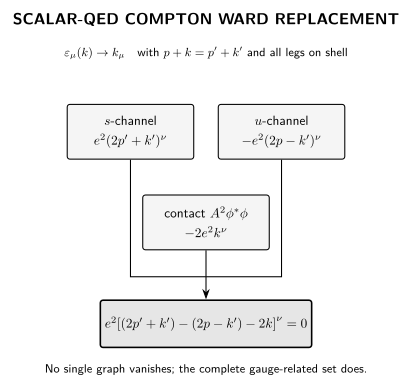
The three scalar-QED Compton contributions cancel as . The figure is schematic and convention-matched to the displayed stripped Ward tensor ; the physical amplitude has the stated overall minus sign. Omitting the seagull contact interaction leaves a nonzero reference-dependent result.
The broader gauge-fixed consistency chain is shown below. Inspect where the propagator and ghost branches rejoin: the identity is a property of the complete object, not of either gauge-dependent ingredient separately.
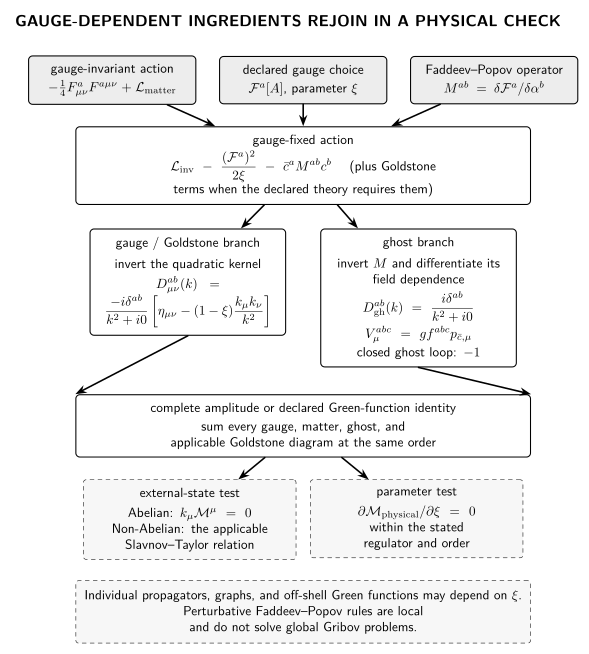
Gauge fixing makes the quadratic kernel invertible and the Faddeev–Popov operator supplies Grassmann-odd ghost propagators and vertices. Neither branch is physical by itself. They rejoin only in a complete amplitude or Green-function identity, where longitudinal and gauge-parameter dependence are tested. Schematic, not to scale.
In Abelian scalar QED the Faddeev–Popov determinant is field independent, so ghosts decouple entirely and are not external physical states. In a non-Abelian calculation, ghosts do participate in internal gauge-fixed identities; this elementary Abelian Ward cancellation does not derive those Slavnov–Taylor relations.
Polarization sums come after the check
Section titled “Polarization sums come after the check”Choose two representatives normalized by and orthogonal to both and . Their completeness tensor is
For this reduces to the null-reference projector derived in Schwartz 2014, § 13.5.1, printed pp. 238–240. For a conserved external current, every -dependent term drops out by the Ward identity. Replacing the sum prematurely by can hide a failed check behind unphysical modes. The safe order is:
- assemble the full amplitude with explicit physical polarizations;
- perform for each external vector;
- only then use a polarization sum or helicity basis to compute a rate.
A Ward failure can signal a missing graph, a wrong charge or momentum sign, an omitted contact vertex, or an inconsistent approximation. It is not fixed by choosing a convenient gauge. General non-Abelian color dynamics and Standard Model processes lie beyond this Abelian tree example.
Check your understanding
Section titled “Check your understanding”Delete the contact term from and compute the Ward remainder. Then restore it and repeat the outgoing-photon contraction. The check passes only if both replacements vanish without using for the replaced leg.
Solution
Without the contact term, the incoming contraction is
which is precisely canceled by . For the outgoing leg, the exchange remainder is and the contact term contributes . Neither calculation uses a transversality condition for the polarization that has been replaced.
References
Section titled “References”- Schwartz, Matthew D. Quantum Field Theory and the Standard Model. Cambridge University Press, 2014, §§ 8.4, 9.2–9.4, and 13.5.1, printed pp. 123–127, 142–149, and 238–240. doi:10.1017/9781139540940.
- Weinberg, Steven. The Quantum Theory of Fields, Volume I: Foundations. Cambridge University Press, 1995, §§ 8.6–8.7, printed pp. 355–368. doi:10.1017/CBO9781139644167.
Original QFT.org content:CC BY 4.0, unless an item supplies different terms. Third-party material retains its own terms.