

Celestial Amplitudes
Celestial amplitudes rewrite momentum-space scattering data in a basis diagonalizing Lorentz boosts. For each massless external leg, a positive scale along its null ray is Mellin transformed while its direction becomes a point on the celestial sphere. Lorentz covariance then takes the form of two-dimensional conformal covariance. This dictionary is exact at the level stated below; it does not by itself establish a complete celestial conformal field theory dual of flat-space quantum gravity.
Required background. Analyticity and Crossing of Amplitudes supplies all-incoming/outgoing continuation and distributional boundary values. Soft Limits as On-Shell Constraints supplies the soft factors that become celestial current relations.
Helpful background. Mellin Transforms and Scaling Asymptotics supplies the transform, inversion strip, and distributional qualifications.
Null momenta and the celestial sphere
Section titled “Null momenta and the celestial sphere”Parameterize a null momentum by
where distinguishes outgoing and incoming orientations and
On the real Lorentzian celestial sphere , while complexified kinematics treats them independently. With the mostly-minus metric, . Notice that this is not normalized to :
Thus is the positive scale coefficient along the null ray, not the ordinary energy in this coordinate normalization. Its overall scale is conventional because it can be absorbed into . Proper orthochronous Lorentz transformations act on by a Möbius map,
and rescale by a positive conformal factor on the real Lorentzian sphere. Thus an external momentum separates into an energy scale and a direction.
Mellin transform to boost weight
Section titled “Mellin transform to boost weight”Write the full four-dimensional momentum-space distribution as
where is the delta-stripped amplitude. The celestial transform used here keeps momentum conservation explicit:
The transform should be applied with a regulator or distributional prescription whenever the energy integrals do not converge absolutely. Authors who instead transform must state that convention; the full-distribution convention above makes support on celestial cross ratios explicit.
For one sufficiently well-behaved dependence, introduce a fixed reference scale and define
The inverse requires a contour inside a fundamental strip:
On the scalar principal line , write to obtain
The power is essential. Setting turns the pair into an ordinary Fourier transform of ; omitting the factor reconstructs . The contour and completeness conditions are given in Pasterski and Shao 2017, § 4.2, printed pp. 18–20. Actual amplitudes generally require a declared test space or distributional continuation rather than pointwise inversion.
For helicity , the two-dimensional weights are
Under the Möbius transformation, the celestial amplitude transforms covariantly as a correlator of primaries with weights , including the chosen incoming/outgoing convention. In four dimensions, delta-function-normalizable massless conformal-primary wavefunctions use the principal continuous series , ; the scalar, spin-one, and spin-two constructions and their completeness qualifications appear in Pasterski and Shao 2017, §§ 3–6, pp. 065022-11–065022-33.
The figure summarizes the map and its qualifications. The null-scale integral changes basis; it does not discard momentum conservation, branch prescriptions, or the distinction between incoming and outgoing states.
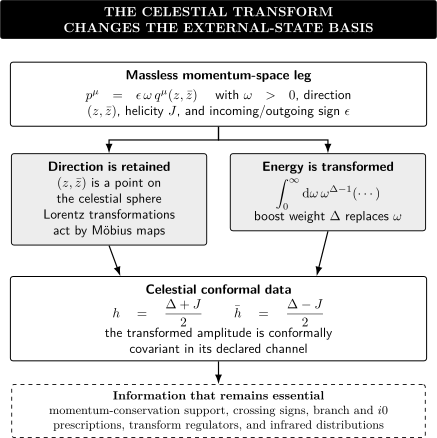
Momentum-space to celestial data for a massless external leg. The signed momentum is Mellin transformed in to boost weight , helicity fixes , and momentum-conservation and boundary-value prescriptions remain part of the transformed amplitude. The diagram is schematic.
A scaling check
Section titled “A scaling check”If a one-leg factor scales as with and initially , then
A boost rescales and shifts the result by the expected power. The poles of the gamma function also show why analytic continuation in is natural. Physical amplitudes have momentum-conserving distributions and power-law behavior at both endpoints, so this regulated example checks weights but is not a substitute for the full distributional transform.
An earlier massive-scalar construction exhibited the same Lorentz-covariant logic and computed a special three-point amplitude with the unique two-dimensional primary three-point form Pasterski, Shao, and Strominger 2017, §§ 2–3, pp. 065026-3–065026-10. This example is not a proof of CFT axioms or OPE completeness.
Momentum conservation and four-point support
Section titled “Momentum conservation and four-point support”For real Lorentzian massless momenta, four-point momentum conservation constrains the complex cross ratio
to an appropriate real locus whose interval depends on the crossing channel. The celestial four-point object therefore includes distributional support rather than being an arbitrary smooth Euclidean correlator. Analytic continuation can relax the real kinematics, but the chosen boundary value and channel must then be tracked.
Energy delta functions can remove some Mellin integrals and leave an overall scale integral. Scale invariance or dimensionful couplings determine whether that integral produces an ordinary function, a delta function in total boost weight, or a regulated distribution.
Soft limits as conformal-current relations
Section titled “Soft limits as conformal-current relations”Momentum-space soft theorems control the behavior as one . For a delta-stripped, fixed-angle tree amplitude away from a soft-collinear overlap, suppose
An auxiliary ultraviolet damper isolates the endpoint:
Analytic continuation therefore gives the reproducible residue
A smooth cutoff equal to one near zero changes only terms holomorphic at . This checks the local soft endpoint; it is not a factorization theorem for the fully transformed momentum-conserving distribution, and loop infrared effects can obstruct exchanging the soft and Mellin limits.
More generally, Mellin transformation converts endpoint behavior into poles or special values in . Residues at conformally soft weights can act as current insertions and generate Ward identities associated with asymptotic symmetries. For tree-level scattering of massless particles in a four-dimensional non-Abelian gauge theory, the leading positive-helicity soft-gluon theorem produces a holomorphic current algebra He, Mitra, and Strominger 2016, §§ 2–4, pp. 3–9.
Four distinctions matter:
- a soft theorem is an amplitude statement, while a current algebra also requires a transform and operator prescription;
- the mixed-helicity double-soft limit is order dependent, and the cited holomorphic algebra uses the prescription that positive-helicity gluons are taken soft first;
- loop corrections and infrared divergences can modify naive soft-current relations;
- a set of Ward identities does not by itself supply a complete operator spectrum, positive inner product, or nonperturbative definition.
The frontier evidence table therefore separates conformal covariance and soft structures from the additional axioms required for a celestial CFT. Its evidence cutoff is 9 August 2026; covariance alone supplies no claim of a positive Hilbert space, convergent OPE, or complete flat-space holographic dictionary.
Common pitfalls
Section titled “Common pitfalls”Dropping the incoming/outgoing sign. Crossing changes both kinematic support and phases. Keep explicit through the transform.
Treating the Mellin integral as absolutely convergent by default. Endpoint powers, momentum delta functions, and infrared divergences often require analytic or distributional prescriptions.
Reading correlator-like covariance as proof of a CFT dual. Covariance is a necessary structural fact, not a complete definition with spectrum, OPE convergence, and unitarity.
Ignoring the real four-point support. Lorentzian momentum conservation restricts cross ratios. State the channel and continuation before using Euclidean correlator intuition.
Check your understanding
Section titled “Check your understanding”Compute the regulated Mellin transform of and verify its scaling under . Then use and to recover the two-dimensional spin and boost weight.
Where to continue
Section titled “Where to continue”- S-Matrix and Amplitude Bootstrap treats crossing and unitarity as constraints without assuming a celestial dual.
- Soft Limits as On-Shell Constraints supplies the momentum-space theorem used in current relations.
- Celestial and Cosmological Correlators tests which conformal axioms survive the transform.
- Celestial CFT and Scattering Interfaces owns the holographic dictionary and its obstructions.
- Color–Kinematics Duality contains the shared evidence table.
References
Section titled “References”- He, Temple, Prahar Mitra, and Andrew Strominger. “2D Kac–Moody Symmetry of 4D Yang–Mills Theory.” Journal of High Energy Physics 10 (2016): 137. doi:10.1007/JHEP10(2016)137. Open PDF.
- Pasterski, Sabrina, and Shu-Heng Shao. “Conformal Basis for Flat Space Amplitudes.” Physical Review D 96 (2017): 065022. doi:10.1103/PhysRevD.96.065022. Open PDF.
- Pasterski, Sabrina, Shu-Heng Shao, and Andrew Strominger. “Flat Space Amplitudes and Conformal Symmetry of the Celestial Sphere.” Physical Review D 96 (2017): 065026. doi:10.1103/PhysRevD.96.065026. Open PDF.
Original QFT.org content:CC BY 4.0, unless an item supplies different terms. Third-party material retains its own terms.