

Tensor Reduction
Tensor reduction separates Lorentz covariance from scalar integration. A loop numerator is first expanded in tensors built from external momenta and the metric; contractions then express the scalar form factors through denominator factors and scalar integrals in the same or pinched families. The method is algebraically exact at generic kinematics, but solving the tensor system can introduce inverse Gram determinants that obscure smooth exceptional limits.
Required background. One-Loop Integral Families and Analytic Functions supplies the scalar tadpole, bubble, triangle, and box families that form the reduction target.
Helpful background. Direct Sums, Tensor Products, and Index Structure supplies the tensor-basis and contraction language used to solve for Lorentz form factors.
Covariant decomposition
Section titled “Covariant decomposition”For a two-point integral there is only one external vector . Lorentz covariance therefore gives
and
For more external legs, choose an independent set and form all parity-even tensors of the required rank from those vectors and . Pseudotensor numerators require the corresponding Levi-Civita prescription. Symmetries of the numerator reduce the basis. In dimensional regularization the metric trace is , not four.
The general tensor-to-scalar construction and its relation to dimension shifts are explained in Weinzierl 2022, §4.3, pp. 122–128.
Rank-one bubble derived
Section titled “Rank-one bubble derived”Let
Contract the decomposition with and rewrite the scalar product as
If denotes the scalar tadpole and the scalar bubble with the same normalization, then a shift of the pinched integral gives
For this determines . Every term has mass dimension two before division by , so is dimensionless like near four dimensions. At , the contraction loses rank and the coefficient must be defined by a smooth limit or an adapted tensor basis rather than division by zero. Exchanging together with the routing change provides a useful sign check.
For rank two, contracting once with and once with gives
This system determines and for . The numerator identities and the squared form of the rank-one relation then reduce its right-hand sides to tadpoles and bubbles. The infinitesimal term is removed only after the regulated algebra is complete; the propagator convention fixes every finite sign.
Gram matrices and exceptional kinematics
Section titled “Gram matrices and exceptional kinematics”For independent external vectors, contractions involve the Gram matrix
at a generic point. Solving for form factors uses . When is small, individual coefficients can become large even when the original tensor integral and the final amplitude have a smooth limit. A vanishing Gram determinant alone therefore does not establish a physical singularity, although exceptional kinematics can coincide with a genuine Landau singularity and must be checked independently.
The family map shows both directions: extra denominators increase topology, while numerator reduction returns to scalar integrals in the same or lower sectors.
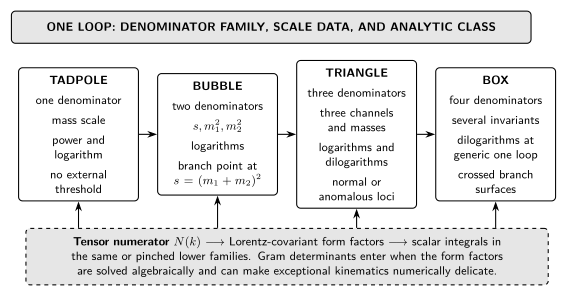
One-loop tensor reduction reuses the basic one- through four-point scalar hierarchy shown here; higher-point families may first require their own scalar reduction. The map is schematic and not to scale. Inverse Gram determinants arise from the chosen covariant basis and require a limiting expansion or alternative basis near exceptional kinematics.
At generic kinematics this procedure is the Passarino–Veltman reduction described in Weinzierl 2022, §5.1, pp. 138–140. Near a Gram-degenerate point, safer options include expanding the unreduced parameter representation, choosing tensors adapted to the lower-dimensional span, or evaluating a basis whose coefficients remain finite.
Numerator algebra versus integrand equivalence
Section titled “Numerator algebra versus integrand equivalence”The identity holds pointwise. Other reductions may discard total derivatives or “spurious” numerator structures only after integration in dimensional regularization. Those are equivalence statements under the integral sign, not pointwise equality of rational functions. Keeping that distinction becomes essential in integrand reconstruction.
Exercises
Section titled “Exercises”- Set in the rank-one result. Then for the routing , consistent with the change .
- Why can appear in a coefficient without a physical pole? It comes from inverting the tensor-coordinate system; the full contracted integral can have cancellations that are hidden term by term.
Where numerator reduction leads
Section titled “Where numerator reduction leads”- Integration-by-Parts Identities and Master Integrals extends scalar-family reduction to shifted powers, irreducible numerators, and multiloop identities.
- Generalized Unitarity and Integrand Reduction explains when numerator relations are pointwise cut constraints and when they hold only modulo surface terms.
References
Section titled “References”- Weinzierl, Stefan. Feynman Integrals. Cham: Springer, 2022. doi:10.1007/978-3-030-99558-4. Open PDF.
Original QFT.org content:CC BY 4.0, unless an item supplies different terms. Third-party material retains its own terms.