

Rapidity Divergences, Glauber Exchange, and Factorization Limits
Two distinct obstructions can invalidate a naive hard–jet–soft separation. First, soft and collinear modes of equal virtuality may be separated only by rapidity, leaving an unregulated integral at fixed invariant mass. Second, spacelike Glauber exchange can be pinched between oppositely directed sectors and preserve color correlations that ordinary soft decoupling does not remove. Neither effect is diagnosed by a virtuality scale alone.
Required background. Eikonal Approximation and Wilson Lines supplies the causal denominators whose poles can pinch. Hard, Jet, and Soft Factorization supplies the candidate factorization structure to be tested.
Helpful background. Collinear Factorization and Splitting Amplitudes fixes the strict collinear limit. Expansion by Regions explains region expansions and overlaps. Measurement Functions and Inclusive Observables states the measurement conditions used in cancellation arguments.
Rapidity can diverge at fixed virtuality
Section titled “Rapidity can diverge at fixed virtuality”Write and . At fixed nonzero product , a boost of parameter acts as
without changing . A factorized soft or collinear integral can then contain
Dimensional regularization changes the integration over invariant mass and transverse momentum, but it does not bound this boost orbit. The separate sector therefore needs an additional rapidity regulator.
A cut eikonal integral isolates the problem without an ordinary transverse endpoint. Work in , set , and choose a smooth nonzero test function supported on a finite interval away from both zero and infinity. Define
On the positive-energy mass shell, . Parameterize
The on-shell delta function and light-cone Jacobian then give
The transverse factor is finite by construction, while dimensional continuation does nothing to the dimensionless translation-invariant integral. With a diagnostic cutoff ,
Thus the divergence remains even after ordinary invariant-mass endpoints have been removed. The cutoff diagnoses the missing regulator; it is not itself a rapidity-renormalization scheme or a detector resolution.
Such a regulator temporarily breaks boost invariance and introduces a rapidity scale ; the combined observable must lose both the regulator and the arbitrary scale. In a two-jet example the consistency condition is schematically
Different analytic, exponential, tilted-Wilson-line, or delta regulators allocate finite terms differently. A rapidity anomalous dimension is therefore scheme dependent sector by sector, while the consistently combined prediction is not. Chiu, Jain, Neill, and Rothstein define the divergence at fixed invariant mass and construct one rapidity renormalization scheme in Chiu et al. 2012, §§ 2 and 4.1–4.2, printed pp. 3–5 and 10–16, PDF.
The scale map below distinguishes ordinary virtuality evolution from this optional rapidity evolution. A arrow belongs only to a factorization whose modes have the relevant equal-virtuality separation.
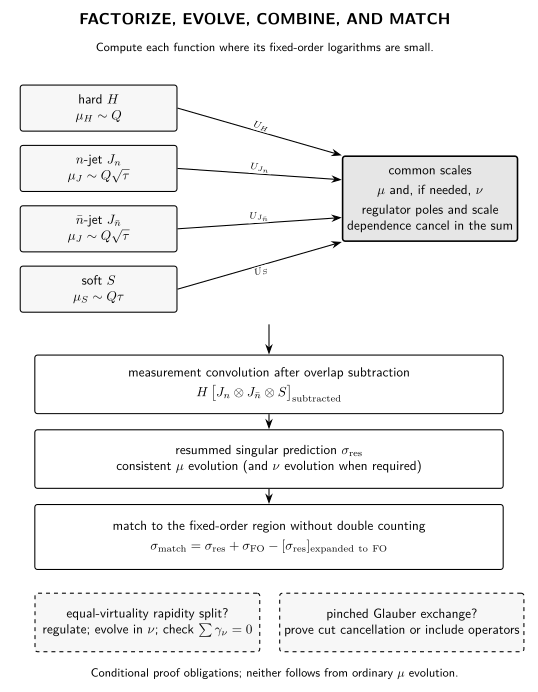
Virtuality evolution in does not automatically regulate an unbounded rapidity separation or account for a pinched Glauber region. The flow and Glauber boundary are conditional additions to a process-specific factorization argument. The diagram is schematic and not to scale.
Glauber scaling and the failed deformation
Section titled “Glauber scaling and the failed deformation”For two energetic directions, a Glauber momentum has representative scaling
It is spacelike and ordinarily virtual. Although every component is small compared with , its transverse virtuality is of the same order as on an energetic line. Consequently the condition needed to drop from a hard propagator, , is not uniformly satisfied. The naive eikonal remainder can remain leading.
For a local pole diagnostic, hold the transverse and external components fixed in a high-energy box routing and let be real. Two longitudinal denominators can reduce to
Their poles,
approach the real contour from opposite sides and meet at , , which has Glauber longitudinal scaling. In the crossed routing the second denominator instead has the form ; both displayed poles then lie below the contour. Provided the arc at infinity vanishes and no other propagator obstructs the move, that contour can be deformed away. This pair is a diagnostic, not a complete graph calculation: every denominator and its must be checked. The full box and crossed-box analysis appears in Rothstein and Stewart 2016, § 5.2.1, printed pp. 34–37, PDF.
Whether this region is independent is a contour question. If the longitudinal poles can be deformed away, the apparent Glauber contribution is already contained in an ordinary soft approximation or vanishes. If initial- and final-state denominators trap the contour on opposite sides, the deformation fails. One must then prove cancellation after the specified sum over cuts, include an explicit Glauber operator with its soft overlap subtracted, or abandon the proposed factorization. Schwartz, Yan, and Zhu analyze the scaling, containment, and strict-collinear violations in Schwartz, Yan, and Zhu 2017, §§ 2–5, printed pp. 7–31, PDF.
Inclusive color-singlet production can admit cancellation after summing appropriate final-state cuts, but that conclusion depends on the measurement not resolving the spectator exchanges. Less inclusive hadron–hadron observables can retain non-Abelian color entanglement between the two incoming hadrons. Rogers and Mulders exhibit a counterexample to even generalized TMD factorization for a class of high-transverse-momentum hadroproduction observables in Rogers and Mulders 2010, §§ III–VI, printed pp. 7–16, PDF. It is a counterexample to a general formula, not a claim that every TMD observable violates factorization.
Three diagnostics that must not be conflated
Section titled “Three diagnostics that must not be conflated”| Symptom | Mathematical origin | Required response |
|---|---|---|
| Soft–collinear overlap | Two sector expansions reproduce the same limiting momentum region | Zero-bin, soft division, or an equivalent overlap subtraction |
| Rapidity divergence | An unbounded boost integral at fixed invariant mass remains in a separated sector | Rapidity regulator, subtraction, scale , and cancellation/evolution across sectors |
| Glauber obstruction | Spacelike exchange is trapped by causal poles or leaves inter-sector color correlations | Contour/cut cancellation proof, explicit Glauber operators with overlap control, or a factorization-breaking term |
A zero-bin subtraction can itself expose a rapidity pole, and a Glauber operator requires soft–Glauber overlap subtraction, but those connections do not make the concepts interchangeable. Rothstein and Stewart construct an operator description for forward scattering and its overlap subtractions in Rothstein and Stewart 2016, §§ 4–8, printed pp. 21–91, PDF.
A practical factorization-limit check
Section titled “A practical factorization-limit check”Before using a separated formula, ask:
- Are all sector integrals regulated, including fixed-virtuality rapidity limits?
- Do and, where present, dependences cancel in the stated convolution?
- Have all soft–collinear and soft–Glauber overlaps been subtracted exactly once?
- Can the Glauber contour be deformed, or does a cut sum cancel the pinched contribution for this measurement?
- Does color remain factorized into independently defined sector matrix elements?
- What power corrections, nonperturbative scales, or measurement boundaries limit the statement?
A “yes” for one process and observable cannot be transferred solely by matching the names of its functions. Wilson-line directions, initial/final orientations, color representations, and the measurement all enter the proof.
Check your understanding
Section titled “Check your understanding”Hold fixed and make the change of variables . Verify that . Then insert the Glauber scaling into and compare with for an -collinear hard momentum. Explain why “all components are soft” is not enough to justify the eikonal expansion uniformly.
References
Section titled “References”- Chiu, Jui-yu, Ambar Jain, Duff Neill, and Ira Z. Rothstein. “A Formalism for the Systematic Treatment of Rapidity Logarithms in Quantum Field Theory.” Journal of High Energy Physics 05 (2012): 084, esp. §§ 2 and 4.1–4.2. doi:10.1007/JHEP05(2012)084. Open PDF.
- Rogers, Ted C., and Piet J. Mulders. “No Generalized TMD-Factorization in the Hadro-Production of High Transverse Momentum Hadrons.” Physical Review D 81 (2010): 094006, esp. §§ III–VI, printed pp. 7–16 of the author manuscript. doi:10.1103/PhysRevD.81.094006. Open PDF.
- Rothstein, Ira Z., and Iain W. Stewart. “An Effective Field Theory for Forward Scattering and Factorization Violation.” Journal of High Energy Physics 08 (2016): 025, esp. §§ 4–8. doi:10.1007/JHEP08(2016)025. Open PDF.
- Schwartz, Matthew D., Kai Yan, and Hua Xing Zhu. “Collinear Factorization Violation and Effective Field Theory.” Physical Review D 96 (2017): 056005, esp. §§ 2–5, printed pp. 7–31 of the author manuscript. doi:10.1103/PhysRevD.96.056005. Open PDF.
Original QFT.org content:CC BY 4.0, unless an item supplies different terms. Third-party material retains its own terms.