

Generalized Unitarity and Integrand Reduction
Generalized unitarity reconstructs loop information by imposing several internal on-shell equations and matching the resulting factorization into tree amplitudes. Ordinary two-particle cuts constrain discontinuities; higher-codimension cuts isolate fewer integral topologies and can determine coefficients or numerator parameters algebraically. Completeness depends on the dimension, ansatz, allowed surface terms, and information invisible to the chosen cuts.
Required background. Cutkosky Cutting Rules supplies the physical two-particle cut from which the generalization begins; Complex Momenta and Factorization supplies complex on-shell solutions and tree factorization; and One-Loop Integral Families and Analytic Functions supplies the scalar basis whose coefficients can be matched.
Helpful background. Integration-by-Parts Identities and Master Integrals explains why integral-level master coefficients need not coincide with coefficients of a chosen pointwise integrand basis.
Cutting an amplitude ansatz
Section titled “Cutting an amplitude ansatz”At one loop, suppose a regulated amplitude has been organized as
where are scalar boxes, triangles, bubbles, and tadpoles in a stated dimension, while denotes terms not captured by a strictly four-dimensional cut basis. Applying the same cut to both sides gives linear equations for .
For a cut shared by several topologies, the reconstruction equation is triangular rather than diagonal:
where denotes surface or spurious terms in the declared representation. Maximal cuts determine parent coefficients first. On a lower cut, their known contributions must be subtracted before solving for daughters. A double-cut product of trees is therefore not by itself “the bubble coefficient” when boxes or triangles share the same cut.
On the amplitude side, cutting propagators factorizes the integrand into a product of on-shell tree amplitudes. The internal-state sum must use the state space of the declared dimensional and regularization scheme:
The equality is on the cut solution set, not throughout loop-momentum space. Double cuts leave a phase-space integration and often mix several topologies. Triple and quadruple cuts impose more constraints and can isolate individual terms.
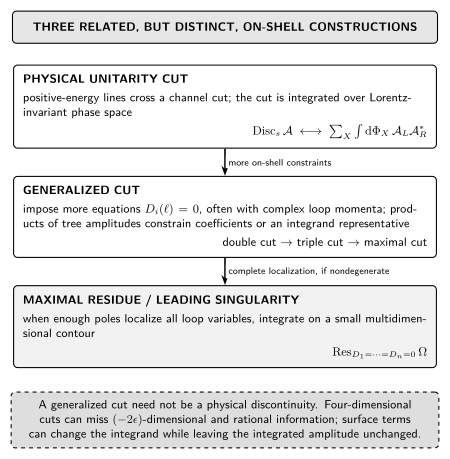
Generalized unitarity increases the number of on-shell constraints to isolate loop data. The diagram is schematic and not to scale; generalized solutions may be complex, and four-dimensional cuts do not automatically capture dimensional or rational terms.
Quadruple localization at one loop
Section titled “Quadruple localization at one loop”In four complex loop-momentum variables, four independent equations
can have isolated solutions . Near a nondegenerate solution, the multidimensional residue contains the Jacobian
Matching the residue of the amplitude ansatz to the product of four trees can then read off a box coefficient, after summing the relevant solutions and using the same contour normalization on both sides. This localization is demonstrated for one-loop super-Yang–Mills amplitudes in Britto, Cachazo, and Feng 2005, §§1–2, pp. 275–285. Their box-only and cut-constructibility assumptions are theory-specific; the localization principle is broader than that example.
For a common scalar-box normalization with two isolated solutions , the coefficient takes the schematic form
after the amplitude and scalar-box Jacobians are matched. The factor and this compact form depend on basis and contour normalization; the invariant statement is equality of oriented residues at every solution.
Integrand reduction and surface terms
Section titled “Integrand reduction and surface terms”A more general one-loop integrand ansatz writes the numerator polynomial over a denominator set as coefficients of master numerators plus spurious or surface terms. Sampling multiple-cut solutions determines those coefficients hierarchically: maximal cuts first, then lower cuts after subtracting already determined contributions. The explicit box-to-tadpole decomposition and reconstruction of rational terms are developed in Ossola, Papadopoulos, and Pittau 2007, §§2–4, pp. 151–165.
Two integrands can differ by a total derivative whose regulated integral vanishes:
They need not be pointwise equal. A reconstruction must therefore state whether it seeks a particular integrand representative, an equivalence class modulo surface terms, or only integrated master coefficients.
Four-dimensional versus d-dimensional information
Section titled “Four-dimensional versus d-dimensional information”In dimensional regularization with , decompose
where is four-dimensional and lies in the -dimensional complement. Terms proportional to vanish when cuts and state sums are restricted strictly to four dimensions, yet after integration they can contribute finite rational pieces. A complete non-supersymmetric amplitude may therefore require -dimensional unitarity, dimension-shift relations, or an independently reconstructed rational term.
This is not merely a numerical correction. It is a statement about what the sampled cut equations can see. Completeness must be proved for the chosen numerator degree, dimensional scheme, and basis.
Exercises
Section titled “Exercises”- Why does a quadruple cut isolate a generic one-loop box more sharply than a double cut? Four independent equations can localize all four complex loop components, while two leave a continuum and several topologies sharing the channel.
- Give an example of cut-invisible information. A numerator term proportional to vanishes on strictly four-dimensional solutions but can integrate to a rational finite contribution.
Where generalized cuts lead
Section titled “Where generalized cuts lead”- Leading Singularities and Integrand Geometry treats a fully localized cut as an oriented multidimensional residue and states what that local datum can establish.
- Integration-by-Parts Identities and Master Integrals supplies the integrated equivalence relations needed when the desired output is a master coefficient rather than a pointwise integrand representative.
References
Section titled “References”- Britto, Ruth, Freddy Cachazo, and Bo Feng. “Generalized Unitarity and One-Loop Amplitudes in Super-Yang–Mills.” Nuclear Physics B 725 (2005): 275–305. doi:10.1016/j.nuclphysb.2005.07.014. Open PDF.
- Ossola, Giovanni, Costas G. Papadopoulos, and Roberto Pittau. “Reducing Full One-Loop Amplitudes to Scalar Integrals at the Integrand Level.” Nuclear Physics B 763 (2007): 147–169. doi:10.1016/j.nuclphysb.2006.11.012. Open PDF.
Original QFT.org content:CC BY 4.0, unless an item supplies different terms. Third-party material retains its own terms.