

The Optical Theorem and Cut Interpretation
In the forward limit, unitarity equates the absorptive part of the elastic amplitude with the inclusive probability for the initial state to produce anything allowed. With the standard invariant flux, . A cut diagram is the perturbative image of the same complete on-shell state insertion; it is not an independent probability rule or a proof of the Cutkosky theorem.
Required background. S-Matrix Unitarity supplies the complete-state identity. Cross Sections and Decay Rates supplies the flux and phase-space normalization.
Match the state sum to the total cross section
Section titled “Match the state sum to the total cross section”For two incoming particles,
and the inclusive total cross section is
The forward unitarity relation therefore becomes
For equal masses in the center-of-mass frame,
For spinful beams the diagonal statement applies to the prepared initial density matrix, not automatically to a spin average. If is positive and normalized, then
Choosing gives the unpolarized theorem; a pure polarized beam uses a rank-one projector. Off-diagonal helicity amplitudes by themselves need not have positive imaginary parts.
This flux factor is convention-sensitive. The invariant checkpoint is the full event rate: translating the state or amplitude normalization must leave and the displayed equality unchanged. The same normalization is stated in Particle Data Group 2025, review 50, § 50.1.2, eqs. (50.5)–(50.7), printed pp. 7–8, PDF. The complete-state derivation and its forward specialization are given in Schwartz 2014, § 24.1, printed pp. 452–465 and Weinberg 1995, § 3.6, printed pp. 147–151.
The discontinuity and the cut
Section titled “The discontinuity and the cut”In a real-analytic domain, the upper- and lower-rim boundary values satisfy
Perturbatively, an allowed intermediate state becomes on shell at its threshold. Replacing the corresponding propagators by on-shell delta distributions and summing over the cut states reproduces the phase-space side of unitarity at the appropriate order. The figure makes the normalization logic explicit.
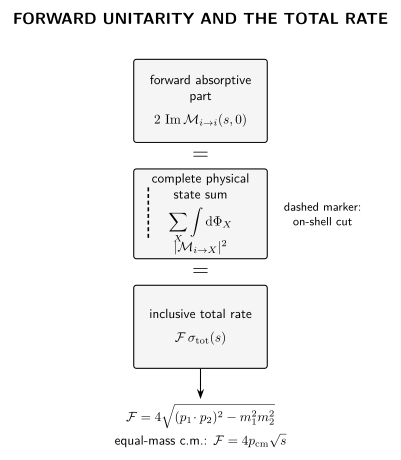
The forward discontinuity equals the complete physical-state sum, and the same sum divided by the incoming flux is . The schematic cut does not select only visible or two-body states and is not a substitute for the later Cutkosky derivation.
At a fixed perturbative order, only cuts compatible with that order and the external quantum numbers contribute. For example, the imaginary part of a one-loop two-point or four-point graph is related to products of tree amplitudes when the corresponding intermediate particles can be on shell. Below threshold the phase space is empty, so that contribution has no absorptive part.
Normalization and interpretation checks
Section titled “Normalization and interpretation checks”- Dimensions: in four dimensions is dimensionless, has dimension two, and has dimension minus two.
- Positivity: for the forward diagonal amplitude with this convention; no analogous sign follows for an arbitrary off-diagonal amplitude.
- Inclusivity: every open asymptotic channel appears. Restricting to one exclusive final state gives a contribution, not the total theorem.
- Forward limit: the initial and final states, including spin and other labels, must coincide before positivity is invoked.
- Infrared safety: in theories with massless quanta, an exclusive Fock-state total rate may be infrared divergent or the assumed asymptotic states may fail. The identity then requires an appropriate inclusive or dressed observable framework.
Experimental luminosity and hadronic applications are separate handoffs; Cutkosky cutting rules give the later diagrammatic proof. The optical theorem is an exact -matrix statement only when the required asymptotic-state and observable definitions exist.
Check your understanding
Section titled “Check your understanding”Starting from the invariant rate, multiply by the flux and compare term by term with forward unitarity. In equal-mass center-of-mass kinematics, derive . A factor-of-two error appears immediately if is confused with .
Solution
Summing gives , exactly the right side of forward unitarity. Since , the invariant flux is . Finally, only when the lower rim is the conjugate boundary value; omitting either the or the spoils the comparison.
References
Section titled “References”- Particle Data Group. “Resonances.” In Review of Particle Physics, 2025 Update, review 50, § 50.1.2, printed pp. 7–8. Official PDF.
- Schwartz, Matthew D. Quantum Field Theory and the Standard Model. Cambridge University Press, 2014, § 24.1, printed pp. 452–465. doi:10.1017/9781139540940.
- Weinberg, Steven. The Quantum Theory of Fields, Volume I: Foundations. Cambridge University Press, 1995, § 3.6, printed pp. 147–151. doi:10.1017/CBO9781139644167.
Original QFT.org content:CC BY 4.0, unless an item supplies different terms. Third-party material retains its own terms.