

S-Matrix Unitarity
Writing , the operator identity is equivalent to . Between scattering states, a complete-state insertion turns its right side into a sum over all kinematically allowed on-shell intermediate states. Thus the absorptive part at one perturbative order is fixed by products of lower-order amplitudes, with the same state and phase-space normalization used in the cross section.
Required background. S-Matrix and T-Matrix Normalization supplies the delta-function and state conventions. Hilbert Positivity and Unitary Evolution supplies the operator-level meaning and limitations of unitarity.
From the operator identity to amplitudes
Section titled “From the operator identity to amplitudes”Expand
It follows that
Use relativistically normalized states and define
The first subscript labels the final state and the second the initial state.
Inserting a complete set of asymptotic states yields, after the common overall delta function is removed,
Here the sum includes particle species, spins, colors, and every multiplicity. The measure is the volume-wide labeled invariant measure, while divides out permutations of each identical species in the intermediate state. For ,
The inequality is a forward, diagonal statement. A generic off-diagonal imaginary part need not be positive. Schwartz derives this normalization in Schwartz 2014, § 24.1, printed pp. 452–465, while Weinberg gives the complete-state form and its scattering consequences in Weinberg 1995, § 3.6, printed pp. 147–151.
The statement can also be projected onto a selected set of channels. If projects onto retained asymptotic states and , then
The second term is positive on a forward diagonal matrix element. Omitting open channels while imposing equality with only the first term is therefore not a unitary truncation; it undercounts absorption. Below the first omitted threshold the phase space can vanish, which explains when a reduced channel description can be exact.
Connected pieces and spectator delta functions
Section titled “Connected pieces and spectator delta functions”The full -matrix contains disconnected terms. On both sides of the unitarity relation, identical spectator delta functions must be matched before one isolates the connected amplitude relation. Treating every disconnected product as a new connected channel double counts processes and leaves powers of the spacetime volume.
For the forward connected relation, the identity component has already been separated by . Intermediate states are nevertheless fully inclusive: two-particle, multiparticle, and any other allowed asymptotic channels all contribute. A truncated channel sum gives a valid equality only below the first omitted threshold or within a declared approximation.
The figure previews the forward specialization. Its dashed cut denotes the complete on-shell state sum, not a literal operation on an arbitrary diagram.
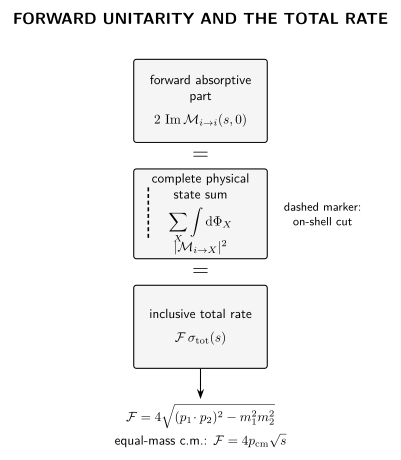
Unitarity matches the forward discontinuity to a convention-normalized sum over physical intermediate states. The diagram is schematic: Cutkosky rules provide a later diagram-by-diagram implementation, while the operator identity already requires a complete asymptotic-state basis.
Perturbative order counting
Section titled “Perturbative order counting”Expand . At order ,
If a four-point tree amplitude begins at , its one-loop imaginary part at is fixed by the phase-space integral of two tree amplitudes. A real tree amplitude below all propagator poles therefore does not violate unitarity; its absorptive part first appears when the perturbative right side has the corresponding order and an open intermediate channel.
For a concrete normalization check, take identical real scalars with . Above , the two-scalar intermediate state contributes and , so at order the forward relation gives
This is the absorptive part of the physical -channel bubble in the present normalization. Below threshold is not a physical phase-space factor and the state-sum contribution is zero; analytic continuation of the loop is a separate statement.
This order-by-order identity does not license selective resummation. Adding a width to one propagator while leaving other terms at tree order can spoil the same cancellations used to prove gauge identities. Generalized cuts and positivity bounds require additional structure: continue to generalized unitarity for cut-based reconstruction and to forward-limit positivity bounds only after the analytic and growth hypotheses are in place. The operator-level meaning of unitary time evolution remains with the foundational page linked above.
Check your understanding
Section titled “Check your understanding”Assume . Derive the anti-Hermitian part of and state which intermediate states are present. The check passes only if the complex conjugation reverses initial and final labels and the phase-space measure matches the state normalization.
Solution
The coefficient of in is
Between states and , insert the complete asymptotic identity to obtain . The sum contains every kinematically open physical state reachable at first order, including its spin/species sums; supplies its identical-particle factor. It is not restricted to the elastic channel unless all others are closed or excluded by exact quantum numbers.
References
Section titled “References”- Schwartz, Matthew D. Quantum Field Theory and the Standard Model. Cambridge University Press, 2014, § 24.1, printed pp. 452–465. doi:10.1017/9781139540940.
- Weinberg, Steven. The Quantum Theory of Fields, Volume I: Foundations. Cambridge University Press, 1995, § 3.6, printed pp. 147–151. doi:10.1017/CBO9781139644167.
Original QFT.org content:CC BY 4.0, unless an item supplies different terms. Third-party material retains its own terms.