

Cutkosky Cutting Rules
Cutkosky rules compute the discontinuity of a Feynman integral across an appropriate physical branch cut by replacing the propagators crossed by the cut with positive-energy on-shell delta functions. The result is a Lorentz-invariant phase-space integral. The channel, energy flow, sheet, and normalization must be fixed before the familiar “put lines on shell” shorthand has a definite meaning.
Required background. The Optical Theorem and Cut Interpretation supplies the unitarity relation between an amplitude discontinuity and sums over physical intermediate states; Landau Equations and Physical Singularities supplies the candidate pinch locus across which the discontinuity is taken.
Distribution identity and cut propagator
Section titled “Distribution identity and cut propagator”Define
The one-variable distribution identity is
For a reciprocal scalar denominator on a cut with momentum oriented from the amplitude to its conjugate, the replacement is therefore
If the Feynman rule includes the numerator , the convention-complete replacement is
Thus a reciprocal denominator contributes , whereas a full scalar propagator contributes . The difference is an exact factor of , not an optional sign convention. One must still state whether the object being cut is the denominator-only integral, , or .
The distributional derivation, positive-energy direction, and relation to phase space are worked out in Schwartz 2014, §24.1.2, pp. 456–459. Cutkosky’s original general statement appears in Cutkosky 1960, pp. 429–433.
From the optical theorem to a channel cut
Section titled “From the optical theorem to a channel cut”Write . Unitarity gives
Inserting a complete set of stable asymptotic states produces
With the volume’s and amplitude convention, Hermitian analyticity gives the equivalent physical-channel form
Diagrammatically, a valid cut separates the graph into two sides and puts every crossed line on shell with positive energy flowing consistently across the cut. Uncut propagators retain their boundary prescriptions. The largest-time identity ensures that all admissible separating cuts are included; replacing an arbitrary subset of denominators does not by itself give the discontinuity theorem.
This is stronger than imposing arbitrary equations . It includes a real physical channel, positive-energy support, conjugation, polarization sums, and phase-space integration.
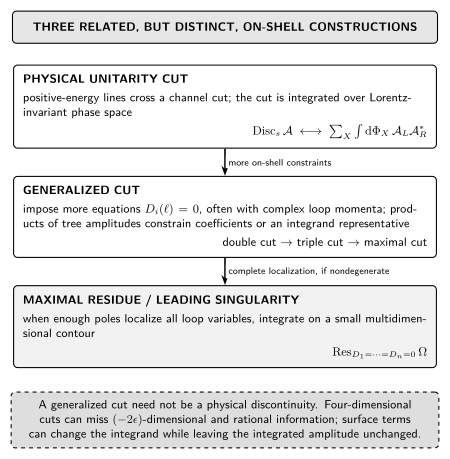
Physical, generalized, and maximal cuts use related on-shell equations but support different claims. The diagram is schematic and not to scale; only the first stage necessarily represents a physical-channel discontinuity integrated over positive-energy phase space.
Equal-mass bubble discontinuity
Section titled “Equal-mass bubble discontinuity”Use the finite scalar function
For , the logarithm crosses its cut between , with
Thus
For the denominator-only master
the two reciprocal replacements give
This agrees with . The negative real discontinuity is not a conflict with positivity: omits the propagator numerators and vertex phases. If a distinct-scalar interaction is normalized so that , then
exactly the positive forward state sum. This phase check fixes the denominator replacement, loop prefactor, labeled phase-space normalization, and amplitude convention simultaneously.
Scope and limitations
Section titled “Scope and limitations”Cutkosky rules determine discontinuities, not subtraction constants or the complete real part. A dispersion relation can reconstruct more information only after its analyticity domain and required subtractions are supplied. Renormalized amplitudes may require counterterm contributions, and massless theories require an infrared-safe combination before interpreting a cut as a finite probability.
Unstable resonances are not ordinary asymptotic states in the completeness sum. Thermal states, finite-density contours, and non-Feynman boundary conditions also require modified cutting formalisms.
Exercises
Section titled “Exercises”- Derive the sign in the reciprocal-denominator identity from .
- Why is insufficient for a physical cut? It includes both energy roots; the channel cut needs a consistent positive-energy orientation, expressed by .
Where physical cuts lead
Section titled “Where physical cuts lead”- Generalized Unitarity and Integrand Reduction adds possibly complex on-shell constraints to isolate loop coefficients or numerator data without interpreting every cut as a physical phase space.
- Damping Rates, Thermal Cuts, and Quasiparticle Widths modifies the vacuum cutting logic for medium occupation factors and thermal quasiparticles.
References
Section titled “References”- Cutkosky, Richard E. “Singularities and Discontinuities of Feynman Amplitudes.” Journal of Mathematical Physics 1 (1960): 429–433. doi:10.1063/1.1703676.
- Schwartz, Matthew D. Quantum Field Theory and the Standard Model. Cambridge: Cambridge University Press, 2014. doi:10.1017/9781139540940.
Original QFT.org content:CC BY 4.0, unless an item supplies different terms. Third-party material retains its own terms.