

Beyond-Forward Positivity
Beyond the forward limit, derivatives probe the angular distribution of absorptive states and full –– crossing relates coefficients that forward moments treat independently. The strengthening is real, but no universal sign attaches to every mixed derivative: one must construct combinations whose entire dispersive weight is nonnegative.
Required background. Forward-limit positivity bounds supplies the positive forward measure. Fixed-t and partial-wave dispersion supplies the analytic domain and positive angular derivatives.
Mixed derivatives and positive partial-wave weights
Section titled “Mixed derivatives and positive partial-wave weights”For identical massive scalars, remove low-energy poles and use
For , define derivative data at the crossing-symmetric point by
To expose the signs, write
and introduce the nonnegative spectral integrals
Here , where is the first remaining -channel singularity after the displayed pole subtraction; differentiating under the integral and partial-wave sum is assumed justified. In the minimal equal-mass elastic example , but additional lighter exchanged states can lower the endpoint. For one derivative, direct differentiation of the kernel gives
The second line is not sign definite. Support on implies
so the adjusted combination
has a nonnegative complete weight. Higher- bounds recursively combine with already constructed lower- quantities; replacing that recursion by a sign claim for a raw mixed derivative is invalid. The hierarchy, including the exact recursion and its mass-gap domain, is derived in de Rham et al. 2017, eqs. (12)–(17) and (23), pp. 2–4, PDF.
Improved bounds subtract known infrared weight
Section titled “Improved bounds subtract known infrared weight”If the low-energy theory predicts the absorptive part reliably through a cutoff in the crossing variable, where has mass dimension two, split a forward moment as
Hence the infrared-subtracted quantity
is nonnegative in the exact split where equals the full absorptive part below , and it is strictly positive when spectral weight remains above the cutoff. At finite EFT order the same statement carries the truncation and perturbative error of the low-energy integral. Because a known positive contribution has been removed, this can constrain the remaining local coefficient more strongly. The subtraction and amplitude coefficient must use the same normalization and compatible perturbative and EFT orders; subtracting a tree estimate from a loop-sensitive exact moment is not controlled.
Full crossing and convex constraints
Section titled “Full crossing and convex constraints”Forward positivity uses . For an identical scalar, the amplitude also obeys , so an expansion in symmetric invariants contains fewer independent coefficients than a generic series in and . Combining these linear crossing relations with positive partial-wave averages yields both linear and nonlinear inequalities. Cauchy–Schwarz, for example, gives moment constraints of the form
while full crossing relates mixed coefficients to the same positive measure. The first nonlinear examples are derived from an explicitly positive partial-wave density in Tolley, Wang, and Zhou 2021, § 3, pp. 7–10, PDF.
The normalized two-moment slice below shows the simplest convex projection. In a full beyond-forward analysis, each allowed partial wave and spectral scale generates a ray in a higher-dimensional coefficient space; positive superpositions form a convex cone, and crossing intersects that cone with a linear subspace.
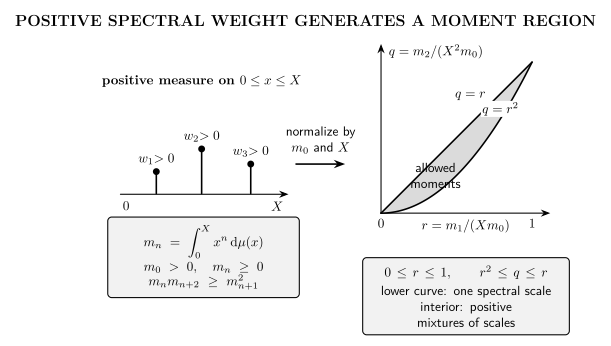
Schematic two-dimensional slice of the positive-moment cone. The displayed region follows from a compact positive measure; beyond-forward derivatives add angular-momentum labels and crossing hyperplanes rather than removing the need for positive weights. The picture is not a numerical bound for a particular EFT.
| Geometric object | Dispersive meaning |
|---|---|
| generating ray | one spectral scale and partial wave with positive weight |
| positive mixture | an inclusive superposition of states and angular momenta |
| Hankel boundary | saturation of a Cauchy–Schwarz moment inequality |
| crossing hyperplane | exact linear relation among expansion coefficients |
| projected allowed region | necessary coefficient constraints after eliminating unobserved moments |
This moment interpretation and its finite-dimensional Hankel tests are developed in Bellazzini et al. 2021, § I.A–B, pp. 2–5, PDF.
Assumption checks before applying a bound
Section titled “Assumption checks before applying a bound”- State and crossing sector: specify species, polarizations, internal indices, and the elastic quadratic form whose absorptive part is nonnegative.
- Analytic domain: state the interval in connecting the physical region to and list every pole removed inside it.
- Subtraction count: prove or assume the large- behavior at that fixed ; do not borrow a forward bound without checking uniformity.
- Derivative combination: display the nonnegative partial-wave kernel or cite its exact construction. A bare derivative is insufficient.
- Infrared subtraction: include light poles, cuts, and loops to one consistent order, with a declared matching scale.
- Crossing completeness: distinguish bounds from constraints using full –– symmetry.
For spin or multiple species, crossing matrices and polarization kinematics can spoil a scalar sign at intermediate steps. The scalar cone is orientation, not a complete spinning classification.
Exercises
Section titled “Exercises”Explain why does not by itself prove .
Check
The two derivatives remove the subtraction function, but the derivative still acts on the dispersive denominator. In the notation above this produces the negative term in . A positivity claim requires an adjusted combination, such as , whose complete spectral kernel is nonnegative.
Apply these constraints to EFT data: EFT Positivity and UV Consistency. If a massless exchange reaches the forward point: Massless Exchange and Infrared Subtractions.
References
Section titled “References”- Bellazzini, Brando, Joan Elias Miró, Riccardo Rattazzi, Marc Riembau, and Francesco Riva. “Positive Moments for Scattering Amplitudes.” Physical Review D 104 (2021): 036006. DOI. Open PDF.
- de Rham, Claudia, Scott Melville, Andrew J. Tolley, and Shuang-Yong Zhou. “Positivity Bounds for Scalar Theories.” Physical Review D 96 (2017): 081702. DOI. Open PDF.
- Tolley, Andrew J., Zi-Yue Wang, and Shuang-Yong Zhou. “New Positivity Bounds from Full Crossing Symmetry.” Journal of High Energy Physics 05 (2021): 255. DOI. Open PDF.
Original QFT.org content:CC BY 4.0, unless an item supplies different terms. Third-party material retains its own terms.