

Quantum Information in QFT
Quantum information in quantum field theory begins with a choice that finite-dimensional notation often hides: what counts as the subsystem? A spacetime region naturally determines an algebra of observables and a restricted state, but generally not a tensor factor with its own density matrix. Entropies may therefore require a regulator, a split inclusion, or a finite-mode approximation, while relative entropy, modular flow, channels, and operational tasks can often be formulated directly for algebras. This algebra-first viewpoint is the central lesson of Witten 2018, §§2–3.
The volume develops four distinct kinds of statement: intrinsic continuum structure, regulated constructions, causal operational tasks, and definition-sensitive resource proposals. Moving between them is allowed only after the needed assumptions are stated. The goal is not merely to calculate an information quantity, but to determine which quantity answers the physical question and exactly what the calculation establishes.
Helpful background. Operator algebras and positive functionals supply algebras, commutants, states, and completely positive maps. Tensor products and index structure clarify what finite-system factorization would require. Relativistic causality and unitary evolution prepare the causal and dynamical constraints on operations. Schwinger functions prepare replica and Euclidean constructions. Ultraviolet and infrared fixed points prepare scale-dependent information diagnostics.
From a region to an information claim
Section titled “From a region to an information claim”A well-posed problem specifies at least six ingredients:
- Subsystem: a local algebra, commuting pair, split inclusion, regulated tensor factor, symmetry sector, channel input, or logical algebra.
- State or process: the states being compared, the preparation and time evolution, or the channel and complementary channel.
- Question: entropy, distinguishability, response, transport, extractable resource, communication, recovery, complexity, or estimation.
- Definition: the exact information measure, normalization, logarithm base, operational metric, and equality criterion.
- Domain: regulator, support and faithfulness, causal region, energy constraint, state class, spacetime dimension, and order of limits.
- Evidence: an identity, theorem, controlled approximation, reproducible computation, or dated observation, together with its failure tests.
Local nets make the first step precise by associating an observable algebra to each suitable spacetime region and enforcing isotony and locality; the physical framework and its limitations are developed in Haag 1996, ch. III, pp. 105–147. The same regional language does not by itself produce a Hilbert-space factorization. That distinction determines whether a density-matrix formula is intrinsic, regulated, or simply inapplicable.
The figure shows the volume-wide decision structure. Read from the physical question to the bounded conclusion. The four central branches are alternatives with different admissible definitions and checks, not interchangeable descriptions of one finite-dimensional calculation.
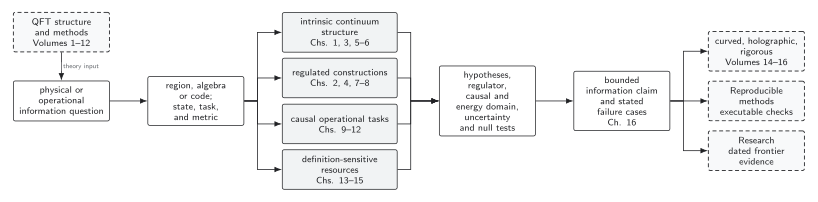
Every information statement must carry its subsystem, task, definition, and domain. Intrinsic algebraic results, regulated entropies, causal protocols, and resource proposals pass through different checks before they support a conclusion. Earlier volumes provide the QFT structure and methods; versioned implementations execute bounded checks; Research carries dated frontier evidence; Volumes 14–16 develop curved-spacetime, holographic, and theorem-first extensions. The diagram is schematic and not to scale.
In linear form, the same decision is:
- Use an algebraic route when the target is restriction of a state, relative entropy, modular structure, an inclusion, or a causal map on observables.
- Use a regulated route when the target explicitly needs a trace, density matrix, entanglement spectrum, replica partition function, covariance matrix, or finite code space. The regulator and its removal remain part of the result.
- Use an operational route when agents couple probes, select outcomes, signal, communicate, extract energy, or attempt recovery. Specify the complete protocol and causal support.
- Use a resource route only after fixing the allowed operations, reference structure, cost function, error metric, and energy or continuum domain. Complexity, accessible entanglement, and correctability are definition-indexed.
The sixteen chapters
Section titled “The sixteen chapters”| Chapter | Use it to answer | Defensible output |
|---|---|---|
| 1. Continuum Subsystems and Local Algebras | What does a spacetime region define when Hilbert-space factorization fails? | A typed algebra–state subsystem, with split, center, and operational qualifications |
| 2. Regulated Entropy and Replica Methods | Which entropy is being computed, by what regulated construction, and with what continuation? | A regulator- and branch-specific entropy statement with UV, IR, and continuation errors visible |
| 3. Relative Entropy, Distinguishability, and Recovery | Which comparison survives the continuum limit and what does data processing imply? | A domain-correct distinguishability or recovery bound with hypotheses and equality cases |
| 4. Universal, Multipartite, and Shape-Dependent Entanglement | Which combinations remove local divergences or isolate geometry, topology, and multipartite structure? | A universal or regulated quantity with dimension, state, shape, and subtraction scheme explicit |
| 5. Modular Operators and Geometric Flow | How do a state and algebra generate modular evolution, and when is that evolution geometric? | A modular operator or flow statement with standard-form, support, and convention data |
| 6. Modular Response and Quantum Information Geometry | How do nearby states encode first-law response, Fisher information, and modular curvature? | A perturbative response or information metric with its positivity and remainder domain |
| 7. Information Across Scales and Renormalization | Which information quantities are monotone or sufficient under coarse graining? | A scale-dependent comparison that separates physical RG input from information monotonicity |
| 8. Symmetry, Superselection, and Information Resources | What information is accessible when charge sectors, centers, grading, or reference frames matter? | Sector-resolved and operational resource accounting with the allowed operations specified |
| 9. Local Measurements, Detectors, and Instruments | Which localized coupling defines a measurement rather than an acausal projection rule? | A system–probe instrument with switching, smearing, noise, backreaction, and causal composition |
| 10. Causal Channels and Relativistic Communication | What can relativistic channels transmit or certify under spacetime and energy constraints? | A complete communication, harvesting, Bell, or capacity task with a causal support test |
| 11. Energy, Entropy, and Localization | How do passivity, energy inequalities, null bounds, and localization cost constrain information? | An inequality or protocol retaining its smearing, state, dimension, normalization, and domain |
| 12. Entanglement Dynamics and Information Transport | How is information redistributed after preparation, evolution, or monitoring? | A transport statement separating entanglement, correlations, operator information, and causal fronts |
| 13. Scrambling, Decoupling, and Recoverability | When does apparent information loss correspond to decoupling or failed recovery? | A diagnostic bundle with subsystem, channel, access structure, symmetry, and finite-size controls |
| 14. Complexity and Continuum Resource Costs | Which reference, gates, penalties, tolerance, and regulator define the proposed cost? | A definition-indexed comparison, never an unqualified scalar called “the complexity” |
| 15. Quantum Error Correction in Continuum Fields | Which algebra is correctable against which noise, by which recovery, in what metric and limit? | A complete exact or approximate QEC task with locality, symmetry, energy, and continuum controls |
| 16. Inference, Certification, and Evidence | How do field records support a bounded information statement? | A calibrated inference with uncertainty, continuum bias, adversarial alternatives, and replication criteria |
The order is prerequisite-aware, but readers need not traverse every chapter. The six paths below preserve the dependencies needed for common problems.
Six complete routes
Section titled “Six complete routes”From a region to a defensible entropy
Section titled “From a region to a defensible entropy”Begin with restricted states and subregion observables and diagnose factorization failure. If the question genuinely asks for a von Neumann or Rényi entropy, choose a regulated subregion entropy and either a replica geometry or another controlled estimator. Finish with continuum extrapolation, bias, and uncertainty. Free-field entropy methods and their regulator dependence are reviewed in Casini and Huerta 2009, §§2–4.
From distinguishability to recovery
Section titled “From distinguishability to recovery”Specify the state pair and algebra on Relative Entropy for QFT States, apply data processing, and use conditional mutual information only for a declared tripartite structure. Then select a recovery map and, in infinite dimensions, the appropriate energy-constrained channel distance. Araki’s algebraic relative entropy supplies positivity, lower semicontinuity, convexity, and monotonicity without requiring a local density matrix Araki 1976, pp. 809–833.
From modular flow to information geometry
Section titled “From modular flow to information geometry”Enter through standard form, cyclic and separating vectors, construct the Tomita–Takesaki modular objects, and distinguish generic algebraic flow from special geometric examples. Perturb the state only after fixing the relative-modular orientation; then proceed to the first law and quadratic corrections and quantum Fisher information.
From a local coupling to relativistic communication
Section titled “From a local coupling to relativistic communication”Start with operational locality and a localized probe model. State switching, spatial smearing, perturbative order, and readout before constructing the induced instrument. Only then compose causal quantum channels and formulate a channel-specific capacity, Bell, harvesting, or coding task. A response probability is not a particle number, and absence of leading-order signaling is not a nonperturbative causality proof.
From a quench to recovery
Section titled “From a quench to recovery”Declare the state preparation and regulator, identify which entanglement-growth mechanism is actually under study, and keep entanglement, mutual information, operator growth, and causal influence distinct. Continue to decoupling and recovery thresholds, then challenge the conclusion with finite-size and symmetry false positives. Volume 11 supplies the physical dynamics and chaos diagnostics; this volume determines what they imply about information access.
From an error model to continuum QEC
Section titled “From an error model to continuum QEC”Specify the logical algebra, encoding, noise, recovery, and metric in Error Models, Codes, and Recovery Conditions. Use information–disturbance to connect the recovered channel with its complement, add energy-constrained error when the Hilbert space is infinite-dimensional, and close the task with regulator refinement and code validation. A good finite code is not yet a continuum code unless its logical algebra, noise family, recovery guarantee, and order of limits converge together.
Check your preparation
Section titled “Check your preparation”| If you cannot yet… | Repair the capability at… | Why it matters here |
|---|---|---|
| distinguish an algebra from its commutant and a state from a density matrix | Operator algebras and positive functionals | local QFT information is algebra-relative |
| state when a tensor product represents independent subsystems | Tensor products and index structure | regulated factorization must not be mistaken for an intrinsic continuum split |
| turn microcausality into a support condition for operations | Relativistic causality | detector and channel claims require causal composition |
| distinguish unitary closed evolution from a channel or selective update | Unitary evolution | dynamics, measurement, and recovery are different maps |
| relate Euclidean correlation functions to Lorentzian observables | Schwinger functions | replica sewing and analytic continuation need a stated reconstruction domain |
| identify the fixed point and coarse-graining map in an RG statement | UV and IR fixed points | information monotonicity does not define the physical RG flow |
Conventions that travel with a result
Section titled “Conventions that travel with a result”The site-wide conventions fix natural units, the (+---) Lorentzian metric, natural logarithms unless otherwise stated, and the Fourier phase pair. Volume-specific information must travel with every exported formula:
| Subject | Minimum convention package | Invariant check |
|---|---|---|
| Algebra and state | algebra, commutant, representation, support, normality, faithfulness, standard-form orientation | restriction or relative-modular identity agrees |
| Entropy | subsystem prescription, logarithm base, regulator, subtraction, state, boundary conditions | a finite-dimensional or free-field benchmark agrees |
| Replica | Rényi index, normalization, sheet and cut orientation, twist convention, continuation variable | integer-sheet sewing and limit agree |
| Fermionic or sector-resolved quantity | covariance convention, grading, partial transpose or time reversal, center and charge projectors | positivity, normalization, and sector sum agree |
| Modular response | modular generator sign, relative-operator orientation, perturbation parameter, domain | first law and quadratic positivity agree |
| Detector or channel | coupling, switching, smearing, proper time, picture, selective status, complementary channel | spacelike composition and trace preservation agree |
| Energy–information statement | stress tensor, null vector, affine parameter, smearing, dimension, state and energy domain | dimensions, vacuum reference, and known saturation limit agree |
| Complexity or QEC | reference, targets, gates, penalties, tolerance; or logical algebra, noise, recovery, metric, energy and limit order | zero-cost identity or exact-correction condition agrees |
| Inference | estimator, calibration, likelihood, covariance, interval meaning, null model, evidence date | held-out benchmark and independent reconstruction agree |
Never compare two results merely “up to conventions.” Write the forward and inverse translations and close them on an invariant quantity.
Evidence and validity ladder
Section titled “Evidence and validity ladder”The strongest supported conclusion is set by the weakest unresolved step. A theorem cannot repair an uncontrolled regulator, and excellent numerical convergence cannot supply a missing theorem hypothesis.
| Level | What is established | Required check | What is not yet established |
|---|---|---|---|
| Finite-mode identity | Exact relation for a stated matrix, lattice, mode truncation, or code | Independent algebra or enumeration | Continuum QFT validity |
| Analytic benchmark | Exact or asymptotic result in a solvable state, geometry, or limit | Dimensions, signs, normalization, and limiting cases | Generic interacting behavior |
| Theorem | Conclusion under its full algebraic, analytic, causal, or energy hypotheses | Hypotheses, equality cases, domain, and cited proof | Extension beyond those hypotheses |
| Controlled regulator result | Regulator errors varied and propagated for a fixed target | Separate cutoff axes and matched renormalized observables | Regulator independence outside the tested range |
| Operational evidence | A complete preparation–interaction–readout protocol supports the stated task | Causal support, calibration, noise, backreaction, and selection | An intrinsic property independent of the protocol |
| Independent reproduction | Materially different methods agree after convention matching | Shared-assumption and adversarial-null analysis | Universality if all methods share the same blind spot |
| Bounded information claim | Subsystem, definition, domain, uncertainty, alternatives, and evidence date are explicit | Reproduce a held-out observable or limiting identity | Any broader theorem, platform, or frontier claim |
For a mutable computational, experimental, or frontier conclusion, attach the date of the evidence inspected. A durable equation does not need a novelty date; a claim about present capability does.
Interfaces with the rest of QFT.org
Section titled “Interfaces with the rest of QFT.org”Volumes 1–12 provide mathematics, field-theory structure, gauge construction, RG dynamics, computational machinery, CFT data, thermal and open-system dynamics, and material realizations. This volume uses those results to formulate information questions; it does not redefine their subjects. In particular, gauge-algebra and edge-mode choices come from Volume 3, regulator and tensor-network machinery from Volume 8, CFT anomaly and defect data from Volume 9, physical chaos and KMS foundations from Volume 11, and platform claims from Volume 12.
The Start Here destination packages prerequisite-closed routes into curricula and capability checks. Executable finite calculations should state their environment, inputs, validation checks, and claim boundary alongside the code. A successful calculation verifies its stated benchmark; it does not turn a finite regulator into a continuum theorem. The dated Quantum Information and Entanglement in QFT research field carries changing method comparisons, evidence, and open questions.
Volume 14 applies the flat-spacetime foundations to curved spacetime, horizons, and quantum fields in gravitational backgrounds. Volume 15 owns holographic entropy, wedges, islands, black-hole information, holographic QEC, and holographic complexity. Volume 16 supplies theorem-first AQFT, locally covariant measurement, type classification, modular analysis, and rigorous energy inequalities. No gravitational construction is used here to define a generic QFT information quantity.
Exercises
Section titled “Exercises”- A calculation returns for a spatial region in a continuum QFT. List the information needed before this is a well-defined physical statement.
Solution
Specify how the subsystem factorizes or is regulated, the state and boundary conditions, the UV and IR regulators, logarithm base, any center or sector choice, the subtraction or renormalization prescription, and the intended order of limits. If no density matrix exists for the local algebra, reformulate the target algebraically or introduce and label a controlled split or regulator.
- Two spacelike probes have vanishing leading-order signaling, and their final states are entangled. What has and has not been shown?
Solution
For the stated switching, smearing, initial state, and perturbative order, the protocol produces detector entanglement without the computed leading-order signaling term. This does not prove exact causal factorization, establish entanglement harvesting beyond the modeled detector protocol, or eliminate higher-order, switching, regularization, and backreaction effects.
- A finite lattice family has decreasing recovery error as the spacing is reduced while the energy cutoff, volume, and code subspace all change. Is this evidence for continuum QEC?
Solution
It is preliminary evidence along one composite sequence. A continuum claim needs a stable logical algebra and noise task, an energy-sensitive metric, separately varied volume and ultraviolet controls, a declared order of limits, and a recovery guarantee that remains uniform on the intended state set. Crossed regulator points are needed to expose compensating errors.
References
Section titled “References”- Araki, H. (1976). Relative entropy of states of von Neumann algebras. Publications of the Research Institute for Mathematical Sciences, 11, 809–833. DOI.
- Casini, H., and Huerta, M. (2009). Entanglement entropy in free quantum field theory. Journal of Physics A: Mathematical and Theoretical, 42, 504007. arXiv. DOI.
- Haag, R. (1996). Local Quantum Physics: Fields, Particles, Algebras (2nd rev. ed.). Springer. DOI.
- Witten, E. (2018). Notes on some entanglement properties of quantum field theory. Reviews of Modern Physics, 90, 045003. arXiv. DOI.
Original QFT.org content:CC BY 4.0, unless an item supplies different terms. Third-party material retains its own terms.