

Inference, Certification, and Evidence
An information claim is the end of an inference chain, not a synonym for a measured correlator or a computed entropy. The chain begins with a calibrated instrument or simulator, passes through estimators and model assumptions, propagates finite-sample and continuum errors, challenges the result with alternative states and independent methods, and ends with the strongest statement actually identified by the data. This chapter supplies that chain for entropies, randomized measurements, replica protocols, Gaussian reconstruction, detector channels, modular response, witnesses, and reproducible evidence.
Helpful background. Information-Measure Domain and Comparison Atlas matches formulas to domains. Detector and instrument validation supplies calibration and causal measurement models. Complete Lattice Error Budgets develops general numerical inference machinery, while From Measured Intensity to Many-Body Claim develops platform-specific evidence. This chapter focuses on what those results license as QFT information statements.
The claim is bounded by the weakest identified link
Section titled “The claim is bounded by the weakest identified link”Represent the inference as
is calibration and data reduction; is an estimator under model ; is its joint uncertainty; denotes volume, cutoff, truncation, and continuum limits; is the set of alternatives tested; and is a null model. Each arrow has a validation test. A precise final number cannot repair an unidentifiable model or an untested continuum extrapolation.
Certification is claim shaped. Randomized Rényi experiments demonstrate one route from controlled measurements to an entropy functional Brydges et al. 2019, pp. 260–263, while classical shadows show how observable-dependent sample bounds replace full tomography Huang, Kueng, and Preskill 2020, Theorems 1–2. A negative entanglement witness certifies entanglement for states within its measurement model but does not reconstruct entropy. A covariance matrix fixes a Gaussian state but does not exclude a non-Gaussian state with identical second moments. An OTOC indicates operator influence under its contour and normalization but does not certify recovery without a decoder test. Durable data and metadata should also follow reusable provenance principles Wilkinson et al. 2016, Principles F1–R1.
Choose a route
Section titled “Choose a route”| Goal | Route | Stop when you can… |
|---|---|---|
| Build the inference chain | From Field Data to Information Claims | name every calibration, estimator, assumption, limit, alternative, and claim ceiling |
| Estimate entropy | Estimating Entropy and Rényi Quantities → Randomized Measurements and Classical Shadows | distinguish direct observables, property estimators, and model-based reconstruction |
| Use multiple copies | entropy estimation → Replica, Swap, and Multicopy Protocols | verify copy identity, region matching, and permutation calibration |
| Reconstruct Gaussian data | Gaussian State Reconstruction from Correlators | certify physical covariance and state the Gaussian assumption |
| Learn an instrument | Detector and Channel Parameter Tomography | establish identifiability rather than reporting a narrow ridge as precision |
| Avoid full tomography | Estimating Modular Response and Relative Entropy | bound neglected modular terms on the stated perturbative domain |
| Certify a resource | Witnesses for Entanglement, Scrambling, and Recovery | state the exact conclusion and adversarial states still compatible with the data |
| Propagate all errors | Continuum Bias and Correlated Uncertainty → Cross-Method Checks and Adversarial Null Tests | separate shared bias from method-specific failure |
| Maintain and reproduce evidence | Claims, Replication, Correction, and Retraction → Reproducible Reporting Standard | preserve provenance while updating every dependent conclusion |
From observations to licensed statements
Section titled “From observations to licensed statements”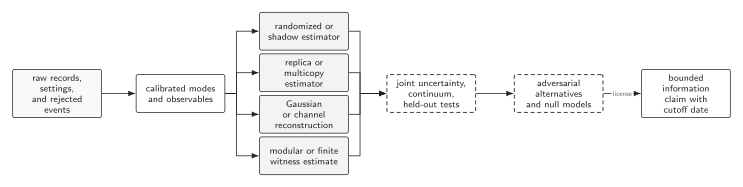
Entropy, tomography, witness, and recovery methods enter at the estimator stage, but all share calibration, uncertainty, continuum, and alternative-model tests. The final statement is no stronger than the least validated arrow. The diagram is schematic and not to scale.
Compare the methods
Section titled “Compare the methods”| Method | Target | Measurement design | Principal assumption | Dominant error | Continuum ceiling | Held-out test | Reproducibility minimum |
|---|---|---|---|---|---|---|---|
| Covariance reconstruction | Gaussian state and entropy | Calibrated quadratures or two-point functions | Gaussianity and mode completeness | Physicality projection and covariance noise | Fixed smeared modes or controlled mode growth | Higher connected moments | Raw moments, calibration, and covariance bootstrap |
| Randomized measurements | Selected observables, purity, or shadows | Known random ensemble and readout map | Invertible ensemble channel and bounded shadow norm | Inversion variance and readout bias | Declared energy or mode truncation | Unseen observables and ensemble condition number | Random seeds or unitaries, counts, and inversion code |
| Swap or cyclic protocol | nth power trace of a regional state | n matched copies and a regional permutation | Copy identity and permutation fidelity | Drift, mismatch, and nonlinear logarithm bias | Matched physical region and copy regulator | Calibration product states and copy swaps | Per-copy records and permutation calibration |
| Detector or channel tomography | Channel parameters or response | Informationally complete calibrated probes | Identifiable channel family | Parameter degeneracy and model discrepancy | Energy-constrained input domain | Held-out preparations and residual structure | Probe states, transfer function, and likelihood |
| Modular response | Perturbative relative entropy | Stress response and a known modular kernel | Correct region and state expansion | Truncation of higher orders | Fixed region geometry and regulator matching | Direct regulated calculation in a solvable case | Kernel, correlators, and perturbative residual |
| Finite witness | Entanglement or another task-specific property | Chosen observable family | Witness hypotheses and trusted calibration | False negatives and adversarial moment matching | Only the tested observable class | Known positive and negative states | Witness coefficients, uncertainty, and decision rule |
Failure channels and controls
Section titled “Failure channels and controls”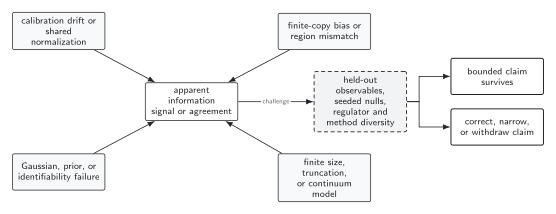
Different estimators can share the same calibration or normalization bias, so numerical agreement is not automatically independent replication. Adversarial nulls, held-out observables, regulator variation, and genuinely independent implementations set the claim ceiling and trigger correction when needed. The diagram is schematic.
The twelve pages
Section titled “The twelve pages”- From Field Data to Information Claims defines the calibrated inference chain.
- Entropy and Rényi Estimation Protocols compares direct, indirect, and model-based estimators.
- Randomized Measurements and Classical Shadows controls ensemble inversion and shadow variance.
- Replica, Swap, and Multi-Copy Measurement Protocols measures permutation invariants across matched copies.
- Correlation-Matrix and Gaussian-State Reconstruction certifies covariance physicality and propagates error.
- Detector, Channel, and Local-Parameter Tomography distinguishes identifiability from precision.
- Modular-Response and Relative-Entropy Estimation uses accessible response without claiming full-state reconstruction.
- Witnesses for Entanglement, Scrambling, and Recoverability matches finite observations to bounded conclusions.
- Continuum Extrapolation, Bias, and Uncertainty combines statistical and systematic errors without double counting.
- Cross-Method Benchmarks and Adversarial Null Tests designs independent comparisons.
- Claim–Evidence Records, Replication, and Retraction Handling maintains dated scientific conclusions when evidence changes.
- Reproducible Reporting Standard for QFT Information gives the minimum record for independent reproduction.
Conventions and evidence boundaries
Section titled “Conventions and evidence boundaries”Every uncertainty states whether it is a standard deviation, confidence interval, credible interval, or deterministic bound and how coverage was checked. Nonlinear transformations are applied within resampling or posterior propagation, not only to central values. Continuum fits state their correction ansatz, fit window, covariance, and regulator family. Witness decisions state the null, decision threshold, multiplicity treatment, and calibration uncertainty.
General algorithms, Monte Carlo, and continuum-fit machinery are developed in Volume 8; instrument platforms and material-specific claims are treated in Volume 12. This chapter concerns the boundary between QFT information evidence and the statements it licenses. A reproducible verification workflow specifies synthetic cross-method tests; its existence is not evidence that any estimator has passed them.
Review the chapter
Section titled “Review the chapter”Moment matching. A measured covariance violates a separability criterion. What is certified, and what is not?
Verification criteria
After calibration and uncertainty are included, the witness can certify entanglement under its measurement assumptions. The covariance determines the full state and entropy only if Gaussianity is justified; a non-Gaussian state can share the same covariance.
Agreement. A replica estimator and covariance estimator agree. Why might this not be independent confirmation?
Verification criteria
They may share state preparation, region definition, normalization, detector calibration, regulator, or analysis code. Independence must be mapped at each stage, and at least one held-out or adversarial test should target the shared failure channel.
Correction. A finer regulator reveals a bias outside the published interval. What changes?
Verification criteria
Preserve the original result and inputs, add the new evidence and corrected analysis, update every conclusion that depended on the old extrapolation, explain which assumptions failed, and distinguish a corrected numerical value from a fully withdrawn claim.
References
Section titled “References”- Brydges, Tiff, Andreas Elben, Petar Jurcevic, Benoît Vermersch, Christine Maier, Ben P. Lanyon, Peter Zoller, Rainer Blatt, and Christian F. Roos. “Probing Rényi Entanglement Entropy via Randomized Measurements.” Science 364 (2019): 260–263. DOI. Open PDF.
- Huang, Hsin-Yuan, Richard Kueng, and John Preskill. “Predicting Many Properties of a Quantum System from Very Few Measurements.” Nature Physics 16 (2020): 1050–1057. DOI. Open PDF.
- Wilkinson, Mark D., Michel Dumontier, IJsbrand Jan Aalbersberg, et al. “The FAIR Guiding Principles for Scientific Data Management and Stewardship.” Scientific Data 3 (2016): 160018. DOI.
Original QFT.org content:CC BY 4.0, unless an item supplies different terms. Third-party material retains its own terms.