

Ultraviolet Divergences and the Area Law
The ultraviolet divergence of a regulated subregion entropy is local to the entangling surface. For a smooth surface, locality and dimensional analysis organize the divergence as integrals of geometric invariants. The leading term is proportional to area, but its coefficient is generally regulator dependent; logarithmic coefficients and finite combinations require more specific symmetry and renormalization statements.
Required background. Review Wick products and point splitting, local counterterms, and regulated subregion entropy. Helpful background. Free-field entropy supplies calculable benchmarks.
Local surface expansion
Section titled “Local surface expansion”In spacetime dimensions, let be a smooth codimension-two surface and a short-distance cutoff. The entropy has the schematic form
The are local invariants built from ambient curvature, intrinsic curvature of , extrinsic curvatures, masses, and couplings, with powers fixed by dimension. Which invariants occur is restricted by symmetries and by exchanging the two normals. Corners or other singularities require additional terms and are not obtained by substituting a distributional curvature into every smooth-surface formula.
The area coefficient changes with the cutoff kernel, lattice orientation, and the convention locating relative to the cutoff cells. This dependence is expected: modes within one cutoff length of the surface dominate it, as the lattice calculation in Srednicki 1993, pp. 666–669 illustrates. A logarithmic coefficient is often more robust because a local dimensionless term cannot be shifted by a change of cutoff scale without leaving a trace, but its universality must still be stated for the particular theory, state, surface regularity, and renormalization prescription.
The structural map places Ultraviolet Divergences and the Area Law on the route from a regulated subsystem to integer moments, spectral checks, analytic continuation, and a continuum claim.
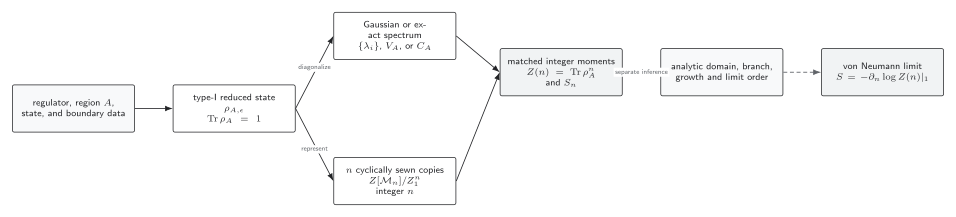
The spectral and replica routes must agree on matched integer moments at fixed regulator. Continuation from those moments to is logically separate and must state its analytic domain, branch, growth conditions, and order of limits. Schematic.
Heat-kernel interpretation
Section titled “Heat-kernel interpretation”For a Gaussian field, the replica effective action can be expressed through a heat kernel on a space with conical excess, as developed in Callan and Wilczek 1994, pp. 55–61. Its short-proper-time expansion is local, and differentiating with respect to replica number produces the surface divergence series. This explains why ultraviolet terms are organized by local geometry rather than by the region’s entire volume.
The same locality appears on a lattice, although rotational symmetry is broken at finite spacing. A planar surface aligned with lattice links and the same surface rotated diagonally can have different leading coefficients. As , suitably normalized universal terms should agree within controlled discretization errors; the bare area term need not.
Planar and curved-surface test
Section titled “Planar and curved-surface test”For a free scalar, compute for a planar cut and for a smooth curved surface over several lattice spacings. Fit only within a scaling window where the physical curvature radii and mass correlation length are large compared with and small compared with the outer volume. Include all dimensionally allowed terms needed at the target precision.
Repeat the fit after rotating the surface relative to the lattice or changing the regulator kernel. A defensible outcome has the following pattern:
- the coefficient of may move;
- residuals decrease under refinement within a stable fit window;
- a claimed logarithmic or universal combination remains stable under the regulator change;
- finite-volume and corner effects are separately bounded.
If the supposedly universal coefficient follows lattice orientation, downgrade the claim. More data points do not cure a misspecified local expansion.
What the area law does not say
Section titled “What the area law does not say”The area law for bare entropy is not the Bekenstein–Hawking formula, and it is not a finite information observable. Mutual information between separated regions can cancel local boundary divergences, but only when the same regulator and state define all terms. Entropy Counterterms and Renormalization Ambiguities explains why local finite shifts remain possible for a single surface entropy.
Before exporting this calculation, use the validity map to check normalization, infrared data, spectral or continuation control, and matched continuum scaling independently.
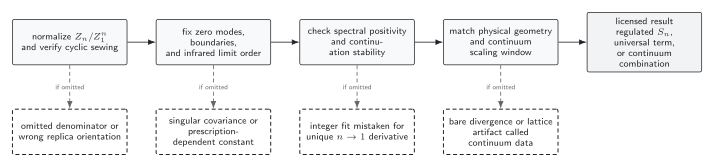
Normalization and sewing establish the intended integer moment; zero-mode and boundary control establish the infrared state; spectral and continuation checks control ; geometry matching and a scaling window establish the continuum target. Omitting any stage licenses only a weaker conclusion. Schematic.
References
Section titled “References”Original QFT.org content:CC BY 4.0, unless an item supplies different terms. Third-party material retains its own terms.