

Randomized Measurements and Classical Shadows
Randomized measurements and classical shadows estimate selected properties by applying a known random transformation, measuring in a simple basis, and inverting the average measurement channel. Their efficiency is observable and ensemble dependent. In field systems, mode truncation, energy, readout calibration, and the condition number of the inverse must be included before a finite-resource claim is made.
Required background. From Field Data to Information Claims supplies the measurement-to-claim chain.
Helpful background. Entropy and Rényi Estimation Protocols supplies the nonlinear targets.
Measurement channel and single-shot shadow
Section titled “Measurement channel and single-shot shadow”Draw from an ensemble , apply it to , and observe basis outcome . The average measurement map is
When is invertible on the target operator subspace, define a single-shot shadow
Then is unbiased for observable under the ideal calibrated ensemble. Median-of-means or related aggregation controls simultaneous prediction of many observables; the required shots scale with their shadow norms, not simply with Hilbert dimension Huang, Kueng, and Preskill 2020, Theorems 1–2.
Purity is nonlinear and uses pairs or U-statistics built from independent shadows. Reusing the same shot in both factors creates bias unless the estimator accounts for it.
Bosonic and field adaptation
Section titled “Bosonic and field adaptation”Choose an energy or Fock truncation and a physically available ensemble, such as passive mode mixing, phase-space displacements, or a Gaussian unitary family. Determine the subspace on which is invertible. Passive mixing alone cannot identify every non-number-conserving observable; declaring full tomography would be false.
For energy-truncated modes, report:
- the physical mode functions and truncation tail;
- distribution and calibration of random transformations;
- readout confusion or loss matrix;
- inverse-map condition number and regularization;
- target observable shadow norms;
- shot allocation, random seeds, and dependence between estimates.
If an ensemble is ill conditioned, inversion amplifies calibration noise and variance. Regularization changes the target by introducing bias, which must be estimated with held-out states.
Finite-resource benchmark
Section titled “Finite-resource benchmark”Prepare known low-energy bosonic states, including squeezed Gaussian and small non-Gaussian alternatives. Estimate selected correlators and purity. Compare empirical variance with the shadow-norm prediction, and hold out observables not used to tune inversion. Increase the Fock cutoff at fixed physical energy; if the result drifts, the truncation rather than shot noise dominates.
Randomized measurements have been used to estimate Rényi entanglement in controlled many-body systems Brydges et al. 2019, pp. 260–263. Transferring that result to a continuum field needs the declared mode map and continuum scaling, not merely a larger number of modes.
Exercises
Section titled “Exercises”Null space. What if has a component in the null space of ?
Solution
The data are insensitive to that component, so is not identifiable from this ensemble. A pseudoinverse silently projects it away; the reported target must be the identifiable projection or the ensemble must be enlarged.
Shared shots. Why should two-shadow purity estimators use distinct shots or a correct U-statistic?
Solution
The product of two independent unbiased shadows has the desired expectation. A self-product contains additional variance contractions and is generally biased. U-statistics average over distinct pairs while using the data efficiently.
Inference and failure-control maps
Section titled “Inference and failure-control maps”The first diagram traces the complete path from raw records to a bounded information claim; inspect the assumption attached to every arrow. The second maps shared and method-specific failure channels to held-out tests, regulator variation, replication, and correction.
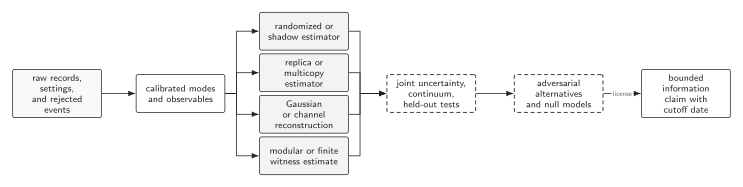
Entropy, tomography, witness, and recovery methods enter at the estimator stage, but all share calibration, uncertainty, continuum, and alternative-model tests. The final statement is no stronger than the least validated arrow. The diagram is schematic and not to scale.
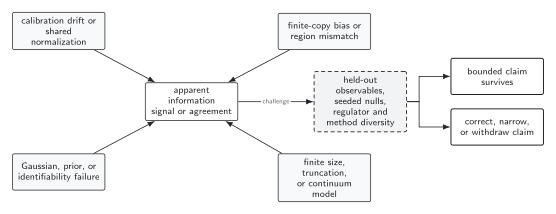
Different estimators can share the same calibration or normalization bias, so numerical agreement is not automatically independent replication. Adversarial nulls, held-out observables, regulator variation, and genuinely independent implementations set the claim ceiling and trigger correction when needed. The diagram is schematic.
References
Section titled “References”- Brydges, Tiff, Andreas Elben, Petar Jurcevic, Benoît Vermersch, Christine Maier, Ben P. Lanyon, Peter Zoller, Rainer Blatt, and Christian F. Roos. “Probing Rényi Entanglement Entropy via Randomized Measurements.” Science 364 (2019): 260–263. DOI. Open PDF.
- Huang, Hsin-Yuan, Richard Kueng, and John Preskill. “Predicting Many Properties of a Quantum System from Very Few Measurements.” Nature Physics 16 (2020): 1050–1057. DOI. Open PDF.
Original QFT.org content:CC BY 4.0, unless an item supplies different terms. Third-party material retains its own terms.