

Modular Intersections and Spacetime Organization
A modular intersection is not merely a nonempty overlap of algebras. It is a precisely oriented pair of half-sided inclusions, supplemented by a strong-limit compatibility condition involving modular conjugation. Those data can generate a low-dimensional Lie group; reconstructing a Poincaré representation or a local net requires further algebras and further checks.
Required background. Half-sided modular inclusions supply positive translations. Helpful background. Modular conjugation supplies commutants and reflection data.
The chapter overview places this construction in the route from standard pairs to geometric flow, compares representative modular flows and their boundaries, and gives a checklist for deciding when a modular-flow claim is licensed.
The modular-intersection property
Section titled “The modular-intersection property”Let and act on one Hilbert space, let be cyclic and separating for both, and set
One standard orientation of the modular-intersection property requires:
-
is cyclic and separating for ;
-
both and are negative half-sided modular inclusions;
-
the strong limits
obey
Here and are the modular operators and conjugations of . The half-sided hypotheses ensure the relevant strong limits exist; equation (2) is an additional compatibility condition, not a consequence of the word “intersection.” This is the definition used in Wiesbrock 1997, definition and main result, pp. 203–205; the author’s preprint abstract displays (1)–(2) explicitly. Reversing both half sides gives the opposite orientation.
Under these hypotheses, the modular groups of the two algebras generate a two-dimensional Lie group. This conclusion is already substantial, but it is narrower than Poincaré or conformal reconstruction. For example, Wiesbrock’s -dimensional QFT construction uses four algebras in specified modular position, not one arbitrary pair Wiesbrock 1998, abstract and §§2–3.
The distinction between the basic half-sided theorem and the extra intersection and net conditions is summarized here. Inspect especially the gate on the right: each check is independent.
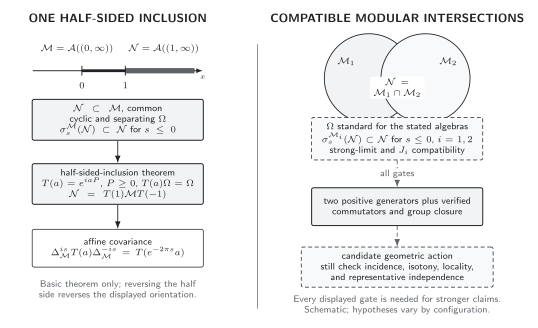
In the displayed negative orientation, for . One such half-sided inclusion licenses the positive-translation and affine relations; a modular-intersection or spacetime-reconstruction claim additionally requires standardness of the overlap, the strong limits and -compatibility, closure of the proposed group, and—if a local net is claimed—well-defined transport, isotony, and locality. The diagram is schematic and not to scale.
First application: two null translations and a boost
Section titled “First application: two null translations and a boost”Consider a controlled wedge-like configuration in dimensions for which two verified half-sided inclusions produce strongly commuting positive generators and . Let
and fix the boost orientation by
These are global unitary identities. Differentiation is allowed only on a common invariant core of analytic vectors for , where
Define
Strong commutation makes their joint functional calculus legitimate. It gives
and
Thus the joint spectrum lies in the closed forward cone. If the wedge modular convention is
then (3) reproduces the half-sided affine scalings:
The opposite exponents express the two null directions; they are not a sign inconsistency. Equations (3)–(9) are an exact group-level calculation once the two positive generators and their strong commutation have been established from the specified modular positions. There is no truncation parameter or numerical uncertainty. The only domain restriction enters when the global identities are differentiated to obtain (4).
This calculation derives a candidate positive-energy translation–boost representation. It does not, by itself, prove that a given collection of algebras realizes the required modular-intersection property.
The strong-limit check is operational
Section titled “The strong-limit check is operational”For a proposed pair, choose a dense test domain and a sequence . For every normalized , record
The exact property requires strong convergence of both sequences in (1) and for every , not merely for a few low-energy states. A finite test set and a finite maximum time can provide only a cutoff-dependent diagnostic. It cannot promote an approximate model to Wiesbrock’s theorem.
Adversarial test: positivity survives while closure fails
Section titled “Adversarial test: positivity survives while closure fails”An algebra-level perturbation can be specified without assuming its conclusion. Let be bounded with , set , and replace
The vector remains cyclic and separating for , but the perturbed intersection need not be standard or half-sided. On a declared finite test set , an operator-norm half-side residual is
The exact inclusion requires zero distance for every unit-ball element and every allowed , together with standardness and the strong-limit condition. A finite only falsifies violations; it cannot prove the universal statement.
Finite-dimensional algebras cannot supply a nontrivial exact positive-energy half-sided inclusion of the continuum kind, so the following calculation is deliberately a downstream generator-level falsifier, not a model of the theorem. It isolates what happens after one candidate translation direction has been perturbed away from the compatible position.
Take
The smaller eigenvalue of is
so positivity survives for . Nevertheless,
The translation group therefore fails to be Abelian at first order. The strongest surviving claim is that each direction separately has a positive generator in the displayed range. What fails is the compatibility needed for joint translation and Poincaré closure; positivity alone does not repair it. In an actual modular-intersection approximation, (13) must be supplemented by the half-side residual (11), the modular residual (10), and a stated operator topology and test domain.
From a group to a local net
Section titled “From a group to a local net”Suppose the modular data have genuinely produced a representation . Starting from a seed algebra , one would like to set
Equation (14) is well defined only if every stabilizer satisfies
One must then prove isotony for contained regions and commutation for spacelike-separated regions. Neither Lie-algebra closure nor products of modular conjugations automatically imply (15), isotony, or locality.
Common pitfalls
Section titled “Common pitfalls”Calling every overlap a modular intersection. Standardness, two oriented half-sided inclusions, and the strong-limit relation (2) are part of the definition used here.
Promoting a two-algebra result to a spacetime net. Two modular groups generate the two-dimensional group in Wiesbrock’s theorem. Larger spacetime and local-net conclusions use a richer, theorem-specific family.
Checking commutators only formally. For unbounded generators, the unitary group relations and strong commutation are primary. Lie-algebra equations live on a declared common core.
Exercises
Section titled “Exercises”1. Derive the forward-cone condition
Section titled “1. Derive the forward-cone condition”Assume and are strongly commuting positive self-adjoint operators. Prove that the joint spectrum of defined by (5) lies in .
Solution
By the joint spectral theorem, each joint spectral value obeys and . The linear change of variables gives
Therefore
These two inequalities are equivalent to . Moreover . Strong commutation is essential because it supplies the joint spectral measure used in this argument.
2. Why the conjugated strong limit is not automatic
Section titled “2. Why the conjugated strong limit is not automatic”Suppose strongly and every is unitary. Show that strongly, but explain why this alone does not prove strongly.
Solution
For any ,
because the antiunitary preserves norms. Thus conjugation by preserves strong convergence.
However, the adjoints of a strongly convergent unitary sequence need not converge strongly unless the limit is itself unitary. A strong limit of unitaries can be a proper isometry. Since
the second limit in (1) is an adjoint sequence. Requiring its strong convergence and the relation supplies genuine information beyond existence of the first limit.
3. Quantify the closure failure
Section titled “3. Quantify the closure failure”For (12), determine the largest interval of on which and compute the relative closure residual
Solution
Strict positivity requires
or . The operator norms are and
Using (13),
Thus near zero. The residual is nonzero for every nonzero perturbation even though both generators remain positive throughout a much larger interval.
References
Section titled “References”- Wiesbrock, Hans-Werner. “Symmetries and Modular Intersections of von Neumann Algebras.” Letters in Mathematical Physics 39 (1997): 203–212. DOI. Open preprint abstract with the defining limits.
- Wiesbrock, Hans-Werner. “Modular Intersections of von Neumann Algebras in Quantum Field Theory.” Communications in Mathematical Physics 193 (1998): 269–285. DOI.
Original QFT.org content:CC BY 4.0, unless an item supplies different terms. Third-party material retains its own terms.