

Scrambling Evidence and Claim-Status Matrix
A QFT scrambling claim is strongest when several diagnostics, applied to the same encoded input and access split, agree after causal, symmetry, finite-size, noise, and regulator controls. Exact identities can establish relations among quantities; analytic models and simulations can establish behavior in their domains; experiments can establish calibrated device-level signals. None of these alone promotes a finite regulated result to generic continuum information scrambling.
Required background. Information Scrambling and Recovery Diagnostics fixes the operational claim. Helpful background. Tripartite Information and Multipartite Scrambling, Operator Growth versus Recoverability, Channel Capacities During Scrambling, Information Velocities and Causal Bounds, and Finite Size, Symmetry Sectors, and Scrambling False Positives supply the independent diagnostic and control columns.
Claim-strength matrix
Section titled “Claim-strength matrix”| Evidence obtained | Supported statement | Missing before a stronger claim |
|---|---|---|
| Exact channel-state identity | declared operator average equals a Rényi information quantity | physical dynamics, continuum domain, recovery task |
| Proven decoupling/recovery bound | decoder exists with stated norm and resources | locality, efficiency, and experimental implementation |
| Analytic solution in a model/regime | diagnostic behaves as derived in that regime | robustness beyond the approximation or ensemble |
| Converged finite-regulator simulation | matched diagnostics agree over tested sizes and times | uniform continuum control and alternative regulators |
| Calibrated device experiment | protocol-level signal with uncertainty and noise controls | generic QFT or thermodynamic-limit interpretation |
| OTOC decay alone | tested operator influence changed | decoupling, recovery, noise discrimination, operator completeness |
| Random-matrix resemblance alone | selected statistic resembles the chosen ensemble | sector resolution, dynamics, and information task |
| Holographic analogy alone | conditional comparison to a gravity model | non-gravitational QFT derivation and generic validity |
Minimum record for a scrambling result
Section titled “Minimum record for a scrambling result”A reusable claim states:
- theory or regulated model, state, dimension, geometry, and boundary conditions;
- encoded logical algebra and reference preparation;
- accessible and inaccessible outputs, side information, and causal timing;
- OTOC contour/operator ensemble, entropy or channel measure, and recovery metric;
- energy window, symmetry sectors, and conserved projections;
- sizes, cutoffs, time windows, thresholds, statistical errors, and fit choices;
- null models, echo/noise controls, and an independent recovery-sensitive test;
- continuum or thermodynamic inference and its uncertainty;
- the exact statement licensed, plus explicit nonconverses.
Without these fields, later readers cannot tell whether two “scrambling times” refer to the same task.
Evidence examples and their ceilings
Section titled “Evidence examples and their ceilings”The finite-dimensional channel identity of Hosur et al. 2016, §§2–4 relates averaged OTOCs to channel-state information measures. It is a structural result under its operator-basis and regulator assumptions, not evidence that every Hamiltonian realizes the corresponding ensemble.
The trapped-ion protocol of Landsman et al. 2019, pp. 61–65 added a teleportation verification signal to distinguish coherent scrambling from ordinary errors in a seven-qubit circuit. A later twenty-qubit trapped-ion study implemented both an OTOC protocol and Hayden–Preskill-style recovery for a kicked-Ising circuit Seki et al. 2024, §§II–IV, Open PDF. These are valuable protocol demonstrations in specified regulated systems. Their finite size, implemented circuit, calibration model, and hardware noise remain part of the conclusion.
An open radiative random-circuit model can even show that operator propagation and decodeability undergo related transitions under its ensemble assumptions Weinstein et al. 2023, §§II–IV. This establishes the connection in that model, not a universal equivalence for open QFT.
Scientific evidence cutoff: 10 August 2026. This page records durable primary examples and claim boundaries through that date. It does not assert a complete catalog of platforms, numerical records, or ongoing disputes; mutable comparisons belong in a dated research resource.
Decision rule
Section titled “Decision rule”Use the narrowest statement that survives all controls:
- “operator influence spread” after a causal commutator test;
- “the inaccessible region decoupled” after a normed reference-system test;
- “information was recoverable from ” after a decoder or recovery theorem;
- “the tested regulated dynamics scrambles this code and access family” after plural diagnostics and false-positive controls;
- “a continuum QFT scrambling statement” only after uniform regulator removal at fixed physical task.
The phrase “fast scrambler” adds another comparison class and scaling law; it is never justified by one small-system time constant.
Exercises
Section titled “Exercises”A noisy experiment observes OTOC decay and entropy growth, but no echo or decoder test. Write the strongest justified conclusion.
Solution
The tested observables show operator-influence decay and increasing entropy under the implemented noisy evolution, with the reported calibration and finite-size uncertainty. Internal coherent scrambling, decoupling of a specified complement, and recoverability are unresolved because noise leakage and estimator alternatives were not separated.
Return to the chapter overview to choose a repair route. For dated platform comparisons and disputed current claims, use the site’s Research layer rather than extending this durable matrix.
Diagnostic and failure maps
Section titled “Diagnostic and failure maps”The first diagram separates influence diagnostics from the decoupling and recovery test; inspect the declared output access, norm, and decoder class. The second collects mechanisms that can imitate scrambling and the controls that distinguish them.
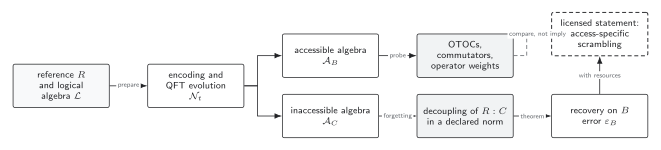
Scrambling becomes operational only after the input algebra, output access structure, side information, norm, energy restriction, and decoder class are declared. OTOCs and operator weights diagnose influence; decoupling and a recovery theorem license a statement about information access. The diagram is schematic and not to scale.
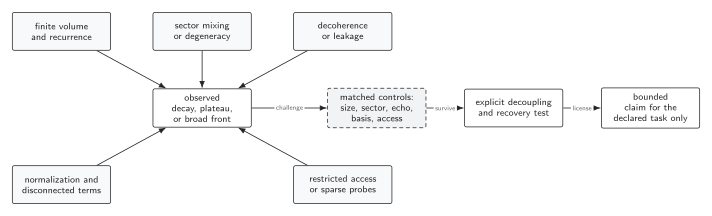
Several mechanisms can suppress a correlator or produce an entropy plateau without delocalizing recoverable quantum information. Sector resolution, recurrence windows, normalization checks, access variation, and an explicit recovery test distinguish these alternatives. The diagram is schematic.
References
Section titled “References”- Hosur, Pavan, Xiao-Liang Qi, Daniel A. Roberts, and Beni Yoshida. “Chaos in Quantum Channels.” Journal of High Energy Physics 02 (2016): 004. DOI. Open PDF.
- Landsman, Kevin A., Caroline Figgatt, Thomas Schuster, Norbert M. Linke, Beni Yoshida, Norman Y. Yao, and Christopher Monroe. “Verified Quantum Information Scrambling.” Nature 567 (2019): 61–65. DOI. Open PDF.
- Seki, Kazuhiro, Yuta Kikuchi, Tomoya Hayata, and Seiji Yunoki. “Simulating Floquet Scrambling Circuits on Trapped-Ion Quantum Computers.” arXiv:2405.07613 (2024). Open PDF.
- Weinstein, Zack, Shane P. Kelly, Jamir Marino, and Ehud Altman. “Scrambling Transition in a Radiative Random Unitary Circuit.” Physical Review Letters 131 (2023): 220404. DOI. Open PDF.
Original QFT.org content:CC BY 4.0, unless an item supplies different terms. Third-party material retains its own terms.