

From Lattice Entropy to a Continuum Claim
A continuum statement does not follow from increasing the number of lattice sites. It follows from a sequence of regulated calculations at fixed physical geometry, controlled volume and infrared scales, an explicit subtraction or universal target, and a stable extrapolation model. Bare subregion entropy diverges; the continuum target must therefore be a coefficient, difference, derivative, or other declared combination.
Required background. Use regulated subregion entropy and the ultraviolet area-law expansion. Helpful background. Numerical replica estimators explains fixed-cutoff statistical errors.
Define the continuum target first
Section titled “Define the continuum target first”Choose physical region data —lengths, separations, curvature radii, and orientation in a continuum coordinate system—and a state with mass and temperature scales. For each lattice spacing , approximate the same , keeping , , and other dimensionless infrared ratios fixed. Record how the entangling surface is represented on the lattice.
Examples of viable targets include a universal logarithmic coefficient, mutual information between separated regions, a shape derivative, or a finite difference between states with matched ultraviolet structure. The separated-region structure of mutual information is analyzed in Casini and Huerta 2009, §§ 2–3, while the regulator-dependent area divergence was exhibited directly in Srednicki 1993, pp. 666–669. The raw entropy
does not extrapolate to a finite number merely because becomes small.
The structural map places From Lattice Entropy to a Continuum Claim on the route from a regulated subsystem to integer moments, spectral checks, analytic continuation, and a continuum claim.
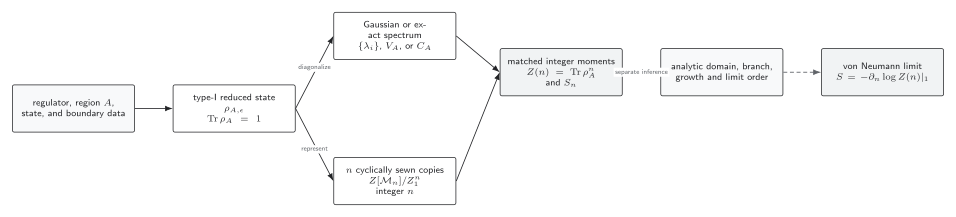
The spectral and replica routes must agree on matched integer moments at fixed regulator. Continuation from those moments to is logically separate and must state its analytic domain, branch, growth conditions, and order of limits. Schematic.
Scaling windows and fit models
Section titled “Scaling windows and fit models”Let be the declared finite target. A typical Symanzik-like model is
possibly with logarithmic corrections. The exponents must follow from the lattice action, geometry, and known singularities rather than from whichever polynomial best fits all points. A scaling window requires
with a relevant curvature radius. Data outside this window can have small statistical errors and still bias .
Use the full covariance matrix when entropies share configurations or subtraction terms. Report fit range, correction exponents, goodness-of-fit diagnostics, and the change under endpoint removal. Model averaging or an envelope of justified correction forms is preferable to selecting a single ansatz after seeing the result.
Multiple discretizations as a check
Section titled “Multiple discretizations as a check”Compute free-scalar mutual information at fixed separated-region geometry using at least two lattice actions or surface orientations. Local divergences should cancel within each matched calculation. Extrapolate each discretization separately before combining them. Agreement of the two values is stronger evidence than a dense sequence from one action because their leading artifacts differ.
Then perform three adversarial changes:
- drop the coarsest and finest endpoint in turn;
- vary the leading correction exponent over the theoretically allowed set;
- rotate the region relative to the lattice while preserving its continuum shape.
If the continuum term moves beyond the combined uncertainty, enlarge the systematic error or restrict the claim. If only the divergent bare entropy changes while a separated mutual information converges, the test illustrates exactly why the target had to be chosen first.
Separation of errors
Section titled “Separation of errors”Keep Monte Carlo or diagonalization error, finite-volume error, geometry-matching error, fit-model uncertainty, and residual discretization error distinct until the final combination. A small statistical bar does not control the scaling model. Conversely, a conservative continuum error should not hide an estimator whose normalization failed at fixed .
The lattice algorithms themselves belong to the numerical volumes. This page supplies the information-theoretic interpretation and the conditions under which their outputs support a continuum entropy claim.
Before exporting this calculation, use the validity map to check normalization, infrared data, spectral or continuation control, and matched continuum scaling independently.
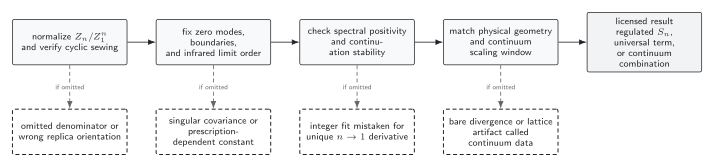
Normalization and sewing establish the intended integer moment; zero-mode and boundary control establish the infrared state; spectral and continuation checks control ; geometry matching and a scaling window establish the continuum target. Omitting any stage licenses only a weaker conclusion. Schematic.
References
Section titled “References”Original QFT.org content:CC BY 4.0, unless an item supplies different terms. Third-party material retains its own terms.