

Von Neumann Factors and Type-III Local Algebras
Type-III local factors explain why a continuum region has no intrinsic density matrix or von Neumann entropy while still supporting normal states, relative comparison, modular flow, and operational tests. “Type III” is therefore a precise statement about projections and traces—not a synonym for “infinitely entangled” and not a reason to abandon information theory.
Required background. Use operator-algebra basics, unbounded-operator domains, local nets, and the factorization diagnosis.
What factor type controls
Section titled “What factor type controls”A von Neumann algebra is a factor when its center is trivial:
Projection equivalence is defined by when some partial isometry satisfies and . A type-I factor contains minimal projections. A type-II factor has no minimal projections but admits a faithful normal semifinite trace. In a type-III factor every nonzero projection is infinite; there is no nonzero faithful normal semifinite trace.
For local algebras this has immediate consequences:
- there is no canonical trace with which to write ;
- a normal state is a functional in , not necessarily a density operator belonging to ;
- sharply localized finite-rank projectors are absent;
- modular and relative-modular operators replace as intrinsic comparison data.
Free-field local algebras already exhibit type-III behavior Araki 1964, pp. 956–965. Under standard phase-space and scaling assumptions, physically reasonable relativistic theories commonly produce the hyperfinite type- factor, but that stronger classification requires hypotheses about the model, region, and representation.
The structural map places Von Neumann Factors and Type-III Local Algebras among sharp local algebras, split inclusions, and regulated or operational substitutes.
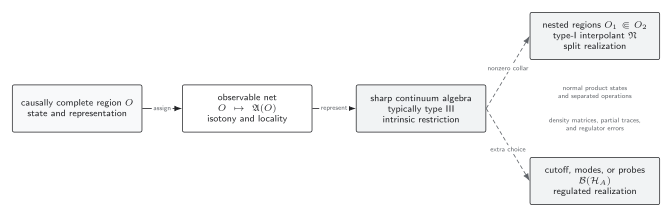
A causally complete region determines a sharp local algebra, usually type III. A nonzero split collar or an explicit cutoff, mode selection, or probe model can instead supply a type-I realization; these alternatives enable ordinary density matrices but retain different physical approximations. Schematic, not to scale.
State comparison survives
Section titled “State comparison survives”Let be cyclic and separating for . The Tomita operator begins on the dense set as
Its closure has polar decomposition . The modular operator and its relative version for a pair of states define intrinsic flow and relative entropy without a trace on . The full construction belongs later; the point here is that type III removes a particular density-matrix representation, not the ability to compare states.
A finite oscillator truncation makes the contrast visible. Its algebra has the matrix trace and a density matrix . As and the ultraviolet resolution increase, local expectation values can approach their continuum values while the spectra and entropies of fail to converge to an intrinsic local density matrix. Relative quantities may nevertheless have controlled limits.
What changes under a cutoff
Section titled “What changes under a cutoff”With a finite lattice cutoff, the local algebra becomes type I. Minimal projections, partial traces, and reappear. This does not refute the continuum classification; it identifies the regulated layer. A valid calculation states both layers:
The order of limits matters if volume, mass, temperature, or collar width is also varied. The type classification cannot be inferred from the number of degrees of freedom alone, and it must not be transferred between inequivalent representations without proof.
Common pitfalls
Section titled “Common pitfalls”“Type III means entropy is meaningless.” Bare von Neumann entropy for a sharp region is not intrinsic. Regulated entropies, universal combinations, relative entropy, and mutual information can still be meaningful when their definitions and limits are controlled.
“All infinite systems are type III.” Infinite-dimensional type-I and type-II algebras exist. The classification follows from projection and trace structure, not from cardinality.
Before applying this result, use the validity map to keep the algebra, state, operation class, resources, and approximation fixed.
For a side-by-side statement of the chapter’s subsystem choices, use the subsystem comparison table.
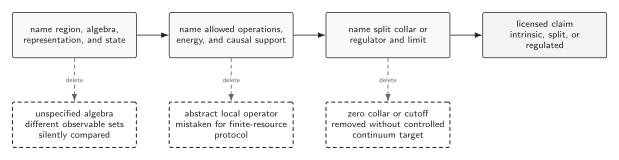
Every local-information claim must specify the represented algebra and state, the allowed operations and resource support, and any split collar or regulator. The dashed lower boxes show what fails when the algebra, protocol, or limiting prescription is left implicit. Schematic.
References
Section titled “References”- Araki, Huzihiro. “Type of von Neumann Algebra Associated with Free Field.” Progress of Theoretical Physics 32 (1964): 956–965. DOI.
Further reading
Section titled “Further reading”- Buchholz, Detlev, Claudio D’Antoni, and Klaus Fredenhagen. “The Universal Structure of Local Algebras.” Communications in Mathematical Physics 111 (1987): 123–135. DOI.
Original QFT.org content:CC BY 4.0, unless an item supplies different terms. Third-party material retains its own terms.