

Replica and Entropy Calculation Verification Ledger
An entropy calculation is credible when independent identities, representations, regulator limits, and numerical implementations converge on the same declared quantity. Agreement between two codes that share configurations, normalization, or an analytic-continuation ansatz is useful but not independent. This page gives a verification record that localizes common sign, sewing, covariance, continuation, and extrapolation errors.
Required background. Use replica branched geometries and lattice-to-continuum entropy. Helpful background. Analytic-continuation failure modes supplies adversarial continuation tests.
Algebraic and spectral identities
Section titled “Algebraic and spectral identities”At fixed regulator, check identities before fitting continuum behavior:
For a global pure state, and have the same nonzero spectrum and therefore equal Rényi entropies. An empty region has zero entropy; a product state has zero bipartite entropy; and a maximally mixed state on dimension has . These limits catch normalization and subsystem-index errors without reference to continuum physics.
For Gaussian bosons, verify and . For number-conserving Gaussian fermions, verify . The spectrum-to-density-matrix check can be implemented as in Peschel 2003, pp. L205–L208. Check spectra rather than only the final summed entropy, because an eigenvalue-level discrepancy reveals where the error enters.
The structural map places this verification workflow on the route from a regulated subsystem to integer moments, spectral checks, analytic continuation, and a continuum claim.
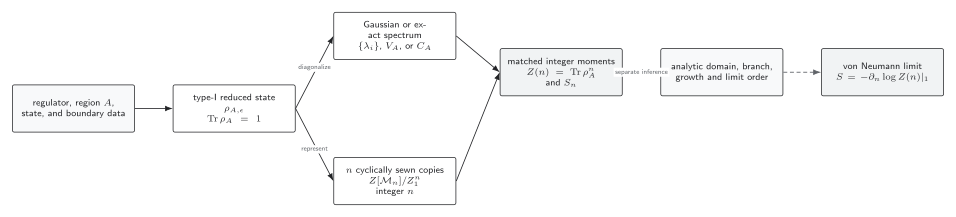
The spectral and replica routes must agree on matched integer moments at fixed regulator. Continuation from those moments to is logically separate and must state its analytic domain, branch, growth conditions, and order of limits. Schematic.
Replica-specific checks
Section titled “Replica-specific checks”Confirm that the implemented partition-function ratio is , that cyclic sewing occurs only on , and that spin structures or field boundary conditions close consistently. At the geometry and normalized ratio must reduce to the original theory and one. For twist fields, the total monodromy at infinity must be trivial.
Evaluate at least one small system by exact diagonalization and one Gaussian case by a covariance matrix. For stochastic replica estimators, reproduce a benchmark of the kind used in Hastings et al. 2010, pp. 157201-1–157201-4. Comparing two replica codes that share the same geometry generator does not test a mistaken branch orientation in that generator. A cross-representation calculation does.
Continuation and continuum checks
Section titled “Continuation and continuum checks”Keep three extrapolations separate:
- statistical or quadrature convergence at fixed , , and integer ;
- analytic continuation in toward one;
- continuum and infinite-volume limits.
Changing their order can change the answer. For continuation, compare admissible fit families, remove replica points, impose spectral convexity, and inspect singularities. For the continuum limit, hold physical geometry fixed, vary the fit window and correction exponent, compare discretizations, and rotate the region relative to the lattice; Srednicki 1993, pp. 666–669 provides a standard free-field target. For infrared control, vary and the zero-mode prescription independently of .
Seeded-error localization
Section titled “Seeded-error localization”Before accepting a workflow, introduce known defects one at a time:
- omit one factor of ;
- reverse a replica sewing orientation;
- perturb a bosonic covariance below the uncertainty bound;
- choose the wrong branch of a logarithm;
- ignore autocorrelation in a replica estimator;
- fit a finite continuum value to a bare area-law divergence.
Record which check detects each defect. If a seeded error survives, add a check that is mathematically sensitive to it. The purpose is not to accumulate redundant tests but to ensure every important failure has an independent observable consequence.
Acceptance record
Section titled “Acceptance record”For each reported result, retain the defining action and state, subsystem geometry, cutoff and boundary convention, code and parameter versions, raw or frozen data needed for reproduction, covariance and error model, analytic branch, fit windows, and independent comparison. Reader-facing claims should state the strongest conclusion that survives these checks: an integer Rényi value, a regulator-dependent entropy, a universal coefficient, or a continuum combination.
Do not certify a result because two plots overlap if both inherited the same inputs or continuation. Independence is a property of the reasoning and data path, not the number of implementations.
Before exporting this calculation, use the validity map to check normalization, infrared data, spectral or continuation control, and matched continuum scaling independently.
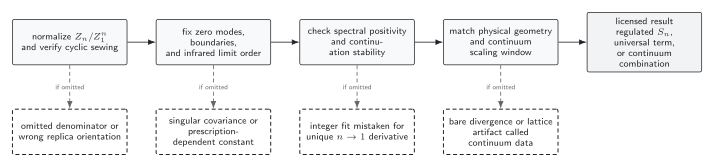
Normalization and sewing establish the intended integer moment; zero-mode and boundary control establish the infrared state; spectral and continuation checks control ; geometry matching and a scaling window establish the continuum target. Omitting any stage licenses only a weaker conclusion. Schematic.
References
Section titled “References”- Hastings, Matthew B., Iván González, Ann B. Kallin, and Roger G. Melko. “Measuring Rényi Entanglement Entropy in Quantum Monte Carlo Simulations.” Physical Review Letters 104 (2010): 157201. arXiv; DOI.
- Peschel, Ingo. “Calculation of Reduced Density Matrices from Correlation Functions.” Journal of Physics A: Mathematical and General 36 (2003): L205–L208. arXiv; DOI.
- Srednicki, Mark. “Entropy and Area.” Physical Review Letters 71 (1993): 666–669. arXiv; DOI.
Original QFT.org content:CC BY 4.0, unless an item supplies different terms. Third-party material retains its own terms.