

Information Velocities and Causal Bounds
Information, butterfly, entanglement, and recovery velocities are threshold-dependent properties of different observables. In a relativistic QFT, any velocity defined through operations and observables with genuinely local causal support is bounded by the speed of light, but the velocities need not equal one another and none is a Lyapunov exponent. A valid comparison fixes the state, operator family, decoder, threshold, regulator, and scaling limit.
Required background. Information Scrambling and Recovery Diagnostics fixes the access task, and OTOCs, Commutators, and Information Measures fixes the operator-influence front. Helpful background. Entanglement, Correlation, and Hydrodynamic Fronts supplies the earlier transport comparators.
The causal ceiling
Section titled “The causal ceiling”Let and be local observables. Microcausality gives
Therefore a commutator threshold cannot cross the null cone. More generally, a decoder assembled from localized operations cannot depend on an input outside its causal past. If its success probability did, the protocol would enable superluminal signaling.
This conclusion assumes exact continuum locality. On a lattice with local interactions, a Lieb–Robinson estimate has the form
where is a bound for that regulator, not automatically a physical continuum velocity. The regulator-level causal estimate follows the Lieb–Robinson framework Bravyi, Hastings, and Verstraete 2006, pp. 1–4; its connection with butterfly propagation is analyzed by Roberts and Swingle 2016, pp. 1–5.
Four distinct fronts
Section titled “Four distinct fronts”For a fixed small threshold , define representative arrival times:
If each scales linearly, its velocity is the large-distance slope . The limits may fail to exist; fronts can broaden, diffuse, or show multiple sector-dependent scales.
| Front | What arrives? | Depends on | Does not by itself establish |
|---|---|---|---|
| Butterfly/OTOC | operator influence | operator pair, contour, threshold | decoupling or recovery |
| Mutual information | total correlation | state, regions, entropy definition | quantum transmission capacity |
| Decoupling | forgetting by a complement | reference, norm, energy, side information | an efficient decoder |
| Recovery | task success | access set, decoder class, metric | physical chaos |
The Lyapunov rate describes temporal exponential growth in a special regime. Since and , identifying them is dimensionally meaningless without another scale.
Threshold and frame dependence
Section titled “Threshold and frame dependence”For a broadened front
different fixed thresholds share the same asymptotic but differ by shifts. At accessible finite times, fitting a sharp front can bias the result. Report threshold variation and the broadening exponent together.
Relativistic velocities also require a frame. Thermal states select a rest frame; boosted states transform front shapes and thresholds. The invariant statement is causal support inside the light cone, not equality of fitted coordinate velocities across frames.
A theorem-shaped claim
Section titled “A theorem-shaped claim”A defensible causal-velocity statement has this form:
For the declared local algebra, state class, and protocol, microcausality makes the influence or decoder advantage vanish outside the causal cone. Under a separately demonstrated scaling form, the fitted asymptotic front velocity is no greater than one in units.
The first sentence is structural. The second is an inference from a scaling analysis. Neither says the front saturates the light cone.
Scientific evidence cutoff: 10 August 2026. The front comparisons and literature-sensitive qualifications on this page are current through that date.
Exercises
Section titled “Exercises”Suppose near its leading edge. Show that the position of a fixed threshold differs from by .
Solution
Setting gives , hence on the leading edge. A linear fit at finite time therefore has a threshold-dependent bias even though .
Continue to Finite Size, Symmetry Sectors, and Scrambling False Positives before interpreting a fitted front as a scrambling result.
Diagnostic and failure maps
Section titled “Diagnostic and failure maps”The first diagram separates influence diagnostics from the decoupling and recovery test; inspect the declared output access, norm, and decoder class. The second collects mechanisms that can imitate scrambling and the controls that distinguish them.
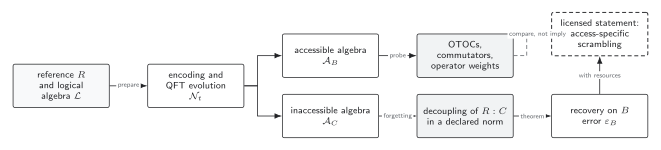
Scrambling becomes operational only after the input algebra, output access structure, side information, norm, energy restriction, and decoder class are declared. OTOCs and operator weights diagnose influence; decoupling and a recovery theorem license a statement about information access. The diagram is schematic and not to scale.
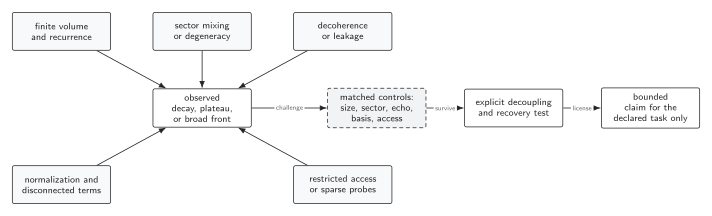
Several mechanisms can suppress a correlator or produce an entropy plateau without delocalizing recoverable quantum information. Sector resolution, recurrence windows, normalization checks, access variation, and an explicit recovery test distinguish these alternatives. The diagram is schematic.
References
Section titled “References”- Bravyi, Sergey, Matthew B. Hastings, and Frank Verstraete. “Lieb–Robinson Bounds and the Generation of Correlations and Topological Quantum Order.” Physical Review Letters 97 (2006): 050401. DOI. Open PDF.
- Roberts, Daniel A., and Brian Swingle. “Lieb–Robinson Bound and the Butterfly Effect in Quantum Field Theories.” Physical Review Letters 117 (2016): 091602. DOI. Open PDF.
Original QFT.org content:CC BY 4.0, unless an item supplies different terms. Third-party material retains its own terms.