

Error Models, Codes, and Recovery Conditions
A QFT error-correction problem is defined by a logical algebra, an encoding into regulated or algebraic field degrees of freedom, a noise channel and its spacetime support, an allowed recovery, a state or energy domain, and an error metric. Exact Knill–Laflamme equations are one finite-dimensional instance of this larger task. Changing the noise support or admitting unbounded-energy inputs changes the theorem being applied.
Required background. Direct Sums, Tensor Products, and Index Structure supplies the regulated code-space decomposition. Completely Positive Maps and Causal Quantum Channels supplies localized noise and recovery maps. Recovery Maps and Approximate Markovianity supplies the recovery viewpoint.
Helpful background. Infinite-Dimensional and Energy-Constrained Channel Distances supplies useful infinite-dimensional metrics.
The code, algebra, noise, and metric
Section titled “The code, algebra, noise, and metric”At a finite regulator, let be an isometry with code projector . A channel
is exactly correctable on the full logical matrix algebra when a recovery satisfies for every logical state. Equivalently, the Knill–Laflamme conditions are
They say that the environment cannot distinguish logical states. The Kraus representation is not unique, but the span condition and correctability are channel properties Knill and Laflamme 1997, §§II–III.
An operator-algebra task replaces the right side by an element of the commutant of the correctable logical algebra. Approximate correction replaces equality with a declared distance. Do not mix worst-case entanglement fidelity, average fidelity, trace distance on code states, and a diamond norm; inequalities between them carry dimension or energy factors.
Noise in a field setting
Section titled “Noise in a field setting”A field noise model must state its algebra and support. Examples include:
- erasure of access to observables in a spatial region;
- bosonic attenuation on selected wave-packet modes;
- localized coupling to a detector environment with a switching function;
- dephasing generated by a smeared field observable;
- truncation or discarded high-momentum modes in a regulated simulation.
These are not interchangeable “local errors.” A sharply supported ideal channel may require unbounded energy; overlapping wave packets need not define independent tensor factors; and a gauge-theory region depends on its center or edge prescription.
Specify the complementary channel because recovery is tied to what the environment learns. In a Stinespring representation , and ; continuity of this representation underlies quantitative information–disturbance bounds Kretschmann, Schlingemann, and Werner 2008, §§III–IV.
Finite-energy logical qubit example
Section titled “Finite-energy logical qubit example”Encode a logical qubit into a two-dimensional subspace of finitely many oscillator modes with codewords and bounded mean physical energy. Let the noise erase one declared mode or region. The exact test computes
If it holds, construct a recovery from the syndrome subspaces and verify it on the maximally entangled logical-reference state. If it fails weakly, measure complementary-output distinguishability and optimize an approximate recovery rather than quoting the largest matrix-element residual alone.
Increase the Fock truncation and energy allowance independently. Agreement at one cutoff can be false if the noise couples to omitted levels. A continuum claim also keeps wave-packet shapes and physical erasure size fixed while refining the regulator.
Failure tests
Section titled “Failure tests”- enlarge the noise support by one mode or one boundary algebra;
- include a logical-reference system so coherence, not only basis states, is tested;
- vary the energy cap and truncation separately;
- compare the chosen recovery metric with complementary leakage;
- impose recovery locality and causal time rather than allowing a global instantaneous decoder.
Exercises
Section titled “Exercises”Basis states are insufficient. Why does recovery of and separately not prove qubit correction?
Solution
The channel may leak or destroy their relative phase. Correction must preserve superpositions and entanglement with a reference, equivalently all logical density matrices or the full logical algebra.
Energetic counterexample. Why can an unrestricted channel norm make two oscillator channels maximally different despite agreement at low energy?
Solution
The supremum can use arbitrarily energetic inputs that amplify a tiny parameter difference. A finite-energy task restricts the input and reference energy, producing a metric aligned with the intended code domain.
Recovery and continuum maps
Section titled “Recovery and continuum maps”The first diagram follows the task from logical algebra through noise, environmental leakage, and constrained recovery; inspect which metric and recovery family support the guarantee. The second identifies the additional uniformity tests required before finite-regulator correctability becomes a continuum field-code statement.
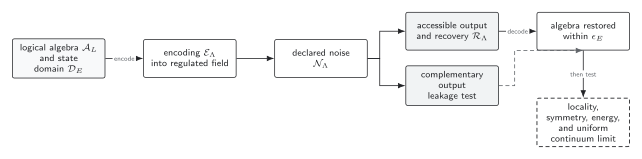
Correctability relates one logical algebra, one noise channel and complement, one state or energy domain, and one recovery class. Environmental forgetting supports recovery only in the matching metric; locality, symmetry, and continuum convergence are additional tests. The diagram is schematic and not to scale.
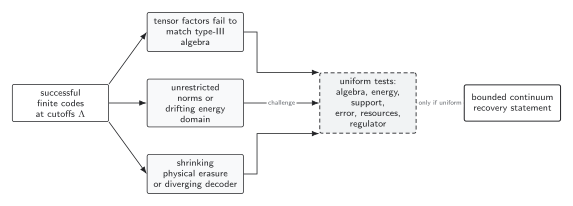
A sequence of successful finite codes does not establish a continuum code unless its logical algebra, physical erasure region, energy domain, recovery error, and locality bounds converge uniformly. Type-III structure and regulator-dependent tensor factors require an algebraic target. The diagram is schematic.
References
Section titled “References”- Knill, Emanuel, and Raymond Laflamme. “Theory of Quantum Error-Correcting Codes.” Physical Review A 55 (1997): 900–911. DOI. Open PDF.
- Kretschmann, Dennis, Dirk Schlingemann, and Reinhard F. Werner. “The Information-Disturbance Tradeoff and the Continuity of Stinespring’s Representation.” IEEE Transactions on Information Theory 54 (2008): 1708–1717. DOI. Open PDF.
Original QFT.org content:CC BY 4.0, unless an item supplies different terms. Third-party material retains its own terms.