

Recovery Maps and Approximate Markovianity
Small conditional mutual information gives a quantitative reconstruction theorem. For a finite regulated tripartite state, there is a deterministic quantum channel acting on the mediator that recreates with root fidelity at least . The conclusion is powerful but specific: it guarantees an abstract channel on the stated systems, not a unique channel, a nearby exact Markov state, a spacetime-local protocol, a Gaussian implementation, or a finite-energy continuum limit.
Required background. Conditional Mutual Information and Quantum Markov Structure defines the ordered quantity and its exact-zero theorem. Helpful background. Markov generators and semigroups distinguish static conditional independence from memoryless dynamics, while data processing supplies the information-loss viewpoint used below.
The chapter’s task-comparison table keeps this fidelity guarantee separate from locality, causality, uniqueness, implementability, and energy cost.
Recovery as a channel optimization
Section titled “Recovery as a channel optimization”Let be a density operator on a finite-dimensional tensor product. In the Schrödinger picture, a recovery channel is a completely positive, trace-preserving map on trace-class operators,
where is just the space of matrices in the finite-dimensional setting used here.
It receives only the part of ; it has no access to . Its recovered candidate is
Throughout this page, fidelity means the root fidelity
The fidelity of recovery is the best score over all such channels,
The maximum exists in finite dimensions because the set of channels is compact and fidelity is continuous. This optimization is not restricted to Gaussian, geometrically local, low-depth, covariant, or energy-limited channels unless one explicitly changes the admissible set.
The structure diagram places recovery after the ordered conditional-correlation question. Follow the channel branch and notice which extra choices enter only after conditional mutual information has been computed.
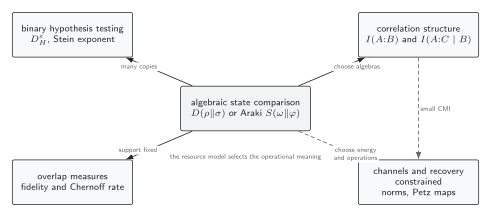
The input is , the target is , and the recovery channel acts on alone. Conditional mutual information controls the best attainable state fidelity; locality and resource restrictions define narrower optimization problems. Schematic.
The Fawzi–Renner guarantee
Section titled “The Fawzi–Renner guarantee”For every finite-dimensional ,
when logarithms are natural. Equivalently, if , then some channel obeys
No faithfulness assumption is needed for this finite-dimensional existence theorem; inverses enter only when one chooses a particular formula and must then be restricted to the appropriate support. The original result is Fawzi and Renner 2015, Theorem 5.1 and Remark 5.2. A later universal form shows that the channel can be selected from alone and can work for every extension of that fixed marginal Sutter, Fawzi, and Renner 2016, Theorem 2.1.
Why conditional mutual information appears
Section titled “Why conditional mutual information appears”The key identity writes conditional mutual information as a loss under the partial-trace channel :
Ordinary data processing says that this loss is nonnegative. A recoverability remainder strengthens the statement: if little distinguishability is lost when is discarded, an operation on the retained system can reconstruct a state close to the original one. Because the reference pair factorizes across , the recovery acts as the identity on and as a channel . This is the conceptual bridge; the proof of the sharp theorem requires substantially more than the identity, using one-shot entropies and an asymptotic argument.
At , the bound gives , recovering the exact quantum-Markov theorem. At small nonzero , the output is only close to the target. Its own marginal can differ from , so the recovered approximation need not itself be an exact Markov state. Quantum states with small conditional mutual information can also remain much farther, in relative entropy, from the set of exact Markov states Ibinson, Linden, and Winter 2008, Theorem 4 and Examples 6–7.
Converting the score into an error
Section titled “Converting the score into an error”Let
be trace distance and purified distance. The Fuchs–van de Graaf inequalities give . Therefore the theorem supplies a channel for which
Here is in nats. These conversions follow from Fuchs and van de Graaf 1999, Theorem 1 and Eq. (46), pp. 1222–1223. They also explain two often-confused scalings: infidelity is at most linear in small , whereas the certified trace-distance error is only of order .
If a source instead defines squared fidelity , the same theorem reads . Mixing these conventions creates an erroneous factor of two.
What the theorem does not optimize
Section titled “What the theorem does not optimize”The unrestricted fidelity of recovery answers one question: does some deterministic channel on all of reconstruct the target accurately? Four nearby questions need additional input.
A nearby exact Markov state. The recovered state is generated from the target’s marginal, not necessarily from its own. Small therefore does not give a dimension-free distance to the set of states with exactly vanishing conditional mutual information.
A prescribed channel. The theorem does not say that the unrotated Petz map, a chosen Gaussian map, or a laboratory decoder attains the bound. Petz, Rotated, and Universal Recovery Maps compares those constructions and their support conditions.
A local or causal operation. “Acts on ” names an input algebra. It does not say that the channel can be generated by couplings confined to a chosen causal diamond during a chosen time window. A spatially extended may require coherent access across the entire block.
A finite-energy implementation. Fidelity alone assigns no cost to creating ultraviolet excitations, squeezing modes, or controlling nearly singular directions. An energy-feasible problem must specify a Hamiltonian, an input energy set, and the resource bound. Infinite-Dimensional and Energy-Constrained Channel Distances supplies the corresponding comparison language.
There is likewise no dimension-free converse saying that one high-fidelity approximation forces small conditional mutual information: entropy continuity requires dimension or energy control. Exact fidelity one is different—then the target has been recovered from its own marginal, and the exact Markov theorem forces .
A regulated Gaussian-chain recovery benchmark
Section titled “A regulated Gaussian-chain recovery benchmark”The first QFT application uses a five-site open spinless free-fermion Gaussian chain, a finite lattice regulator of a quadratic field theory. In units where the hopping is , its one-particle Hamiltonian is
with staggered mass , chemical potential , and Gibbs inverse temperature . The ordered blocks are
Every regional algebra is therefore a matrix algebra. The benchmark constructs the many-body Gibbs density matrix and independently checks that its one-body correlator is the Fermi–Dirac function of . Direct partial traces then give the four entropies entering conditional mutual information. The result is
so the theorem certifies
This number is a floor on the optimized full- recovery. The benchmark also evaluates three explicit full- channels and one deliberately restricted channel. The reported trace norm is , without the factor used in the trace distance .
| Channel | Root fidelity | −2 ln F (nats) | Trace norm |
|---|---|---|---|
| Ordinary Petz on all of B | 0.999996335793 | 0.00000732842750 | 0.00494216013 |
| Equal mixture of rotations t = ±1 | 0.999983105221 | 0.0000337898443 | 0.0106290934 |
| Universal beta-zero twirl on all of B | 0.999998809943 | 0.00000238011554 | 0.00278283839 |
| Petz on site 3 only | 0.997451910152 | 0.00510268351 | 0.132235516 |
The universal row uses the theorem-backed channel of Junge et al. 2018, Theorem 2.1 and Remark 2.2:
This is an average of modularly rotated recovery maps. The weight is nonnegative and integrates to one. Its remainder nats is below the measured conditional mutual information, as the theorem requires, and its fidelity lies well above the certified floor. The bare Petz map happens to perform well here, but that row is diagnostic: Fawzi–Renner does not promise the same performance for the unrotated Petz map in a general state. The two-point rotation is likewise not the universal average.
In the two-point row, is the theorem’s integration variable, so the displayed maps have modular parameter .
The ordinary row uses the equality-case recovery construction introduced by Petz 1986, pp. 123–131. Its strong performance for this state is useful evidence about the benchmark, not a replacement for the theorem-backed universal row.
Midpoint quadratures with 16, 32, and 64 nodes give a root-fidelity envelope of . At 64 nodes the recovered state has trace , a positive minimum eigenvalue , and Hermiticity residual . These are numerical diagnostics, not statistical errors or a rigorous continuum uncertainty. Comparing achieved fidelities with the theorem’s optimum bound is meaningful only after keeping the state, subsystem order, root-fidelity convention, and channel domain fixed.
The machine-readable recovery benchmark records the Hamiltonian and boundary conditions, block geometry, density-matrix construction, spectral-support and inverse policies, modular-rotation quadrature, trace-preservation and positivity diagnostics, and numerical precision. Its deterministic checks distinguish diagonalization and quadrature residuals from changes caused by modifying the admissible channel.
This finite-chain result establishes a regulated state-recovery calculation. It does not by itself establish convergence to a normal recovery channel on a continuum local algebra. That stronger claim would require compatible embeddings of the regional algebras, convergence of the states and channels in a stated topology, and control of energy and localization as the cutoff is removed.
Shrinking the allowed recovery region
Section titled “Shrinking the allowed recovery region”The abstract theorem optimizes over channels on all of . In the chain benchmark, the restricted test leaves sites , , and untouched and applies a Petz map only from boundary site to sites and . It attains
This named edge-only channel misses the full- floor . That is not a violation of Fawzi–Renner: the admissible map has been restricted after the full- conditional information was evaluated. Nor is this one calculation a no-go theorem for every edge-only channel. To certify the optimum over edge-only maps, one must solve that restricted optimization or apply the theorem to the reordered tripartition , , and . The strongest numerical conclusion is exactly that the tested edge-only Petz implementation does not inherit the full-domain guarantee.
A two-bit classical state makes the obstruction exact. Let and
Conditioned on the whole of , the state is Markov: , and a channel that reads and copies its classical value to recovers perfectly. A channel restricted to , which is always , cannot correlate its output with . Optimizing over the state prepared on gives only
Thus even an exact full-domain guarantee does not survive removal of the part of that carries the relevant information.
Imposing an energy budget
Section titled “Imposing an energy budget”Energy restrictions can fail just as sharply. Let be an excited eigenstate with and ground energy zero, and consider the product target
Its conditional mutual information vanishes. An unrestricted recovery channel simply appends and reaches fidelity one. If the admissible output must satisfy
then implies . Fidelity cannot decrease under partial trace, so every energy-limited global recovery obeys
The missing hypothesis is now explicit: the existence theorem never promised that its channel belonged to this energy-limited class. In a field theory, the same issue appears when a cutoff-dependent recovery uses progressively higher modes or unbounded squeezing.
The validity map summarizes both failures. Inspect the domain, support, and resource branches before interpreting a high fidelity as a physical protocol.
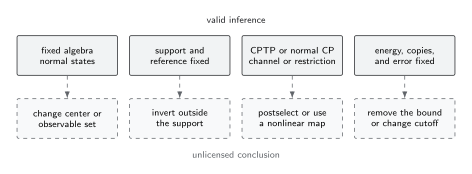
Small conditional mutual information certifies recovery only for the stated ordered systems and channel domain. Shrinking the accessible part of , allowing postselection, changing the fidelity convention, or imposing a new energy or causal restriction defines a different optimization problem. Schematic.
From a regulator to a continuum statement
Section titled “From a regulator to a continuum statement”For separable type-I systems, conditional mutual information has a lower-semicontinuous extension and the recovery theorem remains available even when individual marginal entropies are infinite Shirokov 2016, Theorem 2 and Proposition 13. The explicit universal recovery construction extends from finite dimensions to separable Hilbert spaces, still in the type-I algebra setting Junge et al. 2018, Theorem 2.1 and Remark 2.2. For general von Neumann subalgebra inclusions, including non-type-I settings relevant to local QFT, the corresponding universal remainder theorem requires modular theory and noncommutative spaces Faulkner et al. 2022, Theorems 1–2.
Those results do not license a silent density-matrix calculation for a type-III local algebra. A continuum claim must name the algebras, normal states, inclusion or channel, topology of approximation, and any modular-domain assumptions. A lattice or split inclusion can provide a type-I approximant, but one must still prove that the relevant conditional information and recovered states converge. The complete operator-algebraic sufficiency treatment belongs to Sufficiency, Conditional Expectations, and Petz Recovery.
The safe reporting unit is therefore:
- the ordered input algebra and target algebra ;
- the admissible recovery maps and whether they are deterministic, normal, local, covariant, Gaussian, or energy constrained;
- the fidelity convention and any converted error metric;
- the regulator, support rule, and order of limits;
- the achieved fidelity for each implemented map, separately from the theorem’s optimum bound; and
- the numerical and continuum uncertainties, including any failed constrained test.
Common pitfalls
Section titled “Common pitfalls”Treating a bound as an algorithm. The inequality certifies that a good channel exists. A chosen Petz, rotated, Gaussian, or circuit implementation needs its own performance calculation.
Calling the approximation an exact Markov state. The recovered candidate need not have the same marginal as the target, so it need not be recoverable from its own marginal. Closeness to a recovered state and closeness to the exact Markov set are different problems.
Changing the mediator after computing the certificate. A CMI evaluated with full does not certify a channel that sees only . Recompute the conditional information for the smaller mediator or prove a separate comparison theorem.
Forgetting the fidelity convention. With root fidelity the exponent is ; with squared fidelity it is . State the convention before quoting a number.
Equating algebraic access with causal implementability. A completely positive map on a regional algebra need not be synthesizable within a chosen spacetime support, time window, symmetry sector, or energy budget.
Exercises
Section titled “Exercises”1. From conditional information to operational error
Section titled “1. From conditional information to operational error”Suppose nats. Find the theorem’s lower bound on root fidelity and its upper bounds on purified distance and trace distance.
Solution
The recovery theorem gives
Hence
The simpler estimate is slightly weaker. Notice that a half-percent infidelity certificate becomes an approximately ten-percent trace-distance certificate because the latter scales as .
2. Verify the data-processing-loss identity
Section titled “2. Verify the data-processing-loss identity”Starting from , show that
Solution
The first relative entropy is , and the second is . Their difference is
Tracing out maps the first pair of states to the second pair, so strong subadditivity is precisely data processing for this comparison.
3. Optimize the restricted-bit recovery
Section titled “3. Optimize the restricted-bit recovery”For the classical state in the shrinking-domain example, let a -only channel prepare with probability and with probability . Show that the root fidelity with the target is at most .
Solution
Only the target events and contribute. Their probabilities in the target are , while the restricted recovered distribution assigns them and . Classical root fidelity is therefore
Differentiation gives the maximum at , where
The full mediator reveals the bit and gives fidelity one, so the loss comes entirely from removing from the channel domain.
4. Certify the energy obstruction
Section titled “4. Certify the energy obstruction”Let the target on be with energy , and suppose every admissible recovered output satisfies . Prove the fidelity ceiling .
Solution
Because the Hamiltonian is nonnegative and has energy ,
Taking the expectation in yields
Root fidelity with a pure state is . Fidelity is monotone nondecreasing under partial trace, so the global fidelity cannot exceed this marginal fidelity. Combining the two statements gives the claimed ceiling.
References
Section titled “References”- Faulkner, Thomas, Stefan Hollands, Brian Swingle, and Yixu Wang. “Approximate Recovery and Relative Entropy I: General von Neumann Subalgebras.” Communications in Mathematical Physics 389, no. 1 (2022): 349–397. DOI. Open PDF.
- Fawzi, Omar, and Renato Renner. “Quantum Conditional Mutual Information and Approximate Markov Chains.” Communications in Mathematical Physics 340, no. 2 (2015): 575–611. DOI. Open PDF.
- Fuchs, Christopher A., and Jeroen van de Graaf. “Cryptographic Distinguishability Measures for Quantum-Mechanical States.” IEEE Transactions on Information Theory 45, no. 4 (1999): 1216–1227. DOI. Open PDF.
- Ibinson, Ben, Noah Linden, and Andreas Winter. “Robustness of Quantum Markov Chains.” Communications in Mathematical Physics 277, no. 2 (2008): 289–304. DOI. Open PDF.
- Junge, Marius, Renato Renner, David Sutter, Mark M. Wilde, and Andreas Winter. “Universal Recovery Maps and Approximate Sufficiency of Quantum Relative Entropy.” Annales Henri Poincaré 19, no. 10 (2018): 2955–2978. DOI. Open PDF.
- Petz, Dénes. “Sufficient Subalgebras and the Relative Entropy of States of a von Neumann Algebra.” Communications in Mathematical Physics 105, no. 1 (1986): 123–131. DOI.
- Shirokov, M. E. “Measures of Quantum Correlations in Infinite-Dimensional Systems.” Sbornik: Mathematics 207, no. 5 (2016): 724–768. DOI. Open PDF.
- Sutter, David, Omar Fawzi, and Renato Renner. “Universal Recovery Map for Approximate Markov Chains.” Proceedings of the Royal Society A: Mathematical, Physical and Engineering Sciences 472, no. 2186 (2016): 20150623. DOI. Open PDF.
Original QFT.org content:CC BY 4.0, unless an item supplies different terms. Third-party material retains its own terms.