

Relative Entropy, Distinguishability, and Recovery
Relative entropy is the continuum-safe center of state comparison in QFT. Around it sit operational tasks—binary testing, overlap, correlation, channel discrimination, and recovery—whose meanings depend on the observable algebra, reference support, copy model, energy bound, and regulator. This chapter develops those branches without importing finite-dimensional conclusions beyond their domains.
Helpful background. Review restricted local states, regulated subregion entropy, operator algebras and positive functionals, Markov semigroups, and trace ideals as needed.
From algebraic comparison to information tasks
Section titled “From algebraic comparison to information tasks”For normal states and on a local von Neumann algebra , Araki relative entropy needs no trace or tensor factor. It is positive, monotone under restriction, and compatible with type-I density-matrix formulas when a regulator or split realization supplies them. These features make it the right reference point for continuum distinguishability.
Operational interpretations require more. A Stein exponent assumes independent copies and a test algebra. Fidelity requires a square convention. Mutual information requires two algebras and a product reference. Conditional mutual information requires an ordered tripartition. Recovery requires a channel domain and error metric. Infinite-dimensional channel discrimination requires an input Hamiltonian and energy set.
The diagram below is the chapter dictionary. Follow a branch only after its label has become part of the problem statement.
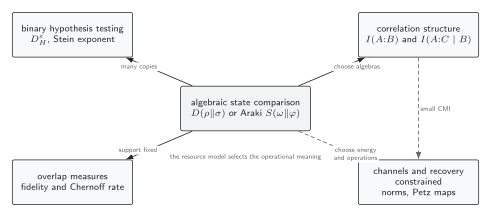
Relative entropy is the common algebraic comparison. Copy resources select hypothesis testing; a common algebra and declared convention select overlap measures; chosen subalgebras select correlation measures; and channel, recovery, and energy data select operational reconstruction. Schematic.
What the chapter establishes
Section titled “What the chapter establishes”The opening sequence defines Relative Entropy for QFT States, explains Araki Relative Entropy and Regulated Limits, and proves the meaning of Positivity, Monotonicity, and Data Processing. The next three pages separate Hypothesis Testing and Asymptotic Distinguishability, Fidelity, Chernoff Bounds, and State Overlap, and Operational Distinguishability and Continuity Bounds.
Correlation structure begins with Mutual Information and Regulator-Independent Correlations and Strong Subadditivity and Entropic Inequalities, then sharpens through Conditional Mutual Information and Quantum Markov Structure. The recovery sequence treats Recovery Maps and Approximate Markovianity and Petz, Rotated, and Universal Recovery Maps. The final pair makes resources explicit through Infinite-Dimensional and Energy-Constrained Channel Distances and the Information-Measure Domain and Comparison Atlas.
Complete operator-algebraic proofs belong to the theorem-first mathematical treatment; here the focus is QFT meaning, regulated comparison, examples, and operational consequences. The chapter excludes unconstrained infinite-dimensional continuity claims, hidden postselection, and abstract Shannon theory detached from field algebras and physical resources.
The table is a compact contract for the whole chapter. Read each row horizontally: a numerical value becomes meaningful only together with its domain, norm or topology, regulator status, task, hypotheses, equality statement, error control, and failure test.
| Quantity | Domain | Topology or norm | Regulator status | Operational task | Theorem hypotheses | Equality case | Error or bound | Counterexample or failed control |
|---|---|---|---|---|---|---|---|---|
| Araki relative entropy S(ω‖φ) | Normal states on one von Neumann algebra; extended value +∞ is allowed | Standard-form relative modular operator; no ambient trace is required | Intrinsic target; type-I or lattice values need compatible embeddings and convergence | Asymmetric comparison with a reference; Stein rate when a separate iid theorem applies | Same algebra and state order; support inclusion is necessary, not sufficient, for a finite value in infinite dimensions | S=0 exactly for equal states | Data processing contracts S under a declared physical restriction or channel | Subtracting divergent local entropies, or comparing states on unmatched algebras, does not define this quantity |
| Regulated von Neumann entropy SΛ(ρA) | A density operator on one finite-dimensional, regulator-defined type-I subsystem A | Spectral trace functional −Tr ρA ln ρA; it is not a state-distance topology | Regulator dependent; only a complete subtraction, combination, or controlled limit can define a continuum quantity | Quantify mixedness, and entanglement for a pure regulated bipartition | Normalized ρA; finite dA≥2, tensor factor, center or edge prescription, logarithm base, and common regulator are fixed | For a pure regulated bipartite state, SΛ(A)=SΛ(Ā); SΛ=0 exactly when ρA is pure | For common dA and T=‖ρ−σ‖1/2≤1−1/dA, |ΔS|≤T ln(dA−1)+h2(T); also 0≤SΛ≤ln dA | A sharp type-III region has no such reduced density matrix; changing the cutoff, tensor factor, center, or edge modes changes the entropy |
| Smooth support min-relative entropy Dminε | A finite-dimensional state pair, with the optimized state allowed to be normalized or subnormalized as declared | Support divergence −ln Tr(Πρ̃σ), maximized over one declared trace- or purified-distance ε-ball | State space, smoothing metric, normalization convention, ε, logarithm base, and cutoff remain fixed | One-shot support overlap and zero-type-I asymmetric testing, with a controlled approximation | For Dmin=DH0, ρ and σ are normalized, Tr(Qρ)≥1, and the log base and state order agree; a smooth identity is not implied | At ε=0 it reduces to the support Dmin; with the stated normalized testing convention this equals DH0 | ε is a metric radius, not a type-I error probability; any comparison bound must translate metric, normalization, and log base | Switching from trace to purified distance, or from normalized to subnormalized smoothing, changes the feasible set and boundary terms |
| Smooth max-relative entropy Dmaxε | A finite-dimensional state pair, with the optimized state allowed to be normalized or subnormalized as declared | Smallest domination exponent ρ̃≤eλσ, minimized over one declared trace- or purified-distance ε-ball | State space, smoothing metric, normalization convention, ε, logarithm base, and cutoff remain fixed | One-shot domination and resource-conversion bounds formulated in the chosen smoothing convention | Support of every finite candidate lies in the support of σ; the theorem uses the same smoothing ball and state normalization | At ε=0 it reduces to Dmax; for normalized states Dmax=0 exactly when ρ=σ | The optimizer certifies ρ̃≤eDmaxεσ; ε controls approximation, not operational failure by itself | Support leakage makes the unsmoothed value +∞; with subnormalized smoothing it can be negative, so an undeclared convention can hide the singularity |
| Relative-entropy variance V(ρ‖σ) | A finite-dimensional ordered state pair with supp ρ⊆supp σ for the iid theorem stated here | ρ-weighted centered second moment of log ρ−log σ, in nats² (bits² for base-two logs); it is neither a divergence nor a norm | The state pair, cutoff, copy model, and logarithm convention remain fixed before n→∞ | Second-order √n correction to asymmetric iid hypothesis testing | Independent tensor powers, collective tests, fixed 0<ε<1, and support inclusion; the nondegenerate Gaussian term additionally needs 0<V<∞ | V=0 exactly when (log ρ−log σ−D)√ρ=0; then the Gaussian √n term degenerates | DHε(ρ⊗n‖σ⊗n)=nD+√(nV) Φ−1(ε)+O(ln n) under the stated hypotheses | Correlated replicas, failed support inclusion, infinite or zero variance, or a moving regulator invalidates the Gaussian expansion |
| Hypothesis-testing divergence DHε | Two states and effects on one declared test algebra | Optimization over effects 0≤Q≤1 at fixed type-I error tolerance ε | Detector algebra, copy model, ε, energy set, and cutoff remain fixed | One-shot asymmetric binary decision; iid Stein and second-order analysis | Independent copies and collective tests for the iid limit; finite relative-entropy variance for the √n term | DHε(ρ‖ρ)=−ln(1−ε) in the unnormalized convention used here | nD+√(nV) Φ−1(ε)+O(ln n) only under the stated regularity conditions | A blind detector, correlated repetitions, singular support, or a moving cutoff changes or destroys the claimed rate |
| Bounded-observable bias ‖ω−φ‖ | Normal states on one observable algebra | Predual norm; trace norm in a type-I realization | Intrinsic to the chosen detector algebra; restriction can only contract it | Optimal equal-prior one-shot state discrimination | All allowed effects belong to the declared algebra; priors and measurement class are fixed | Identical restricted states give success probability 1/2 | psucc*=1/2+‖ω−φ‖/4 and 0≤‖ω−φ‖≤2 | An orthogonal ultraviolet mode outside the detector algebra can be globally decisive while leaving the restricted bias zero |
| Root fidelity F | States on one C* algebra; trace formula only in a type-I representation | Algebraic transition probability; Bures or purified-distance topology after fixing the square convention | Common-algebra target; finite-cutoff overlap needs an independently controlled limit | Symmetric closeness and finite-copy discrimination bounds | Root convention F=‖√ρ√σ‖1; do not import formulas written for F2 without translating | F=1 exactly for equal states; F=0 for orthogonal supports | 1−F≤T≤√(1−F2) | Squaring the wrong convention changes exponents; orthogonal global states can restrict to identical local states |
| Chernoff coefficient Q and exponent ξQCB | Finite-dimensional density operators for the theorem stated here; trace-class coefficients require their own operational limit theorem | Noncommutative s-overlap Tr ρsσ1−s | Copy model and measurement class fixed; occupation and mode cutoffs are removed only in a justified order | Optimal symmetric iid discrimination exponent | Independent copies, fixed nonzero priors, and unrestricted collective measurements | If at least one state is pure, infs Qs=F2; Q1/2 is not generally F | lim −ln pe,n*/n=−ln inf0<s<1 Qs under those hypotheses | Assuming s=1/2, using correlated copies, or interchanging copy and regulator limits can give the wrong exponent |
| Mutual information I(A:B) | A joint state on commuting region algebras with a defined product reference | Relative entropy to the product state | Can be intrinsic for suitably separated regions; touching regions require a common ultraviolet prescription | Total correlations visible to the two chosen algebras | Region algebras, product reference, state restriction, and separation are fixed | I=0 exactly for a product state when the comparison is defined | Positivity and Pinsker-type bounds control bounded connected correlations | Mutual information is not automatically distillable entanglement, and finiteness can fail as the separation closes |
| Conditional mutual information I(A:C|B) | A compatible ordered tripartite system or an explicitly applicable algebraic extension | Entropy difference; equivalently tied to recovery fidelity by theorem-specific bounds | All four entropies use one state, regulator, center choice, and region prescription | Residual A–C correlation when B is retained | The subsystem order and recovery direction are fixed; finite-dimensional statements are not silently exported to type-III factors | I=0 exactly characterizes a quantum Markov chain in finite dimensions | I≥−2 ln F(ρ, recovered ρ) for an appropriate recovery channel | Small I does not make the recovery local, causal, unique, energy bounded, or dynamically Markovian |
| Petz and universal recovery | A state pair, reference state, and channel between fixed operator algebras | Relative-entropy loss measured against fidelity or another stated recovery metric | Supports, modular powers, inverses, and continuum domains need explicit control | Reconstruct information lost through a channel or restriction | Normal completely positive channel, declared adjoint, reference state, and theorem-specific support conditions | Equality in data processing is equivalent to exact recovery of the specified pair under the standard hypotheses | Rotated or universal maps give quantitative fidelity bounds for nonzero information loss | An abstract recovery map need not be unique, local, causal, implementable, or finite energy |
| Energy-constrained diamond norm ‖Φ−Ψ‖⋄,E | Normal channels tested on input–ancilla states obeying a stated mean-energy constraint | Trace norm optimized on an energy set; weaker than the unconstrained diamond norm | Input Hamiltonian, budget E, ancilla, and cutoff remain explicit | Single-use channel discrimination with physically admissible probes | Same Hamiltonian and energy set for both channels; allowed ancillary resources are declared | Equal channels give zero; perfectly distinguishable admissible outputs attain two | psucc*=1/2+‖Φ−Ψ‖⋄,E/4 and the norm is monotone in E | Distinct pure-loss channels have unconstrained diamond distance two even when low-energy probes see only a small difference |
| Entropy continuity | Finite dimension, or an infinite-dimensional energy set with suitable Gibbs spectral control | Trace-distance perturbation converted into an entropy bound | Dimension or Hamiltonian and energy budget are part of the statement | Propagate state-approximation error to an entropy error bar | For the finite-dimensional sharp bound, δ≤1−1/d; infinite-dimensional variants require a finite partition function in the relevant range | The finite-dimensional Fannes–Audenaert bound is sharp for an extremal commuting pair | |S(ρ)−S(σ)|≤δ ln(d−1)+h2(δ) | At fixed trace distance, sending weight into a growing high-energy subspace makes the entropy difference grow like δ ln d |
The exact state-discrimination bounds and asymptotic statements are sourced to Fuchs and van de Graaf 1999, Theorem 1 and Eq. (46), pp. 1222–1223, Li 2014, Theorems 2 and 5, Audenaert et al. 2007, Theorem 1, and Nussbaum and Szkoła 2009, Theorem 2.2. The recovery and infinite-dimensional resource rows use Fawzi and Renner 2015, Theorem 5.1, Shirokov 2018, §§ 3–5, and Winter 2016, §§ 3–4. A machine-readable version of the comparison preserves the same fields in reading order.
A reliable route
Section titled “A reliable route”Readers new to type-III algebras should take the pages in order through data processing. For an operational route, continue through hypothesis testing, fidelity, and channel bounds. For a correlation-and-recovery route, move from mutual information through strong subadditivity, conditional mutual information, and Petz recovery. In either route, finish with the domain atlas before comparing numerical values from different measures.
A recurring example is a vacuum or Gaussian field state restricted to intervals, with lattice or mode regulators used only as controlled approximants. Every computation declares which combination is expected to remain finite, how supports are handled, and which ultraviolet or high-energy tail is bounded.
Validity before inference
Section titled “Validity before inference”The second figure summarizes the domain checks. Its four upper boxes are theorem inputs; each dashed lower box names a way to leave the theorem’s domain.
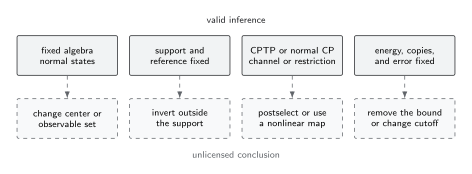
State comparison is valid only on a fixed algebra; support inclusion is quantity- and direction-dependent, especially for finite relative entropy. Data processing additionally needs a physical positive map, while testing and channel claims need fixed errors, copies, Hamiltonians, energy budgets, ancillas, and regulators. Schematic.
For example, small conditional mutual information guarantees an abstract recovery map in a stated fidelity metric. It does not imply that the map is generated within a causal diamond or has bounded energy cost. Likewise, a finite regulated relative entropy approaches the continuum quantity only under compatible algebra embeddings and normal state convergence. These are not technical footnotes: they decide which conclusion is true.
Check your preparation
Section titled “Check your preparation”You are ready to use the chapter if you can:
- Explain why Araki relative entropy survives for a type-III local algebra while local von Neumann entropy need not.
- State the support and channel hypotheses behind data processing.
- Distinguish a one-shot hypothesis test from the independent-copy Stein limit.
- Name the ordered algebras and recovery metric in an approximate Markov claim.
- Define the Hamiltonian and ancillary resources in an energy-constrained channel distance.
References
Section titled “References”- Araki, Huzihiro. “Relative Entropy of States of von Neumann Algebras.” Publications of the Research Institute for Mathematical Sciences 11 (1976): 809–833. DOI.
- Audenaert, Koenraad M. R., John Calsamiglia, Lluís Masanes, Ramon Muñoz-Tapia, Antonio Acín, Emilio Bagan, and Frank Verstraete. “Discriminating States: The Quantum Chernoff Bound.” Physical Review Letters 98 (2007): 160501. DOI. Open preprint.
- Fawzi, Omar, and Renato Renner. “Quantum Conditional Mutual Information and Approximate Markov Chains.” Communications in Mathematical Physics 340 (2015): 575–611. DOI.
- Fuchs, Christopher A., and Jeroen van de Graaf. “Cryptographic Distinguishability Measures for Quantum-Mechanical States.” IEEE Transactions on Information Theory 45, no. 4 (1999): 1216–1227. DOI. Open preprint.
- Li, Ke. “Second-Order Asymptotics for Quantum Hypothesis Testing.” The Annals of Statistics 42, no. 1 (2014): 171–189. DOI. Open preprint.
- Nussbaum, Michael, and Arleta Szkoła. “The Chernoff Lower Bound for Symmetric Quantum Hypothesis Testing.” The Annals of Statistics 37, no. 2 (2009): 1040–1057. DOI. Open preprint.
- Petz, Dénes. “Sufficient Subalgebras and the Relative Entropy of States of a von Neumann Algebra.” Communications in Mathematical Physics 105 (1986): 123–131. DOI.
- Shirokov, M. E. “Energy-Constrained Diamond Norms and Their Use in Quantum Information Theory.” Problems of Information Transmission 54, no. 1 (2018): 20–33. DOI. Open preprint.
- Winter, Andreas. “Tight Uniform Continuity Bounds for Quantum Entropies: Conditional Entropy, Relative Entropy Distance and Energy Constraints.” Communications in Mathematical Physics 347 (2016): 291–313. DOI. Open preprint.
Original QFT.org content:CC BY 4.0, unless an item supplies different terms. Third-party material retains its own terms.